

Kells Coral
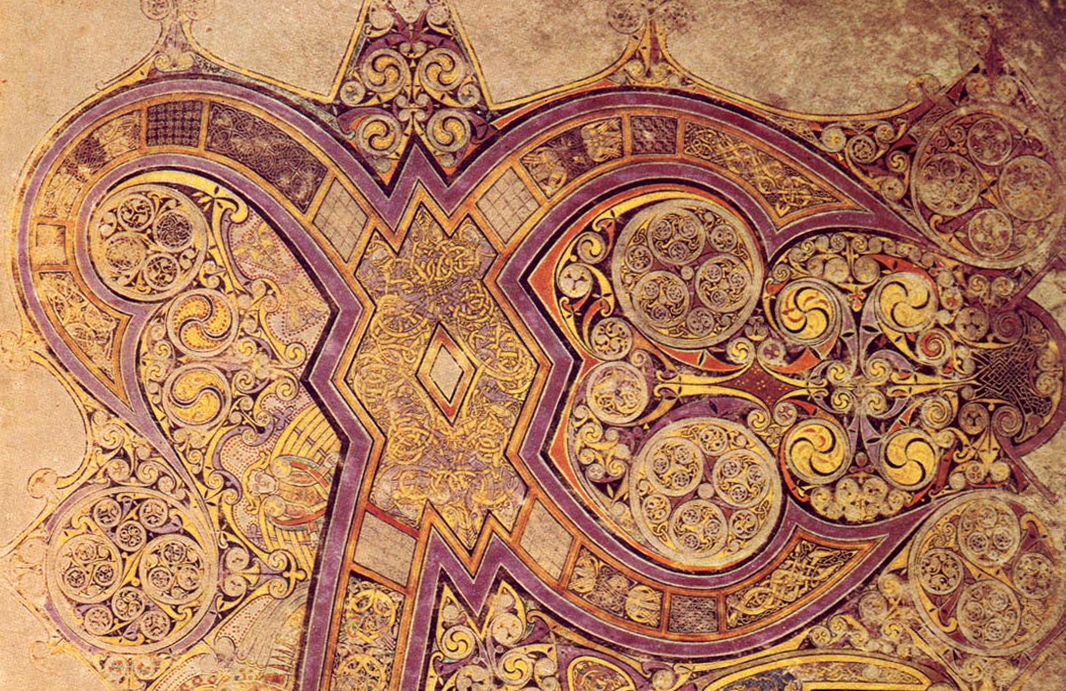
Photo courtesy of the author
The COLOR CODEX series — to which SEMIOVOX has invited 50 of our commercial / applied semiotician colleagues from around the world to contribute — explores the unexpected associations evoked for each of us by specific colors found in the material world. Vol. 1: 2023–24. Vol. 2: 2026–27.
More shifting color palette than static color swatch, Kells Coral lives in a 9th Century illuminated manuscript known as the “Book of Kells”. Both the book and its families of color are wonders of this world housed deep in the recesses of Trinity College Dublin’s august Long Hall Library. I’ve been lucky enough to visit the manuscript twice, but no number of visits would ever be enough, so an image from its pages greets me on screen every time I switch on my laptop.
This image has been part of my desktop background for more than twelve years, and I never want to swap it out. In fact, I wish it would absorb me. Gaze long enough into its color-play of pigments and their semiotic relations, and you merge into a living palette of the in-between, impossible to pin with hex or code: crimson-salmon to purple-pink, with orange-rose relations. Kells Coral is a platypus of colors co-arising: both neither-nor and both-and; all-of-the-above; and above-all, much more. Let me explain.
The Book of Kells exhibit in Dublin features a perfectly curated display of the manuscript’s colour sources. I remember being mildly disappointed to discover that the deep red-orange and vibrant purple-pink pigments that dazzle its pages come from such different sources. The oranges and reds are from dyes made of lead oxide, while orcein lichens scraped from rocks and trees are the source of its purples and pinks. At first it seemed like these two sources had nothing to do with each other. They actually share something profound.
Look up lead oxide, and you’ll find that it’s a “mixed-valence complex”, existing in two states of oxidation at once. And if you know anything about lichen, you know that it’s a bizarre biological blend, a mutual symbiosis between fungus and algae – two forms of life that couldn’t be more different. As with red lead so with lichen: both are two at once and also a third, but neither or nothing alone. Remarkably, the same can be said of coral itself, including “precious coral” or Coralium, the species that inspires its popular namesake color: warmish hues of orangish-pink and pinkish-orange. Coral too is a hybrid symbiont, or holobiont blend, of plant (algae) and animal (polyp colonies).
And the resonances don’t stop there. All three of these mixed-valence color relations share something in common with the manuscript itself. The playful precision that unfurls through the pages of the Book of Kells is an inverting dance between Pagan and Christian, ancient and new, human and animal, where profane and sacred merge and reverse, where geometric angles wed organic form, where salmon oranges blush archil pink through purpled crimson oxides.
COLOR CODEX: Martha Arango (Sweden) on FALUKORV RED | Rachel Lawes (England) on DEVIL GREEN | Audrey Bartis (France) on KYOTO MOSS | Maciej Biedziński (Poland) on SKIN-DEEP ORANGE | Natasha Delliston (England) on MARRAKECH MINT | Whitney Dunlap-Fowler (USA) on RESURRECTION CANARY BLUE | Ximena Tobi (Argentina) on VILLA MISERIA BRICK | Aiyana Gunjan (India) on LETTERBOX RED | Lucia Laurent-Neva (England) on TEAL BLUE VOYAGER | Charles Leech (Canada) on STORMTROOPER WHITE | William Liu (China) on PINING GREEN | Ramona Lyons (USA) on GOTH PURPLE | Greg Rowland (England) on LAUNDROMAT FUTURA | Sónia Marques (Portugal) on RUNAWAY BURRO | Max Matus (Mexico) on CALIFORNIAN BLUE | Chirag Mediratta (Canada / India) on AUROVILLE ORANGE | Alfredo Troncoso (Mexico) on BORGES GLAUQUE | Josh Glenn (USA) on TOLKIEN GREEN | Clio Meurer (Brazil) on PARIS LUMINOUS GREY | Serdar Paktin (Turkey / England) on AMBIENT AMBER | Maria Papanthymou (Russia / Greece) on AGALMATOLITE WHITE | Sarah Johnson (Canada) on ARMY GREEN | Vijay Parthasarathy (USA) on ALPHONSO YELLOW | Tim Spencer (England) on ELECTRO-EROTIC COBALT | Adelina Vaca (Mexico) on MEXICAN PINK | Brian Khumalo (South Africa / USA) on STATUE OF LIBERTY TEAL | Madoka Suganuma (Japan) on BLOSSOM PINK | Susan Bell (Australia) on THAILAND TURQUOISE | Rajan Luthra (India) on AMALTAS YELLOW | Carla Moss (Austria) on EASTERN BLOC GREY | Dora Jurd de Girancourt (France) on JACARANDA PURPLE | Alexandra Ncube (England) on PMDD RED | Katrin Horn (Austria) on PIER BLUE | Ľudmila Lackova Bennett (Czech Republic) on BARBIE PINK | Onaiza Drabu (India) on MOHARRAM BLACK | Jiakun Wang (China) on GEN Z PURPLE | Manar R. El Wahsh (Canada) on FATIMID GOLD | Gianlluca Simi (Brazil) on TECH BLUE | Gemma Jones (Netherlands) on IN-BETWEEN INDIGO | Mariane Cara (Brazil) on IPANEMA GOLDGLOW | Su Luo (China) on CHILLI OIL RED | Jamin Pelkey (Canada) on TBD | Cathy Maisano (Australia) on TBD | Hyaesook Yang (South Korea) on TBD | TBD on TBD | Eugene Gorny (Thailand) on FLAMBOYANT RED | Elinor Lifshitz (Switzerland) on BAMBOO GREEN | Nimesh Nambiar (UAE) on DUBAI DUNES | Iván Islas (Mexico) on MITLA YELLOW | Victoria Gerstman (Scotland) on CALPOL PURPLE.
Also see these global semio series: MAKING SENSE (Q&As) | SEMIOFEST SESSIONS (monthly mini-conferences) | COVID CODES | SEMIO OBJECTS | COLOR CODEX | DECODER (fictional semioticians) | CASE FILE | PHOTO OP | MEDIA DIET | TATTOO YOU (semioticians’ tattoos).