

Moharram Black
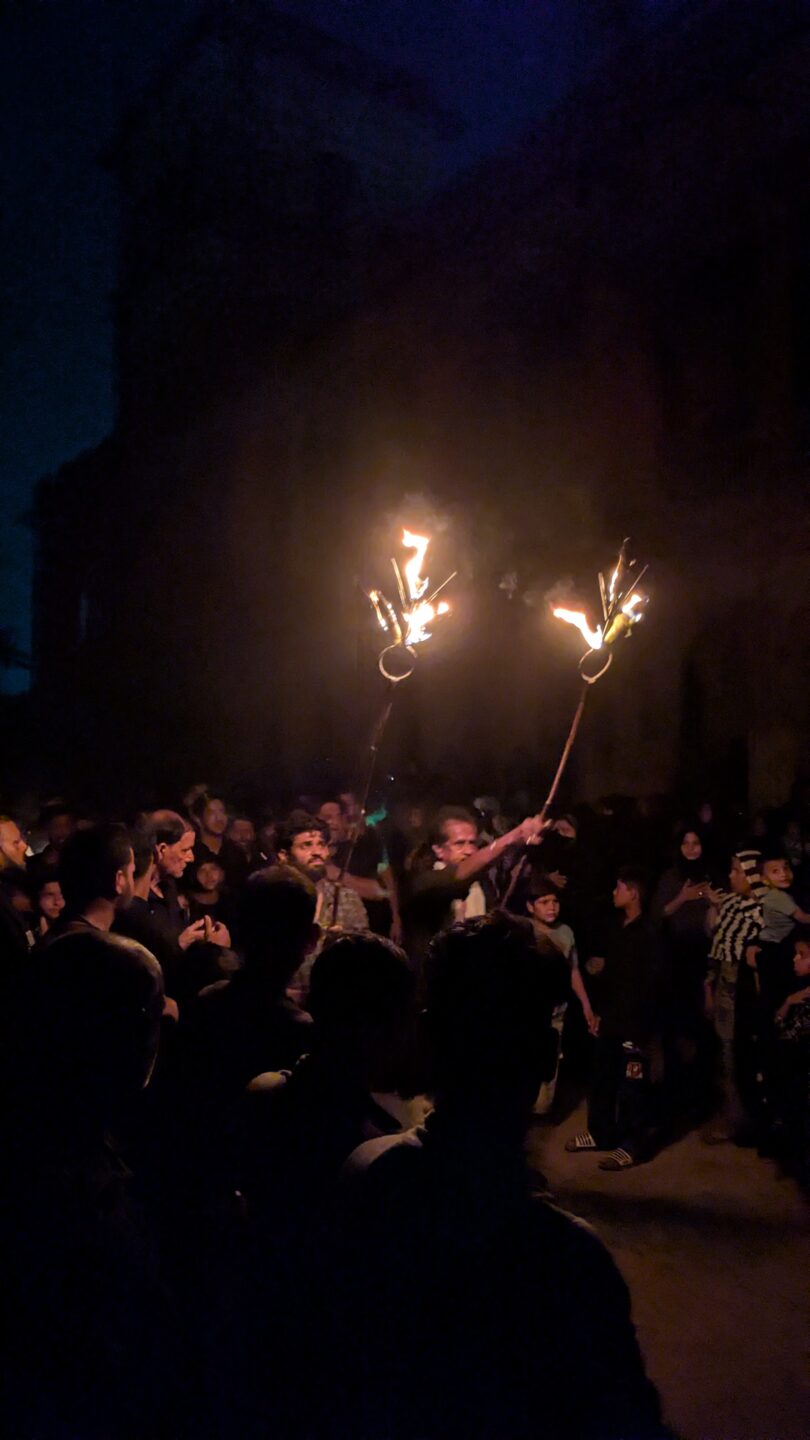
Image courtesy of the author. Photo credit: @azadarimahmudabad
The COLOR CODEX series — to which SEMIOVOX has invited 50 of our commercial / applied semiotician colleagues from around the world to contribute — explores the unexpected associations evoked for each of us by specific colors found in the material world. Vol. 1: 2023–24. Vol. 2: 2026–27.
On the first day of the month of Moharram, the colour black shrouds homes and cityscapes in the Awadh region of North India. At sundown, Shia Awadhis begin to commemorate the death of the grandson of the Prophet Mohammad, Imam Hussain, and his seventy-two companions who laid down their lives to stand against injustice.
The story of the battle was first narrated by Hussain’s sister, Bibi Zainab, fourteen centuries ago. Like Bibi Zainab and those that survived did at the time (according to legend), men and women change into black clothing, remove any jewellery and ornaments, and begin a period of mourning. For the next two and a quarter months, no bright colours are worn and all participate in a series of rituals retelling the story of the Battle of Karbala.
The soundscape is a key aspect of the mourning. People congregate in homes and shrines to commemorate this period through poetry and preaching. No tunes except the ones for mourning are played. No poetry save for litanies and elegies are recited.
Objects are shrouded in black too. The reciters of elegies begin by opening a bundle of black cloth — their basta — to reveal books from which to recite. The calligraphy on these manuscripts is a solemn black; so is the pulpit on which the reciter sits. On social media some change their profile pictures to black. Black banners hang in the streets with slogans of mourning.
As the Battle of Karbala is recalled, women and men cover their eyes — imagining scenes of carnage that are recalled in the most painstaking detail. They hear of thirst, hunger, discomfort, a mother’s milk drying up, a child’s scream. As they listen to stories of sacrifice and loss, their only visual cue is the dark void of their closed eyes.
Hundreds and thousands of black-clad men and women congregate in processions. On the most powerful of the nights, the lights are put out and in the darkness, the dark clothes of the mourners become one with the darkness of the night. On cue, they beat their heads and chests and weep. A toddler raised in the culture learns early that to view black, or to hear the tune of mourning, is a cue to beat your chest lightly.
Mourning a fourteen-hundred-year-old grief, year after year, may seem strange. Yet the mourning of Moharram allows people to superimpose and put into perspective their own grief. The ritual is a cathartic exercise of meaning-making; and it is a reminder of similar injustices and sufferings that we hear of in the news every day. The colour black then becomes a canvas to visualise suffering of all kinds — the personal and collective.
COLOR CODEX: Martha Arango (Sweden) on FALUKORV RED | Rachel Lawes (England) on DEVIL GREEN | Audrey Bartis (France) on KYOTO MOSS | Maciej Biedziński (Poland) on SKIN-DEEP ORANGE | Natasha Delliston (England) on MARRAKECH MINT | Whitney Dunlap-Fowler (USA) on RESURRECTION CANARY BLUE | Ximena Tobi (Argentina) on VILLA MISERIA BRICK | Aiyana Gunjan (India) on LETTERBOX RED | Lucia Laurent-Neva (England) on TEAL BLUE VOYAGER | Charles Leech (Canada) on STORMTROOPER WHITE | William Liu (China) on PINING GREEN | Ramona Lyons (USA) on GOTH PURPLE | Greg Rowland (England) on LAUNDROMAT FUTURA | Sónia Marques (Portugal) on RUNAWAY BURRO | Max Matus (Mexico) on CALIFORNIAN BLUE | Chirag Mediratta (Canada / India) on AUROVILLE ORANGE | Alfredo Troncoso (Mexico) on BORGES GLAUQUE | Josh Glenn (USA) on TOLKIEN GREEN | Clio Meurer (Brazil) on PARIS LUMINOUS GREY | Serdar Paktin (Turkey / England) on AMBIENT AMBER | Maria Papanthymou (Russia / Greece) on AGALMATOLITE WHITE | Sarah Johnson (Canada) on ARMY GREEN | Vijay Parthasarathy (USA) on ALPHONSO YELLOW | Tim Spencer (England) on ELECTRO-EROTIC COBALT | Adelina Vaca (Mexico) on MEXICAN PINK | Brian Khumalo (South Africa / USA) on STATUE OF LIBERTY TEAL | Madoka Suganuma (Japan) on BLOSSOM PINK | Susan Bell (Australia) on THAILAND TURQUOISE | Rajan Luthra (India) on AMALTAS YELLOW | Carla Moss (Austria) on EASTERN BLOC GREY | Dora Jurd de Girancourt (France) on JACARANDA PURPLE | Alexandra Ncube (England) on PMDD RED | Katrin Horn (Austria) on PIER BLUE | Ľudmila Lackova Bennett (Czech Republic) on BARBIE PINK | Onaiza Drabu (India) on MOHARRAM BLACK | Jamin Pelkey (Canada) on KELLS CORAL | Manar R. El Wahsh (Canada) on FATIMID GOLD | Gianlluca Simi (Brazil) on ELLE IN BLUE | Jiakun Wang (China) on GEN Z PURPLE | Mariane Cara (Brazil) on IPANEMA GOLDGLOW | Eugene Gorny (Thailand) on FLAMBOYANT RED | Gemma Jones (Netherlands) on IN-BETWEEN INDIGO | Cathy Maisano (Australia) on AUSTRALIAN SUNSET | Victoria Gerstman (Scotland) on CALPOL PURPLE | Iván Islas (Mexico) on MITLA YELLOW | Su Luo (China) on CHILLI OIL RED | Nimesh Nambiar (UAE) on DUBAI DUNES | Hyaesook Yang (South Korea) on THE INTERSTICE GRADIENT | Alice Sweitzer (Germany) on HÖR GREEN | Elinor Lifshitz (Switzerland) on BAMBOO GREEN.
Also see these global semio series: MAKING SENSE (Q&As) | SEMIOFEST SESSIONS (monthly mini-conferences) | COVID CODES | SEMIO OBJECTS | COLOR CODEX | DECODER (fictional semioticians) | CASE FILE | PHOTO OP | MEDIA DIET | TATTOO YOU (semioticians’ tattoos).