

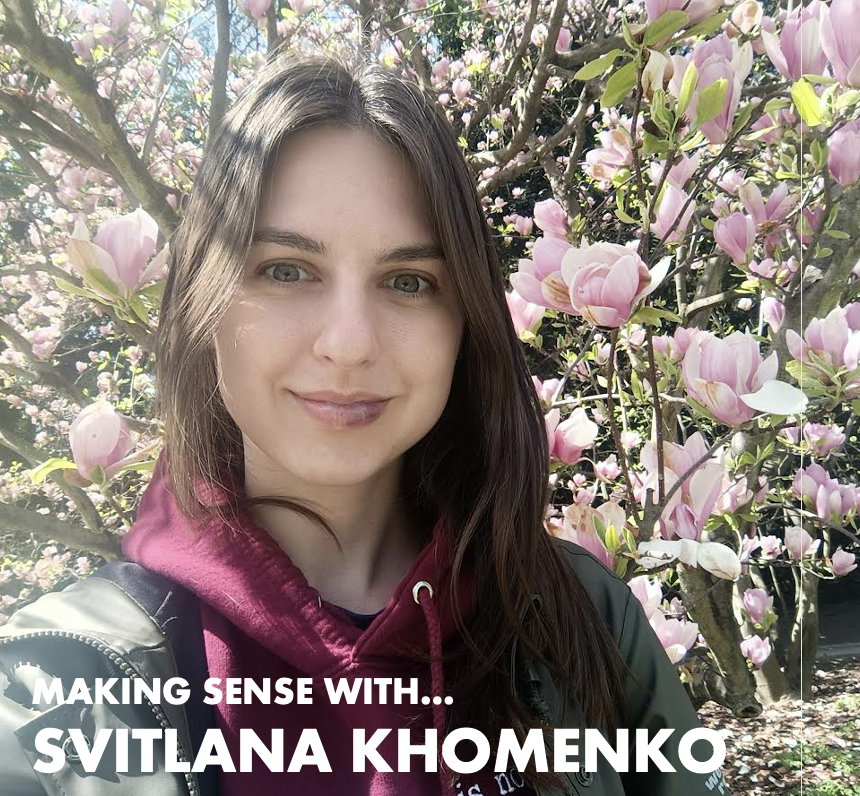
Photo courtesy of SK
What makes a semiotician tick? SEMIOVOX’s Josh Glenn has invited his fellow practitioners in the field of commercial semiotics, from around the world, to answer a few revealing questions.
Ukraine…
SEMIOVOX
When you were a child/teen, how did your future fascination with symbols, cultural patterns, interpreting “texts,” and getting beneath the surface of daily life manifest itself?
SVITLANA KHOMENKO
Since childhood, I’ve been fascinated by the mythologies of ancient Egypt, Greece, Mesopotamia, and the Slavic world. What drew me in was the chance to explore these cultures and figure out how their mythological worlds were organised, how the gods were connected, who was responsible for what, and how everything fitted together.
That curiosity was also nurtured by a book of mystical stories from different cultures. During summer holidays, someone would read me one story every evening before bed.
Even in primary school, I started exploring these subjects on my own, searching online for information about Egyptian gods and trying to make sense of their hierarchy. I was equally fascinated by the material traces of the past.
Alongside these explorations, there was a separate notebook dedicated to a fictional world of my own. I drew maps and developed its geography, history, and cultural features, enjoying the process of figuring out how all these elements could fit together to create a coherent world.
SEMIOVOX
Describe your first encounter(s) with the theory and practice of semiotics.
SVITLANA KHOMENKO
My first formal encounter with semiotics was at university in Kyiv, through a short course on semiotics in traditional Ukrainian culture. I had already been interested in culture and art for a long time and was familiar with the idea that information can be encoded in different “texts” and forms, but I didn’t know this was a separate discipline or that it was called semiotics. 😊
Discovering that these processes could be studied more deeply and applied across different areas was what really attracted me to the field.
SEMIOVOX
How did you find your own way to doing semiotics?
SVITLANA KHOMENKO
In 2022, when the full-scale war began in Ukraine, I was finishing my bachelor’s degree in Kyiv. I had planned to study culture through a semiotic perspective abroad, but initially I wanted to take a break from formal education and continue working on cultural projects. The war changed those plans and accelerated my decision to continue my studies. I enrolled at the University of Tartu in 2022 and moved to Estonia as a refugee to join its international MA programme in semiotics.
My professional work with semiotics began quite unexpectedly through marketing and national branding. By then, I was already developing my marketing career and remotely leading that area at a Ukrainian Employer Branding agency. I started applying semiotic thinking to campaigns, websites, social media, communications, company value systems, and the development of employer brands.
My Erasmus semester in Turin was also important because it brought me closer to Gunther Kress’s theory and gave me an opportunity to apply it directly in my work. Academic learning deepened my understanding of communication and gave me the confidence to take on more complex and unfamiliar projects.
As they say, the stars aligned — although at a very difficult time.
SEMIOVOX
What are the most important attributes of a good semiotician?
SVITLANA KHOMENKO
Seeing the whole system at once and understanding the main relationships through which information is encoded within that system.
SEMIOVOX
What three books about semiotics have you found the most useful and enlightening in your own work?
SVITLANA KHOMENKO
Three authors I would recommend are [German linguist and semiotician] Gunther Kress, Juri Lotman, and [Bulgarian/American Strategic Communication professor] Nadia Kaneva. Kress is especially useful for understanding multimodality and how different modes work together to create meaning. Lotman gives a broader perspective on semiotics and culture, while Kaneva is particularly relevant for understanding nation branding and how meaning is constructed around countries and their identities.
SEMIOVOX
When someone asks you to describe what you do, what is your “elevator pitch”? How do you persuade a skeptical client to take a chance on using this tool?
SVITLANA KHOMENKO
“I use semiotics to understand how meaning is formed and apply it to real-world problems in areas such as Employer Branding, marketing, management, national branding, Human Capital, and the professional integration of young people.”
Persuading a skeptical client is quite easy if you are confident about the result you want to achieve and know what to use to get there. As in any professional field, there’s no need to overwhelm them with theory or unfamiliar terms 😊 The important thing is to give them confidence in the result. How you solve the client’s problem is your responsibility.
SEMIOVOX
What specific sorts of semiotics-driven projects do you find to be the most enjoyable and rewarding?
SVITLANA KHOMENKO
The most rewarding projects are those where the solution becomes a practical tool that people can actually use, but also has the potential to make a difference beyond a single organisation or problem, ideally at a broader societal or national level.
For example, I’ve worked on value systems and EVPs [Employee Value Propositions] that companies later used in their day-to-day interactions with talent. I’m also interested in projects where meaning-making can change how a system understands a problem, such as designing research that can contribute to young people’s integration into the Ukrainian labour market.
In Ukraine, where organisations are navigating the ongoing war, constant attacks and human losses, I find this kind of work especially meaningful. Semiotic thinking allows me to approach complex problems from different perspectives, including business, government, the military, civil society and culture, and understand how different parts of the system influence one another. This is particularly valuable in Human Capital, where solutions need to account for the relationships between people, organisations and the wider social context.
My master’s thesis was another project I found particularly rewarding. I chose national branding because I wanted to study semiotics through real-world practice rather than conduct a purely theoretical investigation. I examined how Ukraine’s national branding changed before and after the beginning of the full-scale war, looking at the relationships between different actors and contexts. What made this project especially interesting to me was the possibility of extracting a structure from a real case that other countries could adapt to their own needs. Given the current global context, I believe this kind of practical knowledge could be useful far beyond Ukraine.
SEMIOVOX
What frustrates you about how semiotics is practiced and/or perceived, right now?
SVITLANA KHOMENKO
Semiotics is still not widely understood, and when it is discussed, it is often reduced to questions like “What does this colour mean?”, as if signs had fixed meanings that could simply be looked up or assigned. This misses the much bigger idea of meaning-making, which depends on context, relationships and the wider system.
I would like to see semiotics move beyond academia and become a practical way of looking at the world, something people can use in everyday life and professional practice to understand and solve concrete problems.
SEMIOVOX
What advice would you give to a young person interested in this sort of work?
SVITLANA KHOMENKO
Don’t be afraid of the unfamiliar.
Semiotics can seem quite philosophical and metaphorical at first, but it becomes much clearer when you start with a concrete problem that many people face in their everyday lives, perhaps one that you experience yourself, and try to understand how meaning-making can help address it.
Look for those invisible threads that connect everything around you.
MAKING SENSE series: MARTHA ARANGO (Sweden) | MACIEJ BIEDZIŃSKI (Poland) | BECKS COLLINS (England) | WHITNEY DUNLAP-FOWLER (USA) | IVÁN ISLAS (Mexico) | WILLIAM LIU (China) | SÓNIA MARQUES (Portugal) | CHIRAG MEDIRATTA (India / Canada) | SERDAR PAKTIN (Turkey / England) | MARIA PAPANTHYMOU (Greece / Russia) | XIMENA TOBI (Argentina) | & many more.
Also see these global semio series: MAKING SENSE (Q&As) | SEMIOFEST SESSIONS (monthly mini-conferences) | COVID CODES | SEMIO OBJECTS | COLOR CODEX | DECODER (fictional semioticians) | CASE FILE | PHOTO OP | MEDIA DIET | TATTOO YOU (semioticians’ tattoos).