

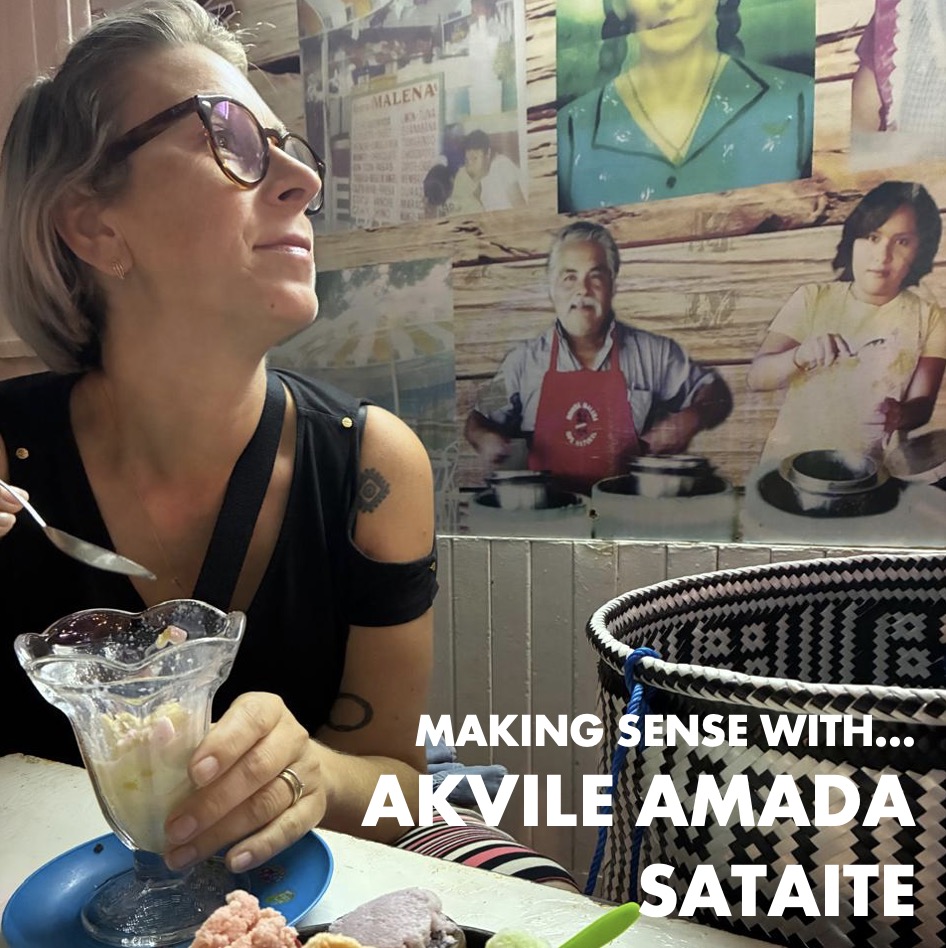
Photo courtesy of AAS
What makes a semiotician tick? SEMIOVOX’s Josh Glenn has invited his fellow practitioners in the field of commercial semiotics, from around the world, to answer a few revealing questions.
Mexico City…
SEMIOVOX
When you were a child/teen, how did your future fascination with symbols, cultural patterns, interpreting “texts,” and getting beneath the surface of daily life manifest itself?
AKVILE AMADA SATAITE
I was born in Lithuania, then part of the Soviet Union, where collective thinking was valued over individuality. As a child, I clearly remember my mother saying every time I did something “wrong” — “Stop it! What will people say?” So, being a very sensitive child, I started creating stories that would make people think well of me, even if those stories were not always true. Looking back, the fascinating part was not the stories themselves, but observing how they influenced people’s opinions and shaped my image in their minds. I wish I had known Eco back then.
There were also many unspoken behavioral codes at home. Over time, I became an excellent interpreter of what my mother really meant without her saying it directly. By observing her expressions, gestures, or tone of voice, I could often predict her actions and decisions. I´d say, without realizing it, I was already connecting signifiers with meanings and constructing a narrative that fit the situation.
Another childhood memory that comes to mind is a traditional girls’ game in Lithuania called secrets. We would collect tiny objects, arrange them carefully under a small piece of glass, bury them in the ground, and leave subtle clues for a friend to discover them. The secret only existed if someone knew how to interpret the signs leading to it. Looking back, I realize that even as a child I was fascinated by the idea that meaning could be hidden, constructed, and revealed through interpretation.
SEMIOVOX
Describe your first encounter(s) with the theory and practice of semiotics.
AKVILE AMADA SATAITE
My bachelor’s thesis explored the figure of the angel in the poetry of Aidas Marčėnas through the interpretation of literary symbols. Looking back, I think that was my first conscious flirtation with semiotics.
A few years later, I started working at a creative advertising agency where the head of the strategic department was a semiotician. Then one of our clients brought us a creative brief prepared by a team of semioticians, and I was fascinated by how meaningful and productive the creative process could become. In a world full of countless and often superficial messages, semiotics felt like a beacon I wanted to follow.
I later moved to Mexico and got married to a… semiotician. Here I pursued a degree in Communication with a strong emphasis on cultural studies and semiotics. That journey eventually led me to my current research, A Semiotic Analysis of the Representation of Racialized Female Bodies in AI-Generated Fast Fashion Advertising.
The only aspect that sometimes frustrates me is what I jokingly call opinion science. Unlike mathematics, semiotics rarely offers a single correct answer. I often spend hours questioning whether my interpretation is convincing enough. At the same time, I think that constant self-questioning is exactly what makes semiotics such a fascinating discipline.
SEMIOVOX
How did you find your own way to doing semiotics?
AKVILE AMADA SATAITE
I sometimes joke that I had no choice. I became fascinated by semiotics, then, by chance, I met a semiotician whom I eventually married. As it turned out, he was also running a semiotic consultancy.
Our first major project together was organizing Semiofest 2020, which, because of the COVID-19 pandemic, was postponed until 2022. It was a challenging experience — not only because of the pandemic, but also because of the cultural differences involved in organizing an international event in Mexico.
More and more semiotic projects started to come our way. Over time, we became a strong team by recognizing each other’s strengths, supporting each other’s weaknesses, and combining different perspectives. That’s how semiotics gradually stopped being just a fascination and became my profession.
SEMIOVOX
What are the most important attributes of a good semiotician?
AKVILE AMADA SATAITE
I would say the eyes of a child, curiosity, and the patience to embrace otherness. Perhaps also a certain kind of naivety — not ignorance, but the ability to look at familiar things as if seeing them for the first time.
I think this combination opens the door to deep observation and meaningful interpretation. A good semiotician doesn’t rush to confirm what they already know. Instead, they remain curious long enough to discover what is hidden beneath the surface.
SEMIOVOX
What three books about semiotics have you found the most useful and enlightening in your own work?
AKVILE AMADA SATAITE
- John Deely’s Basics of Semiotics. It is an excellent starting point for anyone interested in semiotics because it provides a broad picture of the field before diving into individual theories and schools of thought. It helped me understand the foundations of semiotic thinking and gave me a framework for reading other authors.
- Roland Barthes’ The Obvious and the Obtuse. It was my introduction to visual semiotics and completely changed the way I looked at images. It taught me that visual communication always contains layers of meaning beyond what is immediately visible.
- Yuri Lotman’s La semiosfera (The Semiosphere). More than any other book, it helped me understand my own challenges. Having experienced the transition from communism to capitalism and later moving from Lithuania to Mexico, I began to see culture not as something fixed, but as a living space where different systems of meaning constantly interact, collide, and transform one another.
Although it is not a book on semiotics, I would also mention Umberto Eco’s novel Numero Zero. It brilliantly illustrates how media construct reality, reminding us that the stories societies believe are often as influential as the facts themselves.
SEMIOVOX
When someone asks you to describe what you do, what is your “elevator pitch”? How do you persuade a skeptical client to take a chance on using this tool?
AKVILE AMADA SATAITE
I usually avoid saying that semiotics is “the science of signs or symbols” because, for someone unfamiliar with the field, that explanation offers little practical value. Instead, I describe it in terms of what it can do. I explain that a semiotic approach helps identify a brand’s strengths, weaknesses, opportunities, and cultural blind spots. It can also reveal a meaningful direction for future communication.
I see semiotics as a way of thinking about communication. When applied consistently, it becomes a system that helps brands create meaning rather than simply produce more messages. In today’s world, where communication is abundant but meaning is often scarce, I think that is its greatest value.
SEMIOVOX
What specific sorts of semiotics-driven projects do you find to be the most enjoyable and rewarding?
AKVILE AMADA SATAITE
At the beginning of my journey, I was much more interested in textual analysis, the interpretation of literary symbols, and the translation of meaning. Over time, however, my interests gradually shifted toward cultural and visual semiotics.
Today, I find the most rewarding projects to be those involving cultural translation through the visual representation of brands and products. I enjoy exploring how the same message can be interpreted differently across cultures and how visual communication can be adapted without losing its meaning. These projects combine my interests in culture, branding, and visual communication while constantly challenging me to look beyond the obvious.
SEMIOVOX
What frustrates you about how semiotics is practiced and/or perceived, right now?
AKVILE AMADA SATAITE
One of the biggest changes in recent years has been the rapid emergence of AI tools. I understand the excitement they generate, and I use them myself. However, I believe AI should enhance expertise, not replace it. Semiotic analysis requires theoretical knowledge, cultural sensitivity, and critical thinking. When AI is used without those foundations, the result can be superficial, inconsistent, or simply wrong.
Another frustration is the perception of semiotics in the business world. Sometimes, after explaining what semiotics can reveal about culture, meaning, and communication, the client simply replies, “Okay, let’s do a focus group.” I have nothing against focus groups — they answer different questions. I only wish more people understood that semiotics is not a substitute for market research, but a different way of understanding how meaning is created and interpreted.
SEMIOVOX
Peirce or Saussure?
AKVILE AMADA SATAITE
I don’t see semiotics as an either-or discipline and, no doubt, both Peirce and Saussure laid essential foundations. If I had to choose the perspective that most closely reflects my own work, it would be Lotman. His concept of the semiosphere allows me to think about meaning not as isolated signs, but as something produced through culture and the interaction of multiple sign systems.
SEMIOVOX
What advice would you give to a young person interested in this sort of work?
AKVILE AMADA SATAITE
Don’t explore a city by Uber. Walk instead. Take the metro. Visit local markets. Sit alone in a café and simply observe. Learn to notice what usually goes unnoticed and imagine the stories behind what you see.
Never lose the curiosity of a child or the passion to explore. Read, but don’t limit yourself to books — culture is your greatest textbook.
Find a community of people who think semiotically. Share ideas, ask questions, challenge one another, and keep learning together. Semiotics may begin as an individual way of seeing the world, but it grows through dialogue.
MAKING SENSE series: MARTHA ARANGO (Sweden) | MACIEJ BIEDZIŃSKI (Poland) | BECKS COLLINS (England) | WHITNEY DUNLAP-FOWLER (USA) | IVÁN ISLAS (Mexico) | WILLIAM LIU (China) | SÓNIA MARQUES (Portugal) | CHIRAG MEDIRATTA (India / Canada) | SERDAR PAKTIN (Turkey / England) | MARIA PAPANTHYMOU (Greece / Russia) | XIMENA TOBI (Argentina) | & many more.
Also see these global semio series: MAKING SENSE (Q&As) | SEMIOFEST SESSIONS (monthly mini-conferences) | COVID CODES | SEMIO OBJECTS | COLOR CODEX | DECODER (fictional semioticians) | CASE FILE | PHOTO OP | MEDIA DIET | TATTOO YOU (semioticians’ tattoos).