

Session: Teaching Semiotics to an AI
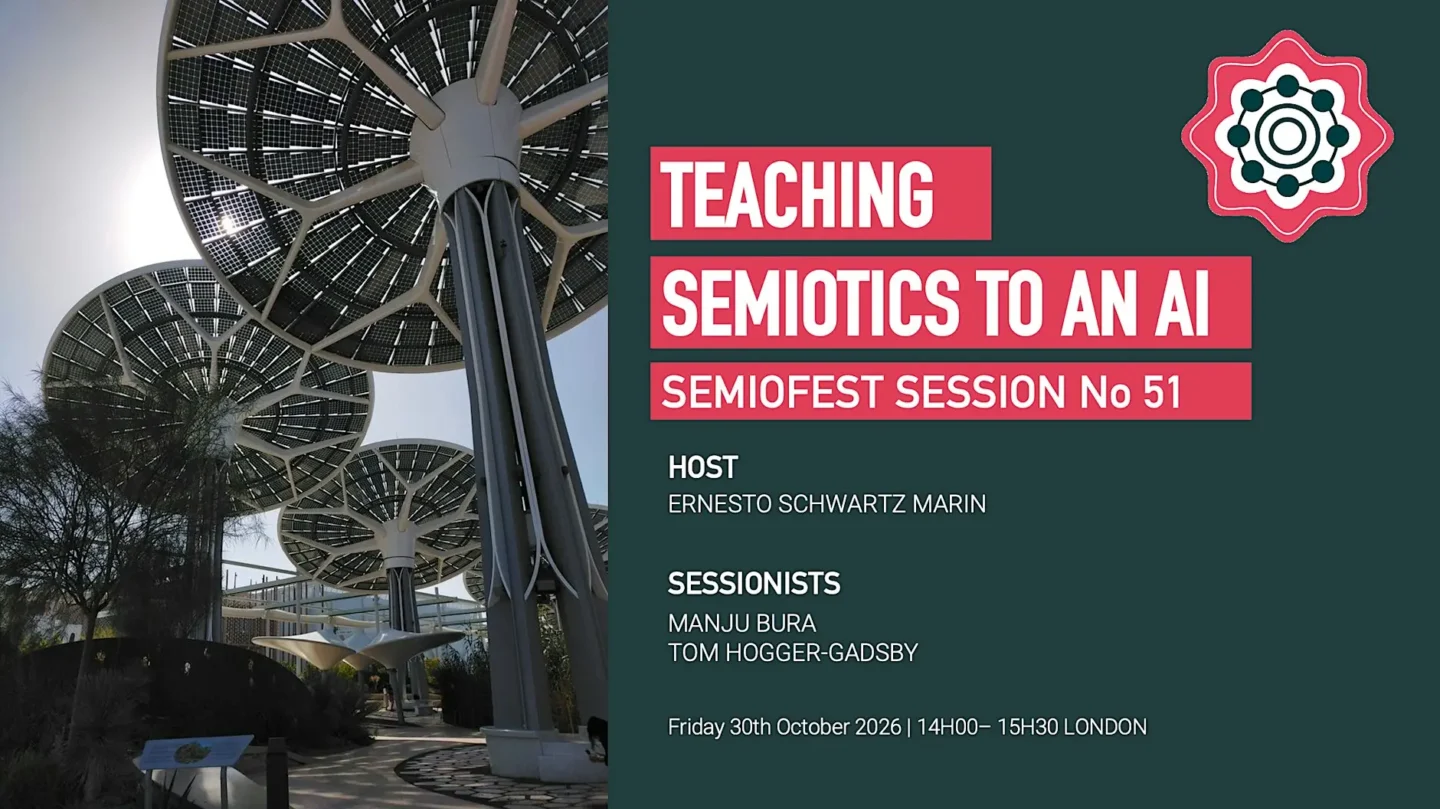
I’m the founder, though no longer the convenor of Semiofest’s series of informal online “sessions.” These events are intended not only to share best practices among, but to nurture collegiality and friendship within the global semio community.
Coming up on October 30th (at 2 pm UK time)…
TEACHING SEMIOTICS TO AN AI
Get tickets (suggested donations only) at the link above.
As semioticians, we often ask ourselves, how do we integrate AI into our work? Join us for a session with the members of Exeter University’s “Semiotics for AI” team. They will discuss how they have been using AI to draw from over five centuries of historical documents, and millions of news articles — bringing the worlds of the very big into conversation with the worlds of the very small through a method that marries semiotics with natural language processing and ethnographic fieldwork.
Our sessionists:
- MANJU BURA is a PhD researcher in Participatory Science and Technology Studies (STS) and Environmental Intelligence, focusing on the diverse narratives and material realities of climate change impacts, particularly heatwaves in Nepal. Her research combines ethnographic situational analysis with Natural Language Processing (NLP) to explore heatwave narratives from micro-level lived experiences to macro-level big data analysis.
- TOM HOGGER-GADSBY is a philosopher and a PhD student at the Centre for Doctoral Training in Environmental Intelligence at the University of Exeter. His current research focuses on urban mobility, sustainability, and inequality in Mexico City. He utilises a blend of ethnographic methods, Machine Learning, and Natural Language Processing (NLP) techniques to examine both contemporary and historical data related to the city’s infrastructure and mobility.
Session host:
- ERNESTO SCHWARTZ-MARIN is Senior Lecturer in Sociology at Exeter University. His research is characterised by the ethnographic engagement with large bioscientific endeavours in Latin America, such as the Mexican Genome or the Colombian Human Expedition. Schwartz Marin leads the environmental intelligence and participatory Science and Technology Studies (STS) group at Exeter, since 2022 he has conducted research in the Chilean Andes, the Himalayas in Nepal and in Mexico City mixing social sciences and Artificial Intelligence with his PhD students. Since 2011 he has been involved in the creation participatory action research interventions in humanitarian crises via grass-roots DNA databases, and citizen-led science.
SEMIOFEST SESSIONS: R/D/E | BINARIES | SEMIOTICS & UX | BODY SEMIOTICS | AI & SEMIOTICS | SEMIOTICS & CINEMA | FICTIONAL DECODERS | ON COLOUR | & more.
Also see these global semio series: MAKING SENSE (Q&As) | SEMIOFEST SESSIONS (monthly mini-conferences) | COVID CODES | SEMIO OBJECTS | COLOR CODEX | DECODER (fictional semioticians) | CASE FILE | PHOTO OP | MEDIA DIET | TATTOO YOU (semioticians’ tattoos).