

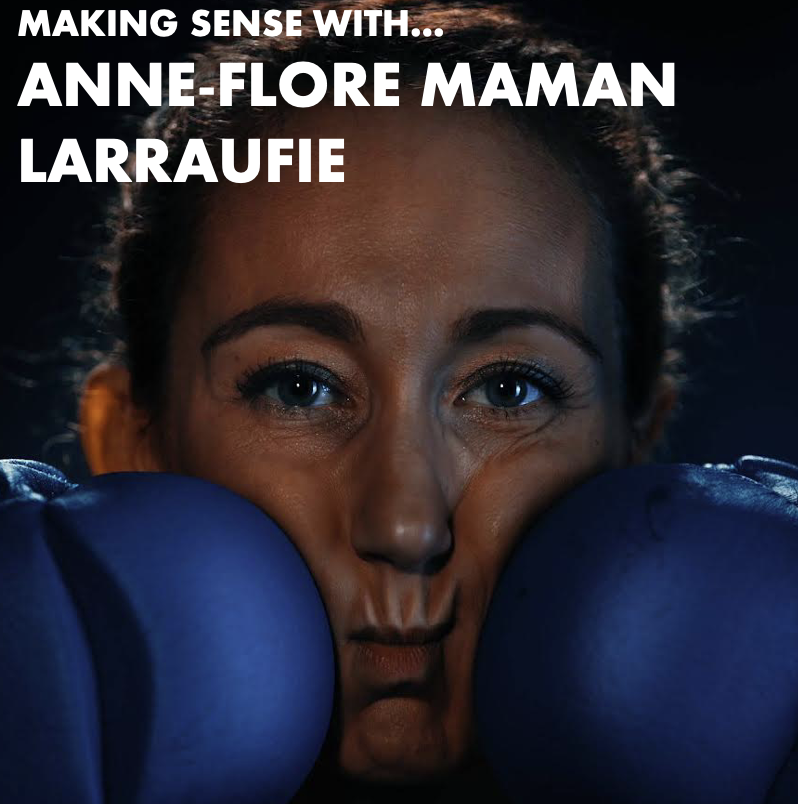
Photo courtesy of AML
What makes a semiotician tick? SEMIOVOX’s Josh Glenn has invited his fellow practitioners in the field of commercial semiotics, from around the world, to answer a few revealing questions.
Vichy…
SEMIOVOX
When you were a child/teen, how did your future fascination with symbols, cultural patterns, interpreting “texts,” and getting beneath the surface of daily life manifest itself?
ANNE-FLORE MAMAN LARRAUFIE
I jumped on any occasion to code-decode. For instance, doing these mystery messages with my friends that only we could read. In high school, I enjoyed lessons on hieroglyphs — and I was reading and speaking ancient Latin/Greek just to be able to understand the mythologies, their artifacts, and symbolic meanings, etc.
SEMIOVOX
Describe your first encounter(s) with the theory and practice of semiotics.
ANNE-FLORE MAMAN LARRAUFIE
That was while doing my Ph.D. As I was initially a mathematician/engineer, it was reassuring for me to find in structuralist semiotics a discipline that enables coding qualitative data using mathematical/scientific rigor. And to be fair nothing did not attract me. 😊
SEMIOVOX
How did you find your own way to doing semiotics?
ANNE-FLORE MAMAN LARRAUFIE
I would say naturally. I’ve never “sold” semiotics per se in consulting — instead, I integrate it into everything that my consultancy does. Sometimes the client knows, sometimes not! Once, for example, we used semiotics in a project for the French Minister of Economy… though we never used the term “semiotics” with him.
SEMIOVOX
What are the most important attributes of a good semiotician?
ANNE-FLORE MAMAN LARRAUFIE
Curiosity, cultural capital, and knowing one’s limits (culturally, for instance). Auto-reflexivity is also fundamental, in order to avoid arriving at a false interpretation of signs.
SEMIOVOX
What three books about semiotics have you found the most useful and enlightening in your own work?
ANNE-FLORE MAMAN LARRAUFIE
- Che cos’è la semiotica visiva by [the Italian semiotician] Piero Polidoro. This books deals with the semiotic interpretation of art. I’ve adapted all its content for my advertising analytics.
- Sémantique structural by Algirdas Julien Greimas. To shape my understanding about structural semiotics.
- A theory of semiotics by Umberto Eco. To link semiotics and linguistics.
SEMIOVOX
When someone asks you to describe what you do, what is your “elevator pitch”? How do you persuade a skeptical client to take a chance on using this tool?
ANNE-FLORE MAMAN LARRAUFIE
You should not try to explain it! Instead, just present it naturally as a scientific tool for analytics or reporting results. As a consultant, you don’t need to persuade a client about the usage of a particular tool; instead, you should just be able to explain why that tool is a perfect fit for your research / data-collection, etc.
Let’s be honest: Clients don’t understand more why SEM [Structural Equation Modeling] or conjoint analysis is more relevant than semiotics!
SEMIOVOX
What specific sorts of semiotics-driven projects do you find to be the most enjoyable and rewarding?
ANNE-FLORE MAMAN LARRAUFIE
Those I do for my own academic research. They start often without any purpose, being very much empirical and grounded theory. Sometimes I end up with some interesting findings — and sometimes not!
SEMIOVOX
What frustrates you about how semiotics is practiced and/or perceived, right now?
ANNE-FLORE MAMAN LARRAUFIE
When it comes to any form of qualitative research, I see too many consultants whose approach to their work does not involve a scientific research process. As a result, they tend to use semiotics in a superficial, non-rigorous way.
Why is it only design and advertising programs that offer courses in applied semiotics? I really wish that business schools would offer them too.
SEMIOVOX
Peirce or Saussure?
ANNE-FLORE MAMAN LARRAUFIE
I’ve found it is possible to reconcile both indeed. 😊
SEMIOVOX
What advice would you give to a young person interested in this sort of work?
ANNE-FLORE MAMAN LARRAUFIE
Go to museums to enlarge your cultural capital!
MAKING SENSE series: MARTHA ARANGO (Sweden) | MACIEJ BIEDZIŃSKI (Poland) | BECKS COLLINS (England) | WHITNEY DUNLAP-FOWLER (USA) | IVÁN ISLAS (Mexico) | WILLIAM LIU (China) | SÓNIA MARQUES (Portugal) | CHIRAG MEDIRATTA (India / Canada) | SERDAR PAKTIN (Turkey / England) | MARIA PAPANTHYMOU (Greece / Russia) | XIMENA TOBI (Argentina) | & many more.
Also see these global semio series: MAKING SENSE (Q&As) | SEMIOFEST SESSIONS (monthly mini-conferences) | COVID CODES | SEMIO OBJECTS | COLOR CODEX | DECODER (fictional semioticians) | CASE FILE | PHOTO OP | MEDIA DIET | TATTOO YOU (semioticians’ tattoos).