

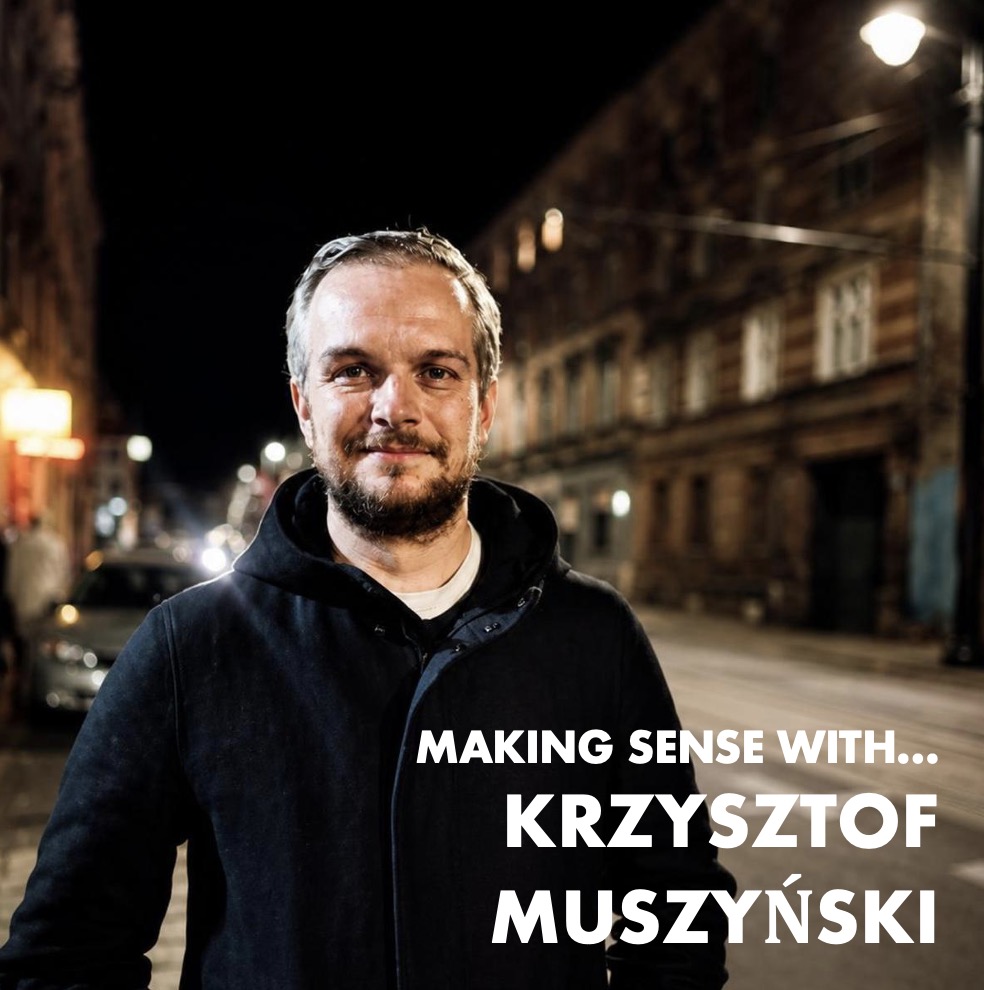
Photo courtesy of KM
What makes a semiotician tick? SEMIOVOX’s Josh Glenn has invited his fellow practitioners in the field of commercial semiotics, from around the world, to answer a few revealing questions.
Bytom (Poland)…
SEMIOVOX
When you were a child/teen, how did your future fascination with symbols, cultural patterns, interpreting “texts,” and getting beneath the surface of daily life manifest itself?
KRZYSZTOF MUSZYŃSKI
When I was in primary school there was a competition for a short story about your pet. We didn’t have any, so I looked around and found one — a spider living in the bathroom air vent. I didn’t expect anything from this competition. And surprisingly, I won. (I couldn’t receive the bar of chocolate as a prize because I had chickenpox…). I think it was the first time I learned the difference between an object and the meaning we give to it. An unpleasant spider became a friend in my story.
SEMIOVOX
Describe your first encounter(s) with the theory and practice of semiotics.
KRZYSZTOF MUSZYŃSKI
It was in a shopping gallery, where we were sent in groups as first-year students of journalism and social communication at the University of Warsaw. We had to notice patterns, customer pathways, the arrangement of space, and how things are valued there: what products are at eye level, what is hidden, where promotional posters are usually placed, how they are designed, etc. We had to decode as much as we could, and relate all these signs and codes to each other.
SEMIOVOX
How did you find your own way to doing semiotics?
KRZYSZTOF MUSZYŃSKI
After my PhD in literature, I started to work with Jacek Wasilewski, who was my professor at the University of Warsaw. We collaborate as the Narrative Impact team, together with Agata Kostrzewa. Since I started doing applied semiotics, I’ve recognized that I can easily translate my knowledge from such heart-moving subjects as “theory of literature” into applicable solutions for brands. It was refreshing, after having spent a few years on very theoretical studies, to do research about something that would be in shops just a few weeks after our recommendations. The word “applied” is key.
SEMIOVOX
What are the most important attributes of a good semiotician?
KRZYSZTOF MUSZYŃSKI
For Saussureans, to remember Peirce. And for Peirceans, to remember Saussure!
Anybody who works in applied semiotics has to know how to communicate insights — to clients and others outside our bubble — in a simple way. I try to learn that every time I present my research, and I hope I’m getting better at it. I admire people who can do it well.
SEMIOVOX
What three books about semiotics have you found the most useful and enlightening in your own work?
KRZYSZTOF MUSZYŃSKI
As a toolbox, [Université du Québec à Rimouski literature professor] Louis Hébert’s Applied Semiotics. As a guide, Rachel Lawes’s Using Semiotics in Marketing. And for a deep dive into semiotics — this may sound surprising to many — St. Augustine’s Confessions, especially Book X, which is absolutely fascinating; it’s a shame I discovered it so late. In this particular chapter, St. Augustine adopts the form of a memoir and moves into thoughts about meaning and human memory.
SEMIOVOX
When someone asks you to describe what you do, what is your “elevator pitch”? How do you persuade a skeptical client to take a chance on using this tool?
KRZYSZTOF MUSZYŃSKI
I love the paradox, or superpower, of applied semiotics: It allows you to do in research what great literature does (avoiding your prejudices, misjudgments, and hurtful generalizations about any phenomenon you’re interested in), while at the same time allowing you to find proper categories for all of these phenomena, recognizable by almost anyone. Literature does it with moral questions; in applied semiotics, you can do it with a package of milk. Applied semiotics allows you to read any object as a novel!
To clients, I say: “I will help you find the proper threads and motifs to tell your brand story in a way your competitors haven’t.”
I try to explain to clients where they are now, and where they could be if they tell their stories with the proper signs and structure. I try to avoid “fear of missing out” arguments and instead lean toward “joy of missing out” — I tell my clients to enjoy avoiding what everybody in their niche does, and what everybody else tells and shows. You can find your own way, which will be satisfying for you as a brand inventor/manager, as well as for your clients. When a novelist isn’t enjoying writing his story, neither do the readers. To paraphrase Donna Tartt.
SEMIOVOX
What specific sorts of semiotics-driven projects do you find to be the most enjoyable and rewarding?
KRZYSZTOF MUSZYŃSKI
As a poet and short story writer, I try to give abstract words their flesh. This activity is satisfying because, at some point, all the dots are finally connected and you can see the shape of a poem or story. I experience similar satisfaction when I help a brand discover its own values — and help shape them into their communication.
SEMIOVOX
What frustrates you about how semiotics is practiced and/or perceived, right now?
KRZYSZTOF MUSZYŃSKI
It’s frustrating when creativity is cut short because of methodological purity.
SEMIOVOX
Peirce or Saussure?
KRZYSZTOF MUSZYŃSKI
I was more into Saussure when I was a father of two boys. There’s just a year’s difference between them, but they have very different characters — like Saussure’s dyadic model. With the birth of my daughter, however, I started to notice the role of the Interpretant more.
More seriously. my main tools are Greimas’s actantial model, the semiotic square, and his conclusions in general, which are more in line with Saussure. That said, the plane of the Interpretant is, in some way, linked (in my simplistic opinion) to the “Sender” in Greimas’s actantial model.
SEMIOVOX
What advice would you give to a young person interested in this sort of work?
KRZYSZTOF MUSZYŃSKI
Don’t be afraid to say or show some of your conclusions. Companies are already looking for Human Experience (I’m referring to the wonderful name of Charise Mita’s company) more than User Experience. So if somebody says “but for marketers it will not be useful,” go ahead and translate your “too abstract” or “too academic” conclusion into simpler language, but don’t give up on your direction! This is what will be a discovery for your clients, and what will be meaningful to you.
Applied semiotics is similar to architecture — the most artistic subject among the engineering disciplines. Applied semiotics is the most humanistic field in the orbit of marketing research. Protect that humanistic and creative part, and you will be happy with your projects. If client decides they don’t need your expertise — they’ve lost an opportunity, not you.
MAKING SENSE series: MARTHA ARANGO (Sweden) | MACIEJ BIEDZIŃSKI (Poland) | BECKS COLLINS (England) | WHITNEY DUNLAP-FOWLER (USA) | IVÁN ISLAS (Mexico) | WILLIAM LIU (China) | SÓNIA MARQUES (Portugal) | CHIRAG MEDIRATTA (India / Canada) | SERDAR PAKTIN (Turkey / England) | MARIA PAPANTHYMOU (Greece / Russia) | XIMENA TOBI (Argentina) | & many more.
Also see these global semio series: MAKING SENSE (Q&As) | SEMIOFEST SESSIONS (monthly mini-conferences) | COVID CODES | SEMIO OBJECTS | COLOR CODEX | DECODER (fictional semioticians) | CASE FILE | PHOTO OP | MEDIA DIET | TATTOO YOU (semioticians’ tattoos).