

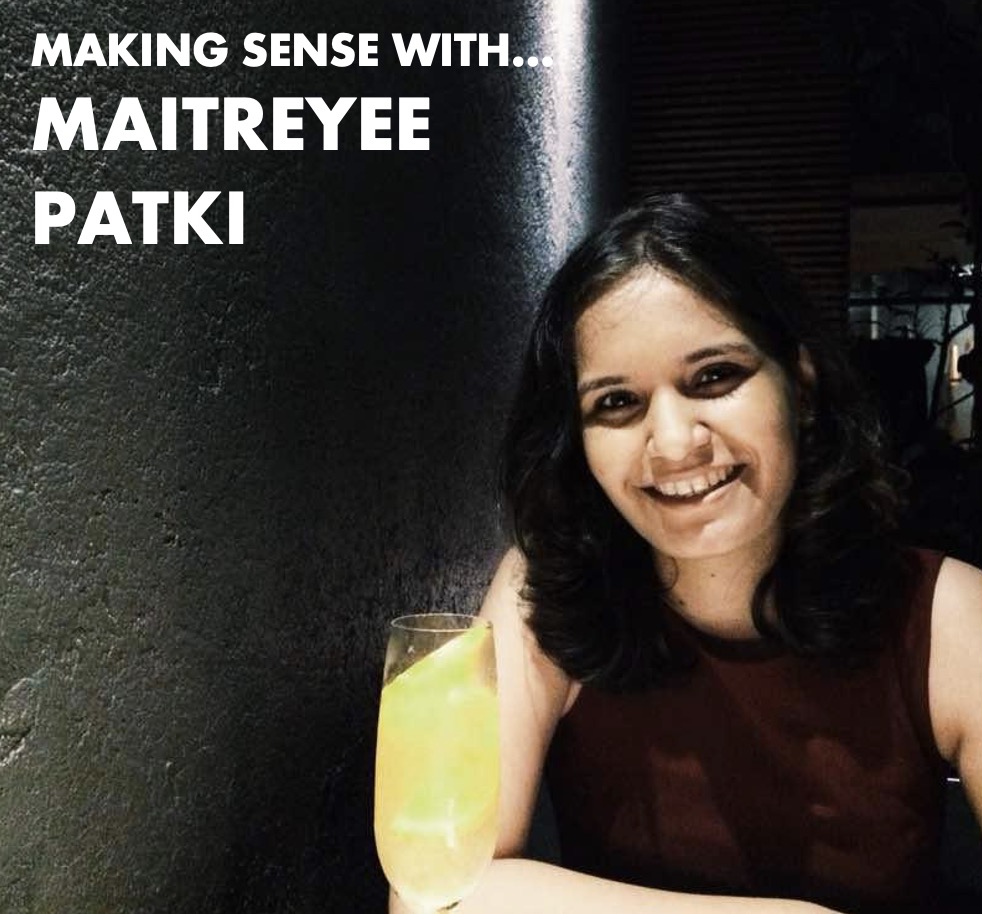
Photo courtesy of MP
What makes a semiotician tick? SEMIOVOX’s Josh Glenn has invited his fellow practitioners in the field of commercial semiotics, from around the world, to answer a few revealing questions.
Singapore…
SEMIOVOX
When you were a child/teen, how did your future fascination with symbols, cultural patterns, interpreting “texts,” and getting beneath the surface of daily life manifest itself?
MAITREYEE PATKI
I was (and still am) just curious in a quiet way. My fascination began more so as noticing that daily life had certain unwritten rules — people said one thing but meant another, something felt respectable in one context and embarrassing in another. That things seemed to carry codes nobody had formally explained.
I particularly remember, as a kid, being hooked onto a show called My Beautiful House on The Discovery Channel. It featured kids from around the world, showcasing their home life. I was deeply fascinated by how different their everyday lives — their rooms, routines, schools, play — were compared to mine.
The cultural differences became even more personal and vivid to me when as a young teen, my family shifted our homebase from Nasik, a small town with a slower rhythm, to Mumbai. Childhood in a big city was so different— everything from the dynamics of play when in a high-rise, to the whole social world structured around apartment life — compared to the landed home setup and open neighbourhood rhythms I’d known.
SEMIOVOX
Describe your first encounter(s) with the theory and practice of semiotics.
MAITREYEE PATKI
I didn’t come through a formal semiotics programme — so my relationship with theory has been gradual, slightly patchworked, and very applied. My first encounter was probably in practice, and without even realising that it was a bit of semiotics. I had studied anthropology and social psychology, and subsequently gotten into qualitative research. So in a way I was already looking at rituals, objects, language, category codes, identity performances, and the little systems of meaning people live inside.
Semiotics, which I first heard about and learnt about on-the-job while at Kantar, gave a sharper vocabulary to that instinct. What attracted me was its permission to take signs, symbols, category and cultural cues seriously. What didn’t was the fact that no one around me could quite ‘teach’ it to me at the time, so it felt a bit distant and untouchable as I never quite got to ‘see’ the process in action.
SEMIOVOX
How did you find your own way to doing semiotics?
MAITREYEE PATKI
I came to it ‘sideways,’ through qualitative research and a repeated realisation that many client questions were not only about behaviour or preference, but about meaning.
I remember a project I did around dishwashing where the rituals around the sink (who washes, when, how much effort is visible, what counts as ‘properly clean’) revealed so much more than functional cleaning needs. Something as ordinary as a dishwashing scrub could start to carry emotional and social meanings around care, competence, fairness, pride, domestic order, and even resentment.
Packaging work also pushed me further into semiotic thinking. Across markets, it was fascinating to see how colours, symbols, naturalness cues, ingredient imagery, clinical whites, or glossy finishes could do completely different work depending on the cultural context. That made it very clear that meaning is never just ‘in’ the object. It is produced between the object, the category, the culture and the viewer.
So over time, semiotics, for me became a way of sharpening the work. Looking beneath what people say they like or dislike, and asking what cultural codes are making something feel a certain way in the first place.
SEMIOVOX
What are the most important attributes of a good semiotician?
MAITREYEE PATKI
A good semiotician needs curiosity, humility, and a slightly overdeveloped interest in looking into things others might gloss over.
Moreover, and especially now, I also think a good semiotician needs discipline around their own biases. In a world where everyone is encouraged to have a quick take, a moral position, a reaction, semiotics requires you to pause before judgment and ask rather than assume and react.
Lastly, it is critical that a semiotician is able to translate the complexity, depth, and nuance of their work in a usable way to business teams who eventually will be the ones to action on it.
SEMIOVOX
What three books about semiotics have you found the most useful and enlightening in your own work?
MAITREYEE PATKI
My learning has come more so through books on anthropology, mythology, and non-fiction narratives. So not necessarily books on semiotics, but book that taught me to read meaning differently.
- I studied Clifford Geertz’s The Interpretation of Cultures as an undergraduate anthropology student, and it has stayed with me. His idea of ‘thick description’ taught me that behaviour is never just behaviour; it has to be read inside the cultural web that gives it meaning. A wink, a ritual, a gesture, a product, a colour, a phrase, none of these mean much in isolation.
- [The Indian mythologist] Devdutt Pattanaik’s Jaya, his retelling and interpretation of the Mahabharata, shaped me in a different way. It showed me how myth is not simply story, but a living system of signs, values, roles, duties, moral tensions and cultural codes. The same character or act can be read differently depending on where you stand inside the story. That has been hugely useful in thinking about culture: meaning is rarely singular or stable; it is layered, relational and often contradictory.
- [The Iranian-American novelist] Dina Nayeri’s nonfiction book The Ungrateful Refugee has stayed with me for how it explores narrative, credibility, and moral reception. It is not only about the stories people tell, but about which stories are believed, which are doubted, what kind of suffering is made legible and what kind is treated with suspicion. It shows how meaning is not only encoded by the speaker, but produced in the conditions of reception.
SEMIOVOX
When someone asks you to describe what you do, what is your “elevator pitch”? How do you persuade a skeptical client to take a chance on using this tool?
MAITREYEE PATKI
The simple version: “I help decode why people say, think and do the things they do, in a way that helps businesses and brands connect with them more meaningfully.” If someone wants the slightly more technical version, I explain that I use qualitative research, cultural reading and semiotic thinking to understand the meanings sitting underneath people’s choices: why something feels trustworthy, premium, caring, modern, outdated, safe, local, aspirational, and such. That said, my parents still remain unsure of what exactly I do, so clearly this pitch still needs work.
As for persuading a skeptical client: Having done a stint on the client-side, I empathise with client-side challenges. To persuade them on using this tool, there are three things I would do. Firstly, help them understand what is semiotics. Most clients do understand the essence of it intuitively. For example, they know when a pack feels too clinical, when an ad feels forced, or when a brand sounds unlike itself. Show them how semiotics gives language and structure to this instinct. Secondly, help them build confidence that there is method behind the apparent ‘mystery’. Demonstrate through examples how it is not just subjective or clever interpretation, that there is rigour in the process. And lastly, work collaboratively with them to understand their internal challenges, and how you can help them sell the value of a semiotic piece internally. A lot of the time, the client reaching out to you may see the value, but the struggle lies in articulating it to business and technical teams.
SEMIOVOX
What specific sorts of semiotics-driven projects do you find to be the most enjoyable and rewarding?
MAITREYEE PATKI
I enjoy projects where we get to decode and break things open a little: for instance, what does the ‘Raymond man’ (by Raymond, a popular formalwear brand) really stand for in India? What kind of masculinity, aspiration, respectability, restraint or success is being performed there? Or, even something as seemingly mundane as: What does a mint mean to people in different situations and contexts?
Those are the projects I find rewarding because they take something people rarely pause to think about — a shirt, a mint, a scrub, a pack, a party, a household ritual — and reveal the larger meanings sitting underneath. In short, I like the moment when the familiar becomes strange again, and therefore readable.
SEMIOVOX
What frustrates you about how semiotics is practiced and/or perceived, right now?
MAITREYEE PATKI
The world is being pushed toward speed, efficiency, dashboards, prompts and AI-generated quick outputs that flatten the human aspect of life. There is a risk where businesses mistake the flattened version of culture for culture itself. These are actually times where semiotics can add considerable value.
So it frustrates me that semiotics is still sometimes seen as abstract, mysterious, or a nice-to-have layer rather than something central to understanding people and culture. I would like to see semiotics valued as a practical way of understanding the meanings people live inside. I want to see it made more accessible rather than being thought of as a specialist black box or a niche solution deployed very selectively.
SEMIOVOX
What advice would you give to a young person interested in this sort of work?
MAITREYEE PATKI
One of my undergraduate psychology professors said something that has stayed with me: “If you are genuinely interested in something, you will usually find a way to make it useful, make it work, and make a living out of it.” I think that is especially true of semiotics, which can sometimes feel mysterious or hard-to-sell from the outside. If you are really drawn to meaning, patterns, culture and interpretation, you will find ways to bring that lens into research, strategy, design, brands, policy, media, or places you haven’t even anticipated yet.
MAKING SENSE series: MARTHA ARANGO (Sweden) | MACIEJ BIEDZIŃSKI (Poland) | BECKS COLLINS (England) | WHITNEY DUNLAP-FOWLER (USA) | IVÁN ISLAS (Mexico) | WILLIAM LIU (China) | SÓNIA MARQUES (Portugal) | CHIRAG MEDIRATTA (India / Canada) | SERDAR PAKTIN (Turkey / England) | MARIA PAPANTHYMOU (Greece / Russia) | XIMENA TOBI (Argentina) | & many more.
Also see these global semio series: MAKING SENSE (Q&As) | SEMIOFEST SESSIONS (monthly mini-conferences) | COVID CODES | SEMIO OBJECTS | COLOR CODEX | DECODER (fictional semioticians) | CASE FILE | PHOTO OP | MEDIA DIET | TATTOO YOU (semioticians’ tattoos).