

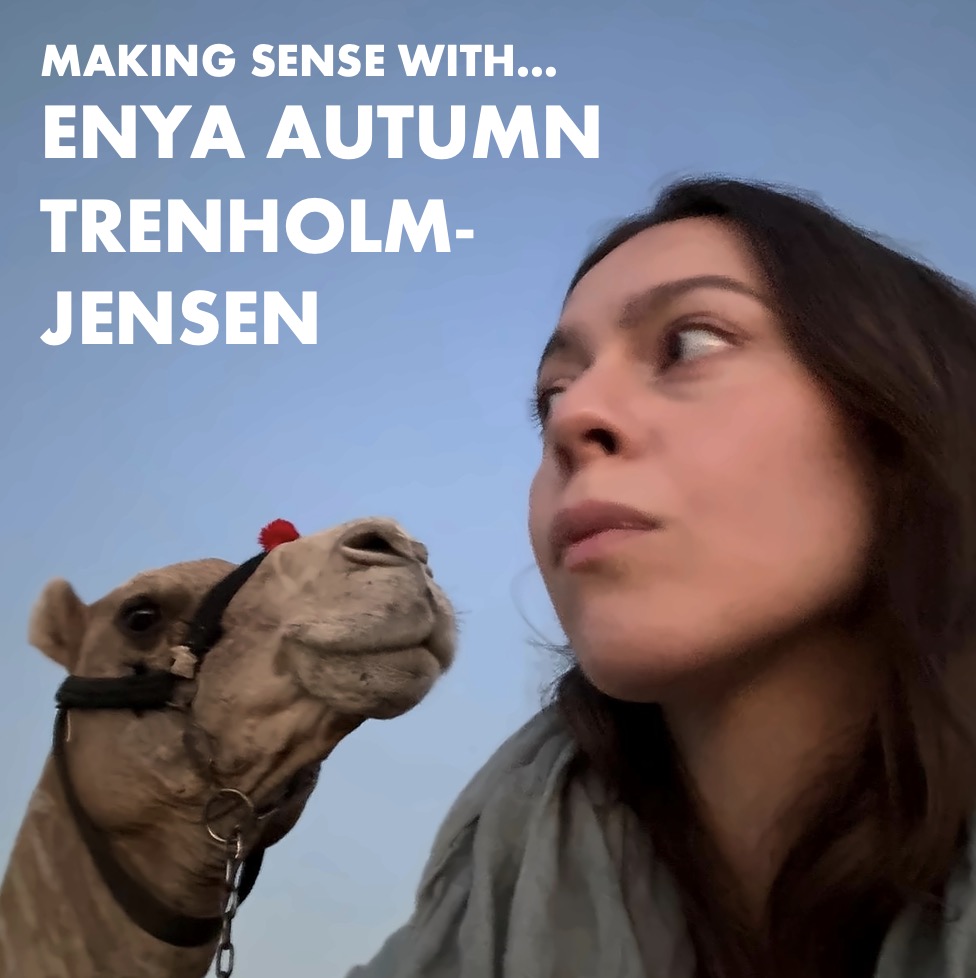
Photo courtesy of EATJ
What makes a semiotician tick? SEMIOVOX’s Josh Glenn has invited his fellow practitioners in the field of commercial semiotics, from around the world, to answer a few revealing questions.
Berlin…
SEMIOVOX
When you were a child/teen, how did your future fascination with symbols, cultural patterns, interpreting “texts,” and getting beneath the surface of daily life manifest itself?
ENYA AUTUMN TRENHOLM-JENSEN
Mostly through perpetual outsiderness. I moved and changed schools constantly as a kid, so I never really acquired a stable sense of “normal.” When something new appeared, I couldn’t immediately categorise it as normal or abnormal; I was lucky enough to get to sit with it and work out what it meant on its own terms.
SEMIOVOX
Describe your first encounter(s) with the theory and practice of semiotics.
ENYA AUTUMN TRENHOLM-JENSEN
I first encountered semiotics as an intern at Gemic, a global growth strategy agency. What hooked me was seeing what I had hitherto considered a hobby, operationalised into a practice of decoding meaning and generating insight. Until that point, I didn’t know there were jobs where you could be paid to think like that, which is precisely what led me to pursue a master’s in semiotics and cognitive science.
I speak English, Swedish, Danish, and a hopeful amount of French, but it wasn’t until I started speaking semiotics that I felt I could properly say anything. Once everything can be treated as a unit of meaning, you become perceptually fluent in a way that enables deeper, more dynamic thinking than with any other tool I’ve ever used.
SEMIOVOX
How did you find your own way to doing semiotics?
ENYA AUTUMN TRENHOLM-JENSEN
Fate! I found the aforementioned internship by googling “internship,” which introduced me to the practice and eventually landed me a job at Gemic.
SEMIOVOX
What are the most important attributes of a good semiotician?
ENYA AUTUMN TRENHOLM-JENSEN
A good semiotician should be observant, open, and democratic in their approach to meaning. Nothing is too small or too trivial to matter.
SEMIOVOX
What three books about semiotics have you found the most useful and enlightening in your own work?
ENYA AUTUMN TRENHOLM-JENSEN
To me, semiotics is more a lens for looking at other things than a subject studied for its own sake, so I don’t read many books purely about semiotics. These are a few books that shaped how I think:
- The Sociology of Consumption by [Australian sociologist] Peter Corrigan is a (speed)walk through the history that produced modern consumer culture. Beyond the consumption angle, what makes it particularly useful is the reminder that the everyday objects and habits we treat as natural are really just fossilised history, layers of the past compacted into the present. Semiotics starts from the same premise: nothing is inevitable, everything arrived from somewhere.
- Simulacra and Simulation by Jean Baudrillard has stayed with me partly because I love the concept of the simulacrum. His reading of Disneyland is one of the most satisfying acts of decoding I’ve ever encountered. If you ever get the chance, yes you, reader, visit Tropical Islands outside Berlin: an entire tropical resort simulated inside an ex-Luftwaffe aircraft hangar. Real flamingos wandering through artificial wetlands beneath a dome built for military engineering. The whole place feels like a perfect semiotic short circuit. Baudrillard would have had the time of his life…At least I did!
- HyperNormalisation, technically an Adam Curtis documentary rather than a book, though the concept comes from [Russian-born American anthropologist] Alexei Yurchak’s Everything Was Forever, Until It Was No More. The core idea is that in the late Soviet Union everyone knew the system was hollow, but nobody could imagine an alternative, so people continued performing belief until the performance itself became reality. If you want to understand how entire societies agree to read signs, it’s an extraordinary case study.
SEMIOVOX
When someone asks you to describe what you do, what is your “elevator pitch”? How do you persuade a skeptical client to take a chance on using this tool?
ENYA AUTUMN TRENHOLM-JENSEN
I usually just say I’m a cultural analyst. “Cultural” sounds interesting, “analyst” sounds serious, and together they leave people with the impression that I do cool things responsibly.
That’s generally enough for dinner parties, but with skeptical clients I start from the end product. I don’t use semiotics unless I genuinely think it will add value in answering the question they’re trying to answer, and often it does. If you begin with the outcome they want, you start in agreement. From there it becomes much easier to show that semiotics isn’t just an interesting methodology, but a practical tool for making sure you’re actually testing the right things.
SEMIOVOX
What specific sorts of semiotics-driven projects do you find to be the most enjoyable and rewarding?
ENYA AUTUMN TRENHOLM-JENSEN
A few years ago I worked on a project using semiotics to help create the perfect burger bun. I travelled across the US barbecuing with all types of different people, from award winning chefs to suburban moms and dads, decoding the cultural and sensory landscape around burgers along the way.
This project was predictably both enjoyable and rewarding but beyond the obvious appeal, what I loved was the chance to use semiotics on multiple levels simultaneously: culturally, spatially, commercially, and sensorially. Those are always the most satisfying projects, the ones where meaning is operating everywhere at once.
SEMIOVOX
What frustrates you about how semiotics is practiced and/or perceived, right now?
ENYA AUTUMN TRENHOLM-JENSEN
Generally speaking, probably the reflexive recoil from AI in parts of the field. I understand the anxiety, much of it is reasonable! But AI is two things at once: a new tool for doing the work, and a new source of the cultural output we study. So we should get good at using it and good at reading what it produces. A discipline built on meaning-making shouldn’t be the last to engage with a new engine of meaning, or at least things that look or sound meaningful. If anything, AI should push us semioticians toward both innovation and preservation; too much of either is its own kind of blindspot.
SEMIOVOX
What advice would you give to a young person interested in this sort of work?
ENYA AUTUMN TRENHOLM-JENSEN
Don’t look for the word “semiotics” in the job title; look for problems in need of semiotic answers. Once you find them, show the value of semiotic thinking rather than just describing it.
Read and travel widely, and stay curious about how meaning works wherever you go.
Talk to people in the field and try to find a great mentor. Thinking with someone else is one of the most beautiful things you can do.
MAKING SENSE series: MARTHA ARANGO (Sweden) | MACIEJ BIEDZIŃSKI (Poland) | BECKS COLLINS (England) | WHITNEY DUNLAP-FOWLER (USA) | IVÁN ISLAS (Mexico) | WILLIAM LIU (China) | SÓNIA MARQUES (Portugal) | CHIRAG MEDIRATTA (India / Canada) | SERDAR PAKTIN (Turkey / England) | MARIA PAPANTHYMOU (Greece / Russia) | XIMENA TOBI (Argentina) | & many more.
Also see these global semio series: MAKING SENSE (Q&As) | SEMIOFEST SESSIONS (monthly mini-conferences) | COVID CODES | SEMIO OBJECTS | COLOR CODEX | DECODER (fictional semioticians) | CASE FILE | PHOTO OP | MEDIA DIET | TATTOO YOU (semioticians’ tattoos).