

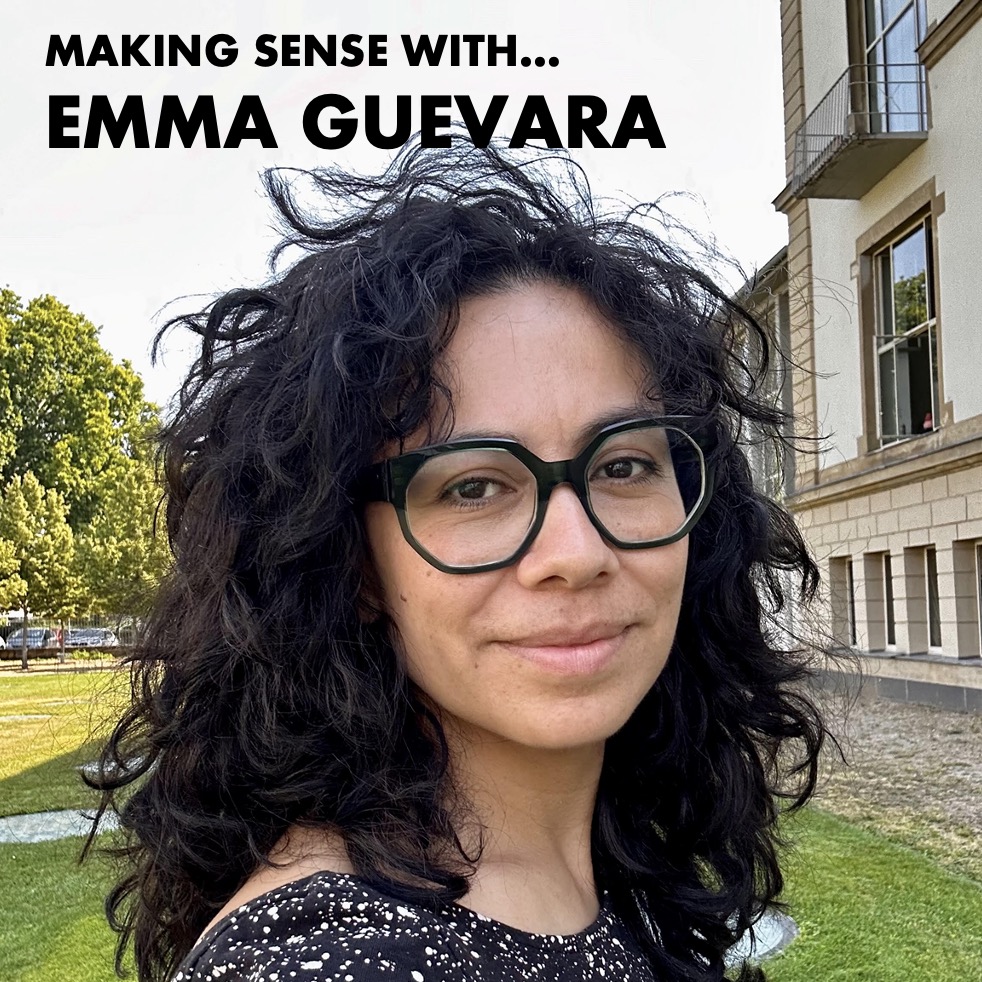
Photo courtesy of EG
What makes a semiotician tick? SEMIOVOX’s Josh Glenn has invited his fellow practitioners in the field of commercial semiotics, from around the world, to answer a few revealing questions.
Frankfurt am Main…
SEMIOVOX
When you were a child/teen, how did your future fascination with symbols, cultural patterns, interpreting “texts,” and getting beneath the surface of daily life manifest itself?
EMMA GUEVARA
Growing up jumping between two very different social classes in Latin America helped me develop an awareness for different meaning codings. I used to live with my mom in a working-class barrio and would visit my dad in the summer. At the time, it was so jarring to me how the same experiences or things were coded one way at my barrio school, and then so fundamentally differently in my dad’s wealthy circle.
But my first experience with formal decoding happened in front of the walls of my dad’s home. My father’s true passion was painting, though during my childhood, his days were largely consumed by running his editorial printing press. He often printed art books for renowned Ecuadorian artists, who would trade their art pieces for his work so his house became a living gallery. One evening, my father lined up my siblings and me in front of a piece and asked us, “What do you see?” I remember the thrill of that moment—I loved it. That exercise taught me the joy of intuitive interpretation. It made me aware of my passion for uncovering hidden narratives and looking beneath the surface of the immediate visual world.
SEMIOVOX
Describe your first encounter(s) with the theory and practice of semiotics.
EMMA GUEVARA
During my Bachelor’s in Cultural Anthropology in Frankfurt, I was already being introduced to semiotics, as it was inherently ingrained in the discipline. Later, during my Master’s in Cultural Studies, I learned the formal academic semiotic tools.
During all my years in Media and Content Marketing Strategy, I always had my cultural studies and semiotics goggles on. I guess that once they get put on you, you can’t get rid of them ever again! That perspective allowed me to look past marketing formulas and help craft better, culturally aligned brand voices and content pillars.
SEMIOVOX
How did you find your own way to doing semiotics?
EMMA GUEVARA
I worked in marketing strategy on the agency side, consultancy side, and then the client side for about eight years before deciding to pivot into market research. I always felt something was missing for me, and it was the depth found in insights work. I loved the moment in my projects when I felt we were truly understanding and connecting with consumers beyond KPIs. I wanted much more of it.
It was during this transition that I came into contact with formal commercial semiotics, through diverse formal trainings (one I found especially expansive was with Gemma Jones and Al Deakin) and through my current work. Now, my way of doing semiotics is informed by all of my experience so far. As an anthropologist, I feel especially drawn to looking at how meaning is created from the ground up—not solely focusing on the top-down. At the same time, my marketing strategy background taught me to look clinically close at the brand world and categories to capture the big business picture.
SEMIOVOX
What are the most important attributes of a good semiotician?
EMMA GUEVARA
Admiration for culture, a highly receptive radar for cultural expressions, and being able to articulate them so that others can read them too. If I had to choose just one, it would be admiration for the shaping, contesting, and reshaping of culture, and the dialogues involved in this process.
Brands are equally participants in that dialogue; they listen, respond, and sometimes they propose and can actively shape culture too. As a commercial semiotician, your job is to be a sharp observer and listener who can guide brands on when and how to authentically join the conversation.
SEMIOVOX
What three books about semiotics have you found the most useful and enlightening in your own work?
EMMA GUEVARA
While semiotics handbooks are good for learning about the techniques, I believe cultural reading is only possible by understanding the inner workings of culture. Three of the works that taught me to do this are:
- Stuart Hall’s Representation. This book was truly seminal in shaping my perspective. I loved the way Hall surfaced the power dynamics in media representation—how whoever holds the amplifier can shape social meaning and attitudes.
- Manuel Castells’ The Rise of the Network Society. I love the work of this Spanish sociologist. He helps you understand that digital platforms are not just spaces where people simply post content, but culture carriers that actively reproduce and amplify existing and changing social structures and ways of interaction.
- To add more diverse thinking into the mix, I want to mention the work of a seminal philosopher in Mexican humanities academia, a fellow Ecuadorian, Bolívar Echeverría. His book Defining Culture adds a new layer to semiology, and that is the layer of meaning across time. He demonstrates that honoring and reading the past is key to understanding current meaning. This is very important, if you ask me, when trying to understand cultural movements that seem to be echoes of the past, such as the current “trad wife” phenomenon or the rise of the “granny hobbies” revival among Gen Z.
SEMIOVOX
When someone asks you to describe what you do, what is your “elevator pitch”? How do you persuade a skeptical client to take a chance on using this tool?
EMMA GUEVARA
Today’s consumers are incredibly visually literate. Like never before, they don’t just consume visuals at an intense speed, they actively perform visually themselves, carefully curating how they appear online. Because of this, consumers possess an intuitive radar. They might not be able to name the exact cultural codes they are seeing and taking part in, but they know instantly when a brand’s communication feels natural, when it feels borrowed, or when it looks completely odd.
That is exactly why brands have to be more deliberate than ever about how they come across. Semiotics is the practice of surfacing, naming, and mapping out those underlying codes. By decoding what makes a visual choice feel authentic or jarring to an audience, brands can stop guessing and be intentional and, ideally, strategic. It gives us a blueprint to see how a cultural message will land before it is out there.
SEMIOVOX
What specific sorts of semiotics-driven projects do you find to be the most enjoyable and rewarding?
EMMA GUEVARA
My favorite projects are those where we are able to look beyond the obvious. For instance, I love landscape analyses where I have the freedom to look far beyond the client’s immediate category. It is gold when a client suddenly realizes that the cultural codes and dynamics playing out in an entirely different industry hold key answers to their own questions.
Also, I really like to add digital ethnography to the mix, actively observing how consumers interpret cultural trends visually or talk about them. Seeing how people organically negotiate these codes on the ground can unlock key insights.
SEMIOVOX
What frustrates you about how semiotics is practiced and/or perceived, right now?
EMMA GUEVARA
While I am thrilled to see semiotics finally gaining the recognition it deserves, I do worry about the side effects of this sudden popularity. As demand grows rapidly, there’s a risk of it leading to a wave of surface-level work, meaning people doing semiotics strictly by the handbook without the necessary cultural lifting.
But at the same time, this can hold some interesting developments; for instance, the differences and effects of superficial work vs. rigorous work will become more clear to the market.
SEMIOVOX
Peirce or Saussure?
EMMA GUEVARA
While I appreciate Saussure for the educational help his frameworks provide in explaining the layers of meaning, I ultimately favor Peirce. His work helps us much better understand the active instances involved in meaning-making, and it is far more fair to the organic, flowing nature of the meaning-making process.
SEMIOVOX
What advice would you give to a young person interested in this sort of work?
EMMA GUEVARA
Bring tons of curiosity, a willingness to have your eyes wide open to cultural expressions as these can be everywhere, and most importantly, admiration. Observing and decoding culture is beautiful; its hidden roots, sudden bifurcations, and internal tensions are so energizing.
No matter what the focus of your study is, bring admiration to the table. You are looking at complex human expression.
MAKING SENSE series: MARTHA ARANGO (Sweden) | MACIEJ BIEDZIŃSKI (Poland) | BECKS COLLINS (England) | WHITNEY DUNLAP-FOWLER (USA) | IVÁN ISLAS (Mexico) | WILLIAM LIU (China) | SÓNIA MARQUES (Portugal) | CHIRAG MEDIRATTA (India / Canada) | SERDAR PAKTIN (Turkey / England) | MARIA PAPANTHYMOU (Greece / Russia) | XIMENA TOBI (Argentina) | & many more.
Also see these global semio series: MAKING SENSE (Q&As) | SEMIOFEST SESSIONS (monthly mini-conferences) | COVID CODES | SEMIO OBJECTS | COLOR CODEX | DECODER (fictional semioticians) | CASE FILE | PHOTO OP | MEDIA DIET | TATTOO YOU (semioticians’ tattoos).