

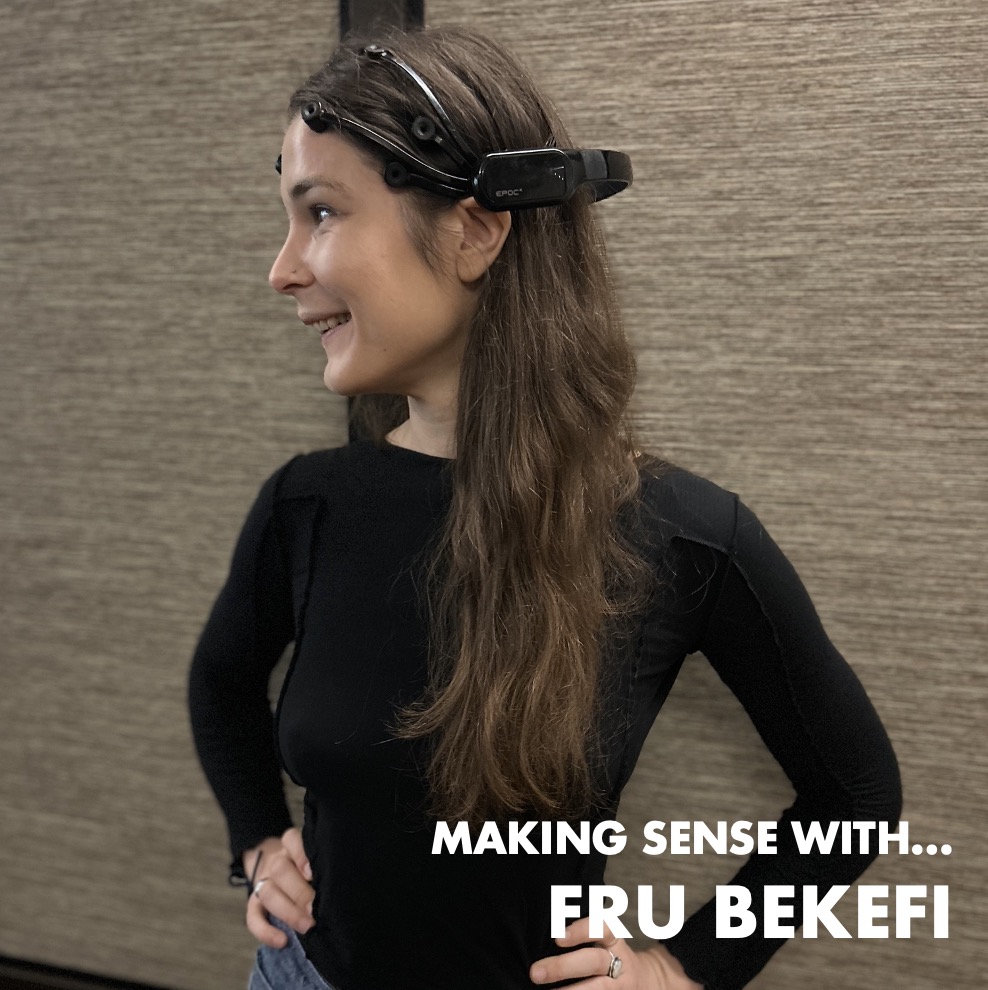
Photo courtesy of FB
What makes a semiotician tick? SEMIOVOX’s Josh Glenn has invited his fellow practitioners in the field of commercial semiotics, from around the world, to answer a few revealing questions.
London…
SEMIOVOX
When you were a child/teen, how did your future fascination with symbols, cultural patterns, interpreting “texts,” and getting beneath the surface of daily life manifest itself?
FRU BEKEFI
I’m a ’90s kid, born just on the cusp of the Iron Curtain’s unravelling. Coming of age in the shadow of one system while another one is being born was formative. So was growing up between Eastern Europe, North America, and the UK — because it meant that navigating different cultural codes and meaning systems was just a tacit part of life.
My upbringing gave me an early appreciation for nuance and just how polyphonic culture really is beneath the surface of dominant paradigms. Also an enduring fascination with myths, folklore, and multi-lingual puns. And it taught me about unreliable narrators, and how systems produce different versions of truth through an endless supply of intriguing f(r)ictions.
SEMIOVOX
Describe your first encounter(s) with the theory and practice of semiotics.
FRU BEKEFI
I studied art history and went on to specialise in fashion history. Interrogating the relationship between aesthetics and ideologies was a red thread throughout both my BA and MA. And it was what drew me to both degrees in the first place because they offered a structured way of making sense of the world. Studying fashion history with Dr. Rebecca Arnold was especially rewarding because she empowered her students to engage with how the sensory, emotional, cultural, and political are intertwined. This training continues to shape my approach.
SEMIOVOX
How did you find your own way to doing semiotics?
FRU BEKEFI
I read William Gibson’s Pattern Recognition on a whim. I was clueless about cyberpunk (and the world of cultural strategy for that matter) but the title spoke to me. The novel made such an impression that I ended up using it in my BA dissertation about how fashion designers addressed urban anxieties in the late ’90s and early 2000s. It’s amusing to see it feature in other colleagues’ origin stories; it’s a hyperstitional text in many ways. Fast-forward a couple of years and I started working with Chris Arning, which was my proper introduction to the world of applied semiotics. (Thanks Chris!)
SEMIOVOX
What are the most important attributes of a good semiotician?
FRU BEKEFI
Humility and curiosity. Both teach us to not jump to easy conclusions, to ask uncomfortable questions, and to translate our findings in ways that serve the research and the task at hand. And to keep honing our craft.
SEMIOVOX
What three books about semiotics have you found the most useful and enlightening in your own work?
FRU BEKEFI
Not all of these texts are about semiotics strictly speaking, but they have all shaped my relationship with the discipline.
- Reading [American art historian] Linda Nochlin’s The Politics of Vision was formative, especially her essay ‘The Imaginary Orient,’ because it taught me the importance of critically interrogating absence, not just presence, in cultural artefacts.
- [Dutch designer and researcher] Ruben Pater’s The Politics of Design is one of the funnest and most accessible, but also sharpest books on semiotics I’ve come across. I like to recommend it to people because it’s packed with great incisive studies that span typography, colour schemes, maps, and even representational technologies that are easy to take for granted like single-point perspective.
- Pharmako AI by [American artist and technologist] K Allado-McDowell, one of the first books co-written with AI, introduced me to the concept of Umwelts (the unique sensory worlds of different organisms) and to biosemiotics. I’m fascinated by the posthuman and how we might explore ways of sensing and communicating that evolve our established frameworks. Although some of this might sound abstract, the potential applications are exciting in practical terms too, especially in fields like medicine or ecological restoration and remediation.
SEMIOVOX
When someone asks you to describe what you do, what is your “elevator pitch”? How do you persuade a skeptical client to take a chance on using this tool?
FRU BEKEFI
I like to joke that I’m a professional alien and chronically curious human. But to make that a bit tangible: “I help clients connect the dots between emerging needs, values, and behaviours, evolving mythologies, and their strategic implications.” I’m grateful that I can explore a wide range of topics and challenges in my work but these days a lot of my focus is on sensory semiotics, regenerative culture, and posthuman aesthetics.
I tend to find that a potential client’s skepticism stems from previous bad experiences, or some sense of insecurity. So I always try to understand the problem from their perspective so I can grasp what they actually want and need.
SEMIOVOX
What specific sorts of semiotics-driven projects do you find to be the most enjoyable and rewarding?
FRU BEKEFI
Some of my favourite topics are the ones that make people feel deeply uncomfortable. When we interrogate social taboos, we can steer towards significant transformation, and I find that both exciting and rewarding.
I also love combining semiotics and futures work (another one of my specialisms). Semiotic insights can help us develop world logics and sensibilities in compelling ways.
SEMIOVOX
What frustrates you about how semiotics is practiced and/or perceived, right now?
FRU BEKEFI
I’m more excited than frustrated at the moment. The topics covered at Semiofest Warsaw, recently, for example, make me more optimistic about the discipline.
SEMIOVOX
What advice would you give to a young person interested in this sort of work?
FRU BEKEFI
Build a good archive and a regular sense-making practice for yourself early on! Good habits pay dividends in the long-run.
MAKING SENSE series: MARTHA ARANGO (Sweden) | MACIEJ BIEDZIŃSKI (Poland) | BECKS COLLINS (England) | WHITNEY DUNLAP-FOWLER (USA) | IVÁN ISLAS (Mexico) | WILLIAM LIU (China) | SÓNIA MARQUES (Portugal) | CHIRAG MEDIRATTA (India / Canada) | SERDAR PAKTIN (Turkey / England) | MARIA PAPANTHYMOU (Greece / Russia) | XIMENA TOBI (Argentina) | & many more.
Also see these global semio series: MAKING SENSE (Q&As) | SEMIOFEST SESSIONS (monthly mini-conferences) | COVID CODES | SEMIO OBJECTS | COLOR CODEX | DECODER (fictional semioticians) | CASE FILE | PHOTO OP | MEDIA DIET | TATTOO YOU (semioticians’ tattoos).