

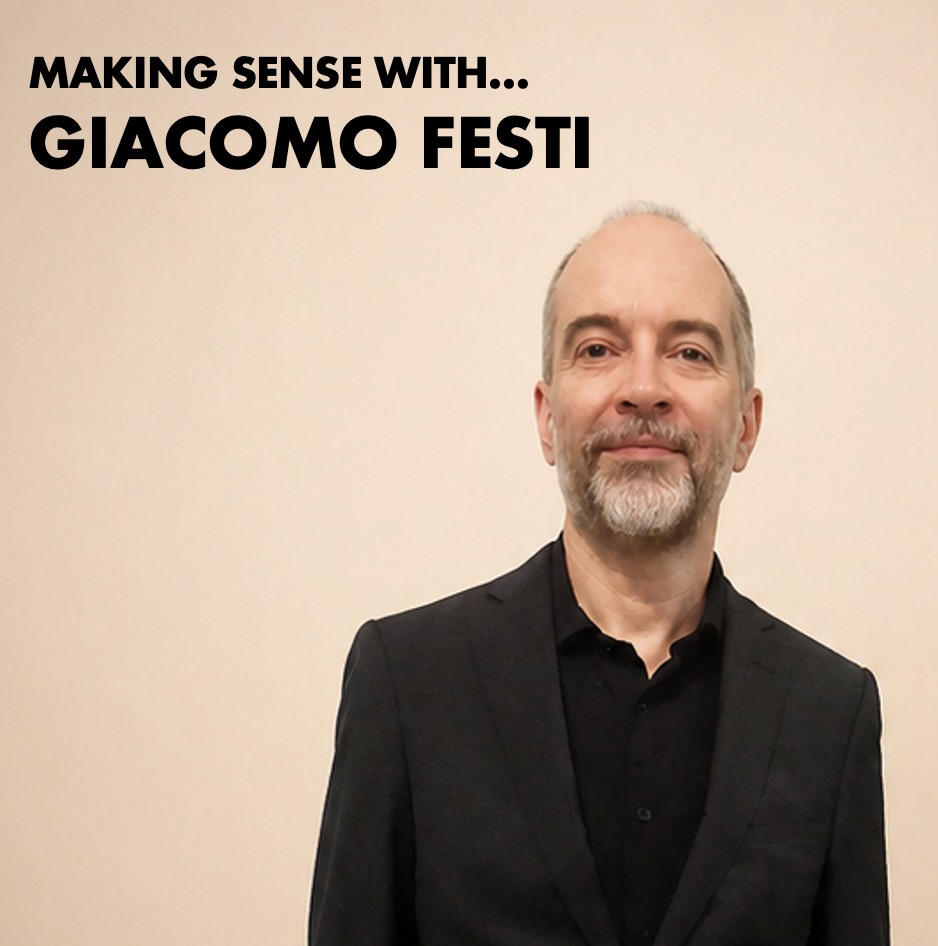
Photo courtesy of GF
What makes a semiotician tick? SEMIOVOX’s Josh Glenn has invited his fellow practitioners in the field of commercial semiotics, from around the world, to answer a few revealing questions.
Milan…
SEMIOVOX
When you were a child/teen, how did your future fascination with symbols, cultural patterns, interpreting “texts,” and getting beneath the surface of daily life manifest itself?
GIACOMO FESTI
I would split the original push toward semiotics into two concurrent feelings. On the one side an enthusiastic fascination with the enigma of meaning, with the complexity of entrapping narratives (in my case, between literature and cinema). On the other side, the tragic feeling of the paradoxes of meaning: “How is it possible we don’t sediment any meaning, learned from history, and we end up repeating ourself, for instance in term of being torturers?”
SEMIOVOX
Describe your first encounter(s) with the theory and practice of semiotics.
GIACOMO FESTI
Before starting university, the last year of secondary education invited me to deeply question languages. I started reading Umberto Eco’s books, and would later meet Eco at the university. Then I quickly encountered [Italian semiotician] Paolo Fabbri in a mind-blowing conference; he would become my tutor.
SEMIOVOX
How did you find your own way to doing semiotics?
GIACOMO FESTI
I enrolled in the newborn Science of Communication course at Bologna in 1993. It was the first edition of that course, deeply wanted by Eco—who was at that time responsible for the program, and who filled the curriculum with semiotic exams. I became so passionate that I did my thesis and then my PhD in Semiotics. Then I became a clericus vagantes, rather typical in Italy: underpaid university teaching contracts wherever in the north of the country, travelling a lot.
SEMIOVOX
What are the most important attributes of a good semiotician?
GIACOMO FESTI
Over time I’ve changed my opinion about this topic. Now I think that the hermeneutic stakes for every analysis/interpretation (the framing) are key attributes of a good semiotician: Always come back, reflexively, to the premises and the cultural background of a choice of whatever cultural object to be considered for the analysis. Only if the premises are good can you arrive at an interesting analytical insight.
Methodological control and cleanness of technical language are also paramount.
SEMIOVOX
What three books about semiotics have you found the most useful and enlightening in your own work?
GIACOMO FESTI
- [Italian semiotician] Pierluigi Basso Fossali’s La promozione de valori. Semiotica della comunicazione e dei consumi. Unrivaled quality in analysis of advertisements (also relevant for corpus analysis, with a rich chapter about perfumes and deodorants). A first attempt to go beyond Jean-Marie Floch’s square of valorization [or semiotic square of consumption values], a clarification about “promotion” as a strategic practice, very original ideas about the communicative identity of the brand in relationship to its visual identity as well, with an astonishingly good comparison between the signature and the logo.
- [French semiotician] Jacques Fontanille’s Figure del corpo. Per una semiotica dell’impronta. A theoretical masterpiece rewriting the grounding of the discipline in a more aware phenomenological rooting without renouncing the operational distinction between Expressions and Contents. Interesting analytical applications. I especially appreciated the analysis of Lars von Trier’s The Element of Crime. The chapter about the patina of object is a crucial one, for me, in my ongoing activities with designers.
- Fontanille’s Pratiques sémiotiques. I participated to the Italian translation of this book, finding the model of integration of different semiotic-objects so relevant for establishing research projects within the framework of the discipline, enriching the dialogue with other disciplines like ethnography and all the practice-based forms of knowledge.
SEMIOVOX
When someone asks you to describe what you do, what is your “elevator pitch”? How do you persuade a skeptical client to take a chance on using this tool?
GIACOMO FESTI
I once had a terrible experience trying to find a clever way to explain to someone what semiotics is.
When I was in Limoges, home of many semioticians, during my Erasmus, on the official “day of the crêpes,” there were three of us, all Italians, in a French bar. A semi-drunk men approached us after listening to us talking and asked what semiotics is. I looked around for an interesting sign and noticed a camel drawn with chalk on a blackboard. “What do you see there?” I asked him.
I triggered the worst flow of psychoanalytical associations, my question being read as a provocation. The man associated the camel to Africa, and from there to the war he’d been engaged in, and finally to the tragic loss of his wife. At the end of this long chain of associations, he stared at me and asked again, “So, what is semiotics?”
I was totally paralyzed, and promised myself that I’d never again attempt to explain semiotics to a stranger.
In most cases, I work with communication agencies — and it’s their job to persuade the client, not mine. Whenever it is up to me to explain, though, I emphasize relevant differences that can be enlightened by semiotics — and let the client think about the consequences of considering the weight of those differences. You have to improvise using materials that refer to the specific case.
SEMIOVOX
What specific sorts of semiotics-driven projects do you find to be the most enjoyable and rewarding?
GIACOMO FESTI
I appreciate working with challenging corpuses provided by the client, asking you to mobilize all the conceptual tools and categories that can assist in discovering and displaying patterns.
I also like when a project is set up in a preliminary phase, where alternatives have to be considered and constructed, emphasizing the idea that semiotics is a science of possibilizations, feeding creativity. Imagining directions where to exercise the creative side is so exciting.
SEMIOVOX
What frustrates you about how semiotics is practiced and/or perceived, right now?
GIACOMO FESTI
We are in a historical moment of transition, as far as the semiotic presence in academia is concerned. Frustration coexists with fresh hope, observing a qualified new generation of researchers. As far as the negative side is concerned, we should differentiate between academic and professional contexts. I can talk about the academic side.
En passant, I would say that LLM might resolve, potentially and provocatively, several frustrating flaws in quality that the semiotic research and publications present at the moment. Too many pure cv-related publications (especially in Italy), only to build a career: that’s a major limit of the academization of the discipline, impacting on the quality of it. Absence of clear corpus, unclarity of the theoretical reference models, poor interpretative outcomes, mechanical application of tools, these are typical issues in contemporary semiotic publications.
The huge question today is how much semiotics is able to create credible research projects, with other disciplines, that could have relevant hermeneutic outcomes. The virtuous example of this is the research about autism conducted by the Bologna research group, guided by [Italian semiotician] Claudio Paolucci.
SEMIOVOX
Peirce or Saussure?
GIACOMO FESTI
So simple the answer: Peirce and Saussure, with different roles.
Per the discussion (L’efficacia semiotica. Risposte e repliche) that Paolo Fabbri started in 2017, we know that in Peirce we can hardly find a model of enunciation or narrative ideas, yet it is also true that the American thinker is crucial if we want to integrate a cognitive dimension in the semiotic theory.
Saussure is substantially the first to clearly elaborate the paradox of approaching the duality of meaning: its materialization and the immaterial side of it, both as relevant. Saussure has to be filtered by Hjelmslev first and generations of semioticians later (Greimas, above all) to move from signified vs. signified to expressions and contents and from signs to textuality and (today) practices.
SEMIOVOX
What advice would you give to a young person interested in this sort of work?
GIACOMO FESTI
Here in Italy, we don’t have any canonical path to become a semiotician or someone working in the field of marketing consultancy with a semiotic-oriented approach. So the only advice is to be fully prepared at the academic level — for instance trying a PhD, in order to be ready in case you have the opportunity to start desk work.
MAKING SENSE series: MARTHA ARANGO (Sweden) | MACIEJ BIEDZIŃSKI (Poland) | BECKS COLLINS (England) | WHITNEY DUNLAP-FOWLER (USA) | IVÁN ISLAS (Mexico) | WILLIAM LIU (China) | SÓNIA MARQUES (Portugal) | CHIRAG MEDIRATTA (India / Canada) | SERDAR PAKTIN (Turkey / England) | MARIA PAPANTHYMOU (Greece / Russia) | XIMENA TOBI (Argentina) | & many more.
Also see these global semio series: MAKING SENSE (Q&As) | SEMIOFEST SESSIONS (monthly mini-conferences) | COVID CODES | SEMIO OBJECTS | COLOR CODEX | DECODER (fictional semioticians) | CASE FILE | PHOTO OP | MEDIA DIET | TATTOO YOU (semioticians’ tattoos).