

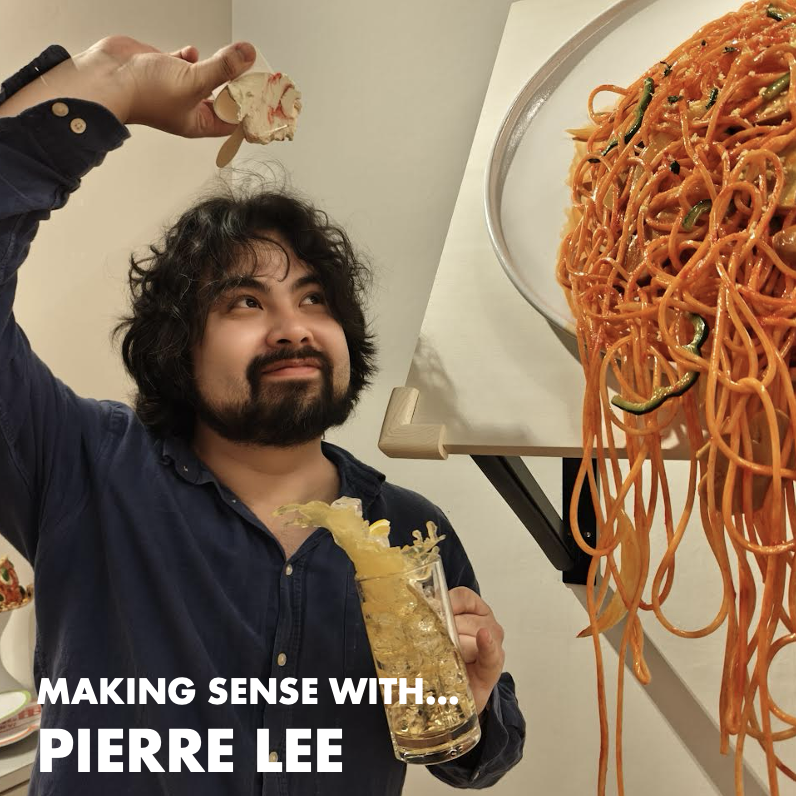
Photo courtesy of PL
What makes a semiotician tick? SEMIOVOX’s Josh Glenn has invited his fellow practitioners in the field of commercial semiotics, from around the world, to answer a few revealing questions.
Toronto…
SEMIOVOX
When you were a child/teen, how did your future fascination with symbols, cultural patterns, interpreting “texts,” and getting beneath the surface of daily life manifest itself?
PIERRE LEE
I grew up in a French-Singaporean family, so cross-cultural context was ingrained into my everyday from a very young age. From different ways of expressing love, success, and curiosity, to differing opinions on the same piece of homework, I was very privileged to be exposed to a wide spectrum of ways of seeing, thinking through and experiencing daily life. And most importantly, understanding that one point of view was not superior to another.
SEMIOVOX
Describe your first encounter(s) with the theory and practice of semiotics.
PIERRE LEE
Formally, I was introduced to semiotics through the consulting world — first at Gemic, then at Space Doctors. I appreciated how semiotics was a great complement to interviews and ethnographic fieldwork. In certain ways, it gives an abstract idea of culture a more material form and feel. What became frustrating was when semiotics (especially codes) was presented in extremely “heady” or abstract language which not only nullifies its value, but makes semiotics feel unapproachable. Yes, semiotics and cultural analysis allow us to reveal what people might not be able to articulate in words, but its role should be to contextualise and clarify, without conceit.
SEMIOVOX
How did you find your own way to doing semiotics?
PIERRE LEE
I was brought into Space Doctors by a former client of mine, Michael Thomas, to whom I am eternally grateful. In many ways, I feel like I am still semiotics-adjacent — there are facets of semiotics work like pack design and expression that are definitely not my forte, and I try to pick up as much as I can through my amazing colleagues. All to say, I am still relatively new in the world of semiotics so in my practice of it, I try to be as much of an “observer” as a “do-er”.
SEMIOVOX
What are the most important attributes of a good semiotician?
PIERRE LEE
To not (only) think of yourself as one. That may be unhelpful at best to some, but in my personal experience, semiotics, cultural analysis, and ethnography are all different, intersecting ways to interpret the world around us. And sometimes labels or titles become limiting. Regardless of title, a core attribute should be the ability to make abstract ideas and observations clearer, without losing the rigour or wonder of whatever initial ideas you had in the first place.
SEMIOVOX
What three books about semiotics have you found the most useful and enlightening in your own work?
PIERRE LEE
Riffing off the semiotics-adjacent theme, none of these books are foundational “semiotics” books per se, but they have shaped my way of thinking and approaching the world and my practice.
- Gaston Bachelard’s The Poetics of Space. I picked a copy up in a wheelbarrow book sale while at university, and it has been one of my best chance finds. Bachelard really emphasises the need to surface the “feeling” and “being in” a space when analysing it. His thoughts are poetic but grounded in everyday experience, not floating in abstract theory — which is something that I try to achieve in my work. Plus, he gives a beautiful explanation (which I’ve used as an excuse on more than one occasion) for why you can step into a room and immediately forget why you entered it in the first place.
- [British archaeologist] Ian Hodder’s Entanglement. Recommended by a then-partner when we were both studying heritage and archaeology. Hodder’s definition of entanglement as the intersection of “humans depend on things”, “things depend on other things”, and “humans depend on other humans” really helps shift away from purely subject- or object-oriented approaches. There is relationality, messiness, and entanglement not just in spaces and rituals, but across time. What he helped me think through was that even seemingly enduring concepts like connection, trust or indulgence change in meaning and expression over time, which has been crucial because so many projects focus on these themes.
- [American journalist] Bianca Bosker’s Get the Picture. A very recent book but I picked it because Bosker has helped clarify a lot of thoughts around different ways of seeing and experiencing art. She writes with wit, depth, and empathy, and her motto of deep and messy immersion over casual observation is something which resonates deeply with me. Art and ‘the eye’ are very associated with semiotics, and Bosker artfully reveals another facet of the “high-end art is a vacuum” observation — the dust, the annoying noise, the filters which work only to a point before being clogged, and how everyone in one way or another gets sucked into this wondrous world.
SEMIOVOX
When someone asks you to describe what you do, what is your “elevator pitch”? How do you persuade a skeptical client to take a chance on using this tool?
PIERRE LEE
Different answers for different people, but it always revolves around the idea of unpacking culture through the lens of people, places, and practices. For skeptical clients, I find that it helps to give them an approachable example of how we think about or approach a challenge differently — relating it to something that happens in their everyday life. An example I sometimes use is “fresh coffee”. Coffee in many ways expresses the opposite of what we would traditionally associate with fresh — the beans are roasted, not a fresh pod, coffee we buy is often weeks or months-old after harvest, and we grind it up instead of keeping it whole. Yet we say “fresh cup of coffee” to start the morning — all to show that our rituals and everyday experiences can contradict our notions or associations around a topic. And it is semiotics which helps reveal those fun contradictions.
SEMIOVOX
What specific sorts of semiotics-driven projects do you find to be the most enjoyable and rewarding?
PIERRE LEE
Food and placemaking. Food because it allows us to think about cues beyond the visual and verbal — the smells, the gestures, the tastes. My colleagues’ work with sensory semiotics was a highlight of my time at Space Doctors, and it complemented my previous experience working part-time in a professional fine-dining kitchen. Placemaking because it gives our projects a more concrete anchor — not just connecting brands or a category (e.g. CPG) to wider shifting cultural drivers, but thinking about how the role of a space — be it a room in a home, the home itself, a public space, a city — gives a product and/or experience a (different) sense of place and meaning. And it re-connects me to my Human Geography roots.
SEMIOVOX
What frustrates you about how semiotics is practiced and/or perceived, right now?
PIERRE LEE
I feel like I covered this above — the abstraction and perceived ‘headiness’ does the practice a disservice. Additionally, I would love for more organisations to think of semiotics and respondent interviews / ethnographic fieldwork as complementary approaches — both client- and the agency-side.
SEMIOVOX
What advice would you give to a young person interested in this sort of work?
PIERRE LEE
Do not let methodology constrain you and make sure to explore the widest spectrums and edges of your interest in any way that you can. Also, find an avenue to escape your thoughts. Being ‘in your head’ can be a consequence of this work, so find something tactile – scrapbooking, crafting, sports, cooking – to channel and/or release those swirling thoughts.
MAKING SENSE series: MARTHA ARANGO (Sweden) | MACIEJ BIEDZIŃSKI (Poland) | BECKS COLLINS (England) | WHITNEY DUNLAP-FOWLER (USA) | IVÁN ISLAS (Mexico) | WILLIAM LIU (China) | SÓNIA MARQUES (Portugal) | CHIRAG MEDIRATTA (India / Canada) | SERDAR PAKTIN (Turkey / England) | MARIA PAPANTHYMOU (Greece / Russia) | XIMENA TOBI (Argentina) | & many more.
Also see these global semio series: MAKING SENSE (Q&As) | SEMIOFEST SESSIONS (monthly mini-conferences) | COVID CODES | SEMIO OBJECTS | COLOR CODEX | DECODER (fictional semioticians) | CASE FILE | PHOTO OP | MEDIA DIET | TATTOO YOU (semioticians’ tattoos).