

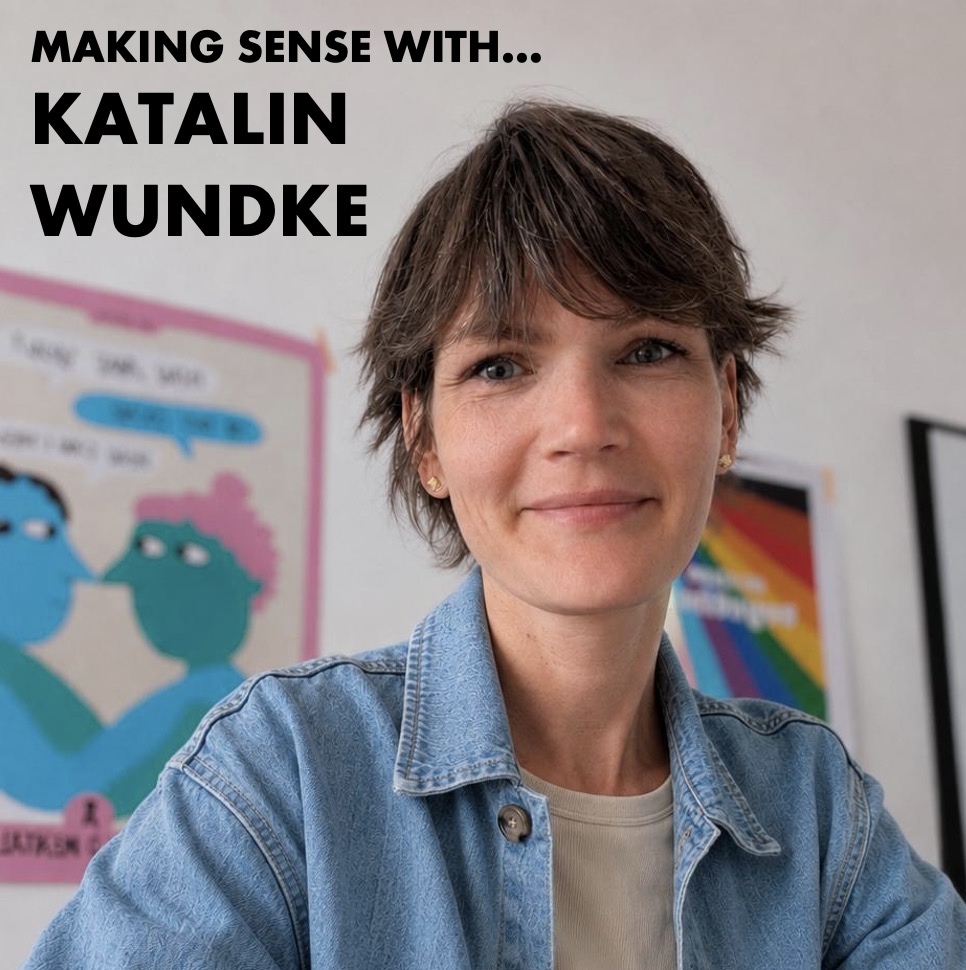
Photo courtesy of KW
What makes a semiotician tick? SEMIOVOX’s Josh Glenn has invited his fellow practitioners in the field of commercial semiotics, from around the world, to answer a few revealing questions.
Berlin…
SEMIOVOX
When you were a child/teen, how did your future fascination with symbols, cultural patterns, interpreting “texts,” and getting beneath the surface of daily life manifest itself?
Katalin wundke
My earliest awareness of meaning systems probably comes from my family background. We moved from the former GDR to West Germany after the fall of the Wall, so as a child I had a strong sense that different environments carry different systems of meaning.
Later, when we were living in a new housing development in a small suburb in Bavaria, I spent long, quiet, unstructured afternoons. Around the age of 13 or 14, I began spending my pocket money on lifestyle magazines. I would decode fashion spreads, photo shoots, and campaign images by theme and composition, and rearrange them into new sets of my own. In a way, I was creating my own codebook, which felt like a fun activity back then, though I wouldn’t have called it that at the time.
Around the same time, I started writing short stories and worked closely with dictionaries and thesaurus to make sure I was conveying exactly the meaning I intended, while also building the right atmosphere. Exploring the nuances and connotations of the words felt deeply satisfying.
SEMIOVOX
Describe your first encounter(s) with the theory and practice of semiotics.
Katalin wundke
Semiotics wasn’t a clearly defined concept for me at first. I studied English literature and linguistics, so I encountered Saussure and the idea of the sign, but it didn’t really click at the time.
What did resonate with me was postmodern literature. I was fascinated by the deconstruction of meaning and the idea that texts could hold multiple, unstable interpretations.
SEMIOVOX
How did you find your own way to doing semiotics?
Katalin wundke
I was first introduced to semiotics in practice towards the end of my studies, when I joined the Cultural Insight team at Added Value (AV). Before that, I had been working with the AV Brand Strategy team as a student, and a colleague encouraged me to apply.
What drew me in was the opportunity to dive deeply into cultural fields and themes, and to explore how meaning is constructed and expressed in different ways.
Above all, it satisfied my broader curiosity to explore and understand culture.
SEMIOVOX
What are the most important attributes of a good semiotician?
Katalin wundke
The most essential attribute is an awareness of how meaning is constructed.
Curiosity is undoubtedly essential, as several of the people interviewed previously have pointed out. Beyond that, a good semiotician needs the ability to connect the dots and weave a coherent analysis out of diverse, often fragmented material.
I also think good semioticians need a strong and precise way with words, because how you name something shapes how others understand it.
SEMIOVOX
What three books about semiotics have you found the most useful and enlightening in your own work?
Katalin wundke
For a long time, I wasn’t someone who read semiotics in a very canonical or systematic way. I tend to draw more broadly from literature, cultural theory, and postmodern writing. So, I’d like to point to two books first that sharpened my sense of how meaning is produced, destabilized, and negotiated in culture.
- Paul Auster’s The New York Trilogy. (Originally: City of Glass, Ghosts, and The Locked Room.) Auster plays with authorship, identity, and narrative structure in a way that constantly destabilizes meaning. For me, it’s a reminder that interpretation is never fixed.
- Michael Cunningham’s The Hours. The novel layers time, perspective, and intertextual references in a way that heightens sensitivity to atmosphere and nuance.
- Recently, I returned to Daniel Chandler’s Semiotics: The Basics while preparing a presentation. It’s been especially useful in structuring and explaining semiotics in a clear and accessible way, particularly for colleagues or clients less familiar with the approach.
SEMIOVOX
When someone asks you to describe what you do, what is your “elevator pitch”? How do you persuade a skeptical client to take a chance on using this tool?
Katalin wundke
Because “semiotics” can sound abstract, I usually start by saying, “I work in qualitative market research, but with a focus on cultural context rather than consumer interviews. I look at how culture shapes what people perceive, value, and ultimately buy.”
To make it more tangible, I often use familiar concepts such as “naturalness” or “sportiness” to show how they can take on different meanings and forms of expressions. That usually helps clients understand why it’s valuable to understand the deeper cultural layers shaping their category.
SEMIOVOX
What specific sorts of semiotics-driven projects do you find to be the most enjoyable and rewarding?
Katalin wundke
I am very drawn to deep analytical work. I enjoy immersing myself in a topic and developing a nuanced understanding of its many facets. I find it especially rewarding when this leads to a genuine moment of insight for the client.
SEMIOVOX
What frustrates you about how semiotics is practiced and/or perceived, right now?
Katalin wundke
I feel that especially in Germany, there is still a certain skepticism toward non-consumer, non-numbers-based methods. Semiotics is sometimes perceived as too abstract or too “soft”, even though it can uncover cultural dynamics that are highly relevant strategically.
I would like to see more openness to interpretive methods as a legitimate part of research and strategy.
SEMIOVOX
What advice would you give to a young person interested in this sort of work?
Katalin wundke
Immersion comes first for me. Expose yourself to culture in every possible way. Read, watch, listen, observe…
And then practice: Interpretation is a skill you develop over time by actively engaging with texts, images, and environments, and by constantly questioning what they mean and how that meaning is constructed.
MAKING SENSE series: MARTHA ARANGO (Sweden) | MACIEJ BIEDZIŃSKI (Poland) | BECKS COLLINS (England) | WHITNEY DUNLAP-FOWLER (USA) | IVÁN ISLAS (Mexico) | WILLIAM LIU (China) | SÓNIA MARQUES (Portugal) | CHIRAG MEDIRATTA (India / Canada) | SERDAR PAKTIN (Turkey / England) | MARIA PAPANTHYMOU (Greece / Russia) | XIMENA TOBI (Argentina) | & many more.
Also see these global semio series: MAKING SENSE (Q&As) | SEMIOFEST SESSIONS (monthly mini-conferences) | COVID CODES | SEMIO OBJECTS | COLOR CODEX | DECODER (fictional semioticians) | CASE FILE | PHOTO OP | MEDIA DIET | TATTOO YOU (semioticians’ tattoos).