

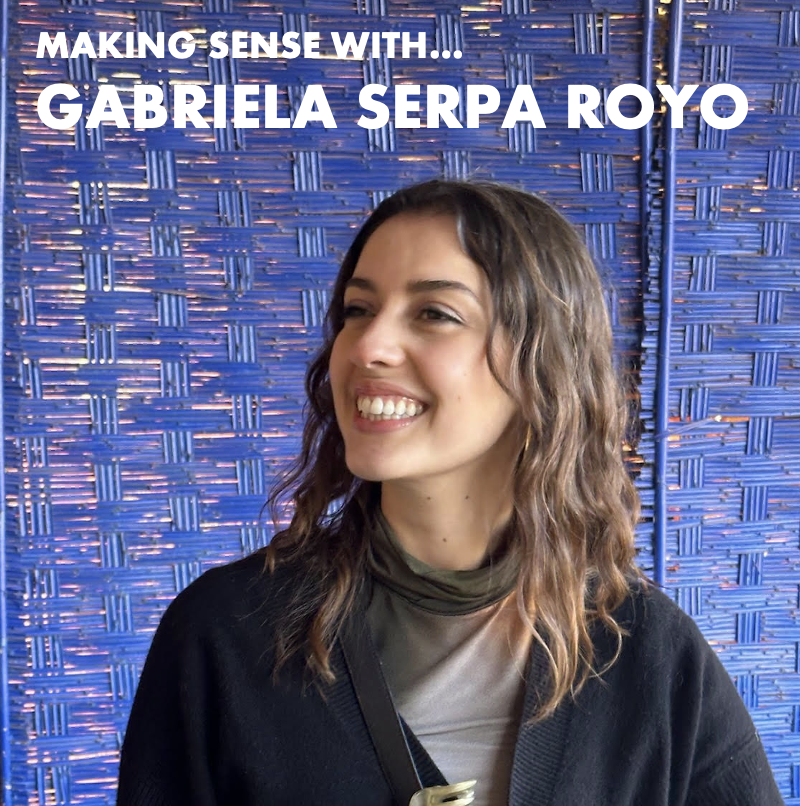
Photo courtesy of GSR
What makes a semiotician tick? SEMIOVOX’s Josh Glenn has invited his fellow practitioners in the field of commercial semiotics, from around the world, to answer a few revealing questions.
London…
SEMIOVOX
When you were a child/teen, how did your future fascination with symbols, cultural patterns, interpreting “texts,” and getting beneath the surface of daily life manifest itself?
GABRIELA SERPA ROYO
My parents are Colombian, and when they got married, they moved to the U.S. so my dad could learn English. I was born while he was still learning, so he and I were learning the cultural codes of our environment at the same time — which set a precedent for how I navigate the world. Growing up in a melting-pot environment, that normalized (and quite frankly, demanded) constant adaptation made cultural translation my way of life.
I also went to French school from the age of three. So growing up in New York, I was speaking Spanish at home, French at school, and surrounded by English everywhere else. I was constantly making sense of different cultures, languages, and ways of seeing the world, long before I was even conscious of doing it.
The thing about growing up between cultures is that you’re not just translating language, you’re translating behavior. The customs we had at home weren’t necessarily the same as those of the Americans around me, or what was expected of me at French school. So getting beneath the surface of things wasn’t really a conscious fascination as much as it was how I learned to navigate the world. Observing, interpreting, and code-switching was my modus operandi.
My parents tell a story that speaks to this. When I started French school at three, I didn’t speak a single word at school for the first month. Not in French, not in English. My teachers actually called home to ask if I had an undisclosed disability. My parents were baffled, because I’d get home everyday and list out everything that we’d done, and everything that I had seen at school. I didn’t start speaking until a few months in. My family likes to joke that once I finally did start, I never stopped.
Looking back on that story, I think it’s quite telling. I’ve always been someone who observes and absorbs things before jumping in. I like to understand the environment I’m in, the people around me, and the unspoken rules at play before participating. And I think that’s ultimately what led me to semiotics, cultural insights, and cultural strategy. I can’t help but observe how people behave, pick up on signs and patterns, and read between lines. It’s how I’ve always made sense of the first.
SEMIOVOX
Describe your first encounter(s) with the theory and practice of semiotics.
GABRIELA SERPA ROYO
During my first year at NYU as a Media, Culture, and Communications major, I had to take a semiotics class as part of the core curriculum. I loved painting and sculpting, and I grew up in a very artistic household. My mom has an art gallery, so art was always a big part of my life. But at the same time, I was also drawn to literature, psychology, and the more analytical side of things. I’d always felt a tension between my love of aesthetics and my desire to engage with ideas on a deeper, more intellectual level. So semiotics felt like this perfect combination of my artistic sensibilities and my analytical disposition. It just felt very me, giving me a framework for bringing together things I’d always been interested in but hadn’t necessarily thought of as belonging together.
What I didn’t love, though, was how difficult academic semiotics could be to ground. Even then, I was quite aware of how esoteric it could feel and I wasn’t entirely convinced of its commercial applicability, at least as an isolated methodology and in the way it was being taught to me at the time. Obviously, commercial and academic semiotics can be quite different, and I’ve since focused on the commercial side of things.
SEMIOVOX
How did you find your own way to doing semiotics?
GABRIELA SERPA ROYO
I was walking down the street one day when I ran into a friend of a friend, and one thing led to another, and I accidentally ended up crashing his Tinder date. The Tinder date started asking me questions about myself, what I’d studied, what I was interested in, and what I wanted to do next. As I was telling him about my interests, he said, “Have you ever heard of this company called Flamingo? It sounds exactly like what you’re describing.” It had never really occurred to me that I could become a semiotician or work in cultural strategy. I wasn’t even entirely aware that those were career paths! But the stars aligned that day because Flamingo, which at the time was one of the leading cultural insights agencies in the world, had just opened applications for internships. I applied that same day, got the internship, and started working there straight out of my Master’s. I ended up specializing in semiotics.
SEMIOVOX
What are the most important attributes of a good semiotician?
GABRIELA SERPA ROYO
Accessibility and strategic thinking.
I’ve encountered a lot of semioticians who are ridiculously intelligent and knowledgeable, but who are so cerebral and academic in their approach that they kind of miss clients entirely. If you can take really complex ideas and make them easy to understand, you’ve already done more than most semioticians.
But if you can go beyond that, and say “OK, here’s what these signs are telling us, but more importantly, here’s what you can do with that information,” you’ve hacked it. A great semiotician can tell a client what the signs mean for their strategy, their positioning, and their bottom line.
SEMIOVOX
What three books about semiotics have you found the most useful and enlightening in your own work?
GABRIELA SERPA ROYO
Most of what I’ve learned has come from experimenting and thinking creatively. Whether exploring cultural content online, studying case studies, or getting exposure to other semioticians behind the scenes, learning on the job can be much more dynamic than reading books.
Of course, it’s important to understand where semiotics came from, but for me, the interesting question isn’t what the gold standard was when the discipline first emerged, but how we can take those principles and push them forward. How can we design something bespoke for a brand that actually answers its questions, rather than applying an established framework because that’s how it’s always been done?
When I think about books that have shaped my understanding of semiotics, my mind goes to The Great Gatsby, which I read in high school. I remember being fascinated by the symbolism of the Valley of Ashes and the eyes on the optician’s billboard, which took on this almost godlike sense of judgment. I was struck by how much meaning could be communicated through something as simple as a landscape or a billboard, even if I didn’t have the language of semiotics to describe it yet.
SEMIOVOX
When someone asks you to describe what you do, what is your “elevator pitch”? How do you persuade a skeptical client to take a chance on using this tool?
GABRIELA SERPA ROYO
Semiotics is just one of the tools in my toolkit. I do foresight work, trends, etc. Fundamentally, I’m a cultural strategist, but at dinner parties, where people always ask me what that means, I’ve resorted to calling myself a “cultural translator for brands.” And I am! Because I look at the world, from micro and macro trends to signs, symbols, and cultural texts, and make sense of what it tells us about how people think, feel, and behave. Then I distill that analysis into something brands can actually understand.
I controversially think that client skepticism is often justified when it comes to semiotics. Semio can be a hard sell when it’s presented as a purely academic exercise with no clear strategic application. So I always sell strategic semiotics. For me, identifying cultural codes is only half the work. The other half is translating those findings into tangible business implications.
I position myself as a bridge between the nuanced world of human emotion and cultural meaning and the practical world of business strategy. And that’s how I’ve won projects against semioticians with far more experience than me, including people who’ve written books on the subject. Rather than leading with the methodology, I lead with the client’s problem. What are you trying to solve, and how can semiotics help you solve it?
SEMIOVOX
What specific sorts of semiotics-driven projects do you find to be the most enjoyable and rewarding?
GABRIELA SERPA ROYO
Rather than just looking at a category or comparing brands, I really enjoy projects that look at culture more holistically. For example, a multi-method project where we’re not only analyzing the visual language of brands within a category, but also exploring the visual codes of different demographics and the wider cultural world they inhabit.
These projects tend to be more complex, but I find them so much more rewarding because you’re looking at an entire ecosystem of meaning rather than hyper-fixating on a specific angle. It allows you to really immerse yourself in a cultural world, which is not only incredibly valuable for the client, but also genuinely exciting from a research perspective.
SEMIOVOX
What frustrates you about how semiotics is practiced and/or perceived, right now?
GABRIELA SERPA ROYO
In a world where everything is increasingly data-driven, there’s this unspoken insecurity around semiotics being more of an art than a quote-unquote science. That insecurity sometimes leads people to gate-keep semiotics, wrapping it in this mystique that makes it seem like some kind of magic that can’t really be explained.
Perhaps the intention is to elevate the discipline, but it does the opposite. It can make semiotics seem a bit woo-woo and difficult for clients to grasp, when in reality it’s an immensely valuable tool that complements conventional market research beautifully. Where surveys can tell us what people say they think, semiotics can read between the lines and uncover meanings that people might not even be consciously aware of.
SEMIOVOX
Peirce or Saussure?
GABRIELA SERPA ROYO
Pierce is my guy. His whole thing is about how meaning is constantly being interpreted and reinterpreted, which really resonates with how I approach semiotics. Signs are dynamic and evolved. Systems aren’t fixed.
SEMIOVOX
What advice would you give to a young person interested in this sort of work?
GABRIELA SERPA ROYO
If you’re interested in this sort of work, chances are you’ve already got that semiotic spark. I’ve hardly met a semiotician who wasn’t, in some way, always a semiotician, just without having the language for it.
Of course, there’s a learning curve, but I think so much of being a good semiotician comes down to trusting your unique perspective. You can read all the books you want, but at some point, you just have to jump in and start analyzing the world around you. Treat it like a creative practice. It’s a bit like English literature: what’s your interesting take on something? How can you back it up? What research can you bring in to support your interpretation? Semiotics is fundamentally an act of deep analysis, but it’s also an art form. So practice your art!
I’d also encourage people not to think of semiotics as an isolated career path. There are plenty of cultural insights, strategy, and marketing agencies where semiotic thinking is incredibly valuable. If you’re drawn to semiotics, chances are you’re drawn to cultural work more broadly. Don’t feel like it has to be semiotics or nothing.
MAKING SENSE series: MARTHA ARANGO (Sweden) | MACIEJ BIEDZIŃSKI (Poland) | BECKS COLLINS (England) | WHITNEY DUNLAP-FOWLER (USA) | IVÁN ISLAS (Mexico) | WILLIAM LIU (China) | SÓNIA MARQUES (Portugal) | CHIRAG MEDIRATTA (India / Canada) | SERDAR PAKTIN (Turkey / England) | MARIA PAPANTHYMOU (Greece / Russia) | XIMENA TOBI (Argentina) | & many more.
Also see these global semio series: MAKING SENSE (Q&As) | SEMIOFEST SESSIONS (monthly mini-conferences) | COVID CODES | SEMIO OBJECTS | COLOR CODEX | DECODER (fictional semioticians) | CASE FILE | PHOTO OP | MEDIA DIET | TATTOO YOU (semioticians’ tattoos).