

Kalinga Redox
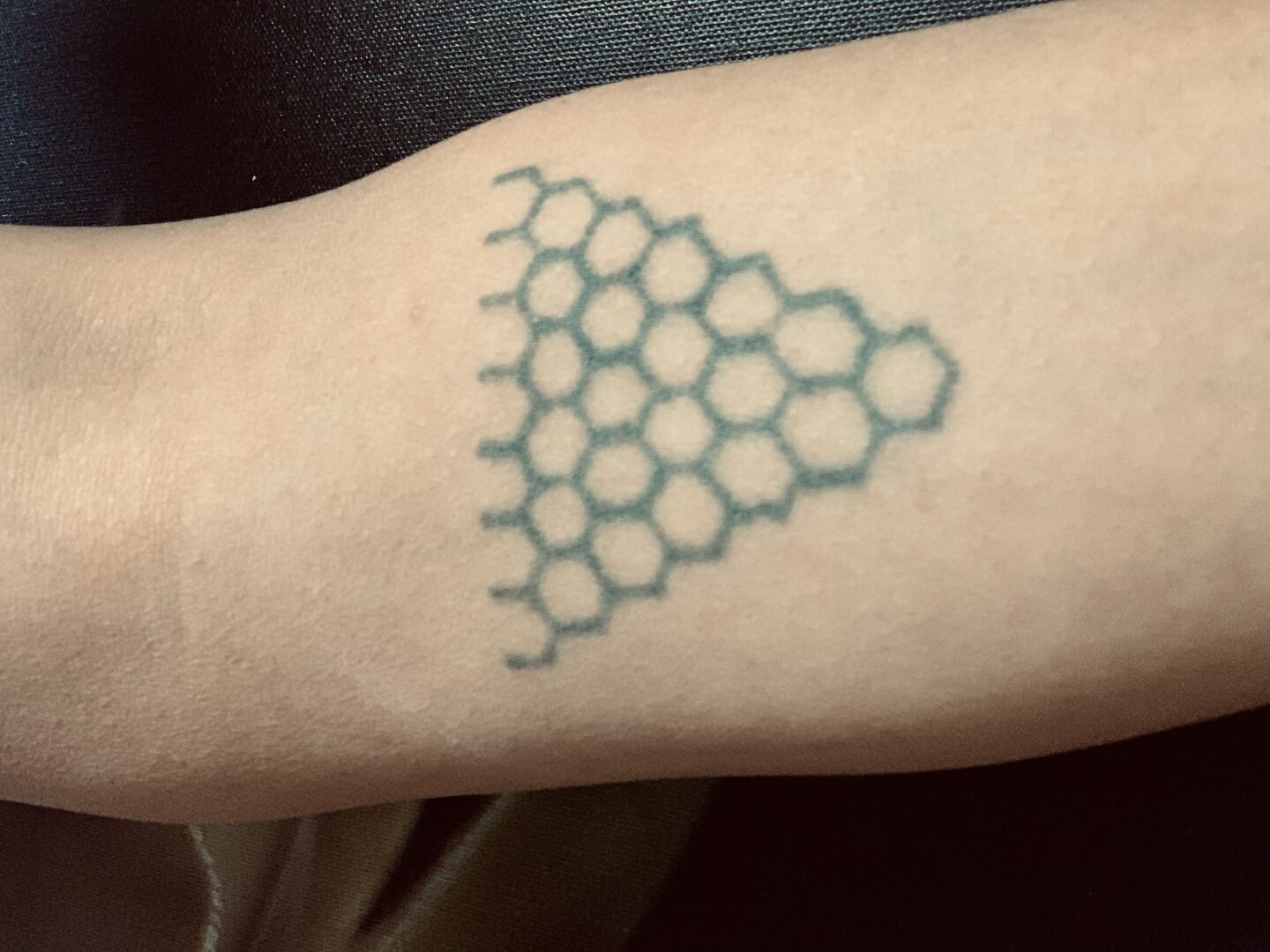
Image courtesy of the author
Semioticians analyze symbols, so for this series, we’ve asked 25 of our semio colleagues from around the world to explicate the symbolism of… one of their own tattoos.
I stretch / from precipice / to river / the American / woman fell / along my / rocky spine / contusions on / her face / no autopsy / no way / to check / for water / in lungs / to know / if rocks / or river / the cause / of death / but I / am blamed / though I / never wanted / this day / of lamentation.
“The Cliff,” by Renato Rosaldo
When I did my bachelor’s in Anthropology one of the lessons that most impacted me was learning about the Latino-American anthropologist Renato Rosaldo, who in 1981 lost his wife, the anthropologist Michelle (Shelly) Zimbalist Rosaldo, from an accidental fall while they were preparing to conduct fieldwork, among the Ilongot — an indigenous people who were formerly headhunters — in the northern Philippines village of Mungayang. Renato’s poem, above, is one of many to be found in the 2014 collection The Day of Shelly’s Death: The Poetry and Ethnography of Grief.
Rosaldo tells us that it was only after this traumatic event that he understood what the Ilongot meant when they told him that, after the death of a relative, they felt a strong urge to hunt their enemies and cut off their heads — the only way to rid themselves of the affliction their relative’s death caused them. All of this is described in Rosaldo’s essay “Grief and a Headhunter’s Rage,” which first appeared in 1984. Here he states that the affective force he felt when Shelly died was so extreme that he could understand how the Ilongots try to “cure” it, by taking the life of their enemies.
In 2016, I visited the area where the tragic event had happened. I had the opportunity to get to know some Ilongot people, who these days mainly work in the tourist industry, or are peasants or migrants. The region where they live has become globally famous thanks to Apo Whang-Od, a tattoo artist from the village of Buscalan within Tinglayan, Kalinga, Philippines. She is often described as the last Kalinga tattooist; as of this writing she is 108. The patterns she tattoos were traditionally used to provide force, recognize status, and protect local people from headhunters.
One of the most common Kalinga patterns is the shape of a protective net. I have this type of tattoo on my left arm. However, my tattoo was not done it Apo Whang-Od. Instead, one of her nieces tattooed me… because to be tattooed by Apo Whang-Od herself you have to wait for days or weeks. (Her home is full of foreigners from around the world waiting for their turn; but I was only there for a day.) Apo Whang-Od’s niece, who was at that time learning the tradition, and who was the only person besides her aunt allowed to do Kalinga tattoos (the practice is inherited from mother to daughter, though in this case Apo Whang-Od doesn’t have a daughter, so the community has made an exception), did my tattoo.
I describe my tattoo as KALINGA REDOX because for a tourist like myself to get a traditional tattoo from Apo Whang-Od’s successor involves the reduction or oxidation of an old and deep cultural practice into and individual egoistic and extractive practice. Hence my coinage, redox.
Not that I’m ashamed of my tattoo. I regard it as a lesson. When I relate to other cultures, these days, I try my best to be respectful of their traditions and expressions, and not an ignorant cultural extractor.
TATTOO YOU: Nicola Zengiaro (Italy) on CORAL OF LIFE | Su Luo (Taiwan) on AN ISLAND, A TREE | Thierry Mortier (Sweden) on LIJFSPREUKEN | Cristina Voto (Italy) on JELLYFISH | Charles Leech (Canada) on SURF WAVES | Mariane Cara (Brazil) on BECOMING’S TRIAD | Chris Martin (Canada) on PUNK ROCK HEART | Angie Meltsner (USA) on ENJOY EVERY SANDWICH | Samuel Grange (France) on POLYMORPHOUS | Inka Crosswaite (Germany) on LAYERED FRAGMENT | Al Deakin (England) on FAMILY STAR | Hibato Ben Ahmed (France) on HENNA HAND | Max Matus (Mexico) on KALINGA REDOX | Whitney Dunlap Fowler (USA) on IN THE UNTETHERED | Chirag Mediratta (India) on THE SONG OF THE BUTTERFLY | Alexandra Ncube (England) on LIMINAL ROOTS | Josh Glenn (USA) on FALLING ANGEL | Aarushi Chadha (India) on PART-TIME PEOPLE PERSON | Serdar Paktin (Turkey/UK) on RESISTANCE & SURRENDER | Tatiana Jaramillo (Colombia/Italy) on EMBERÁ BLACKOUT | Antje Weißenborn (Germany) on FADED STAR | Sundari Sheldon (USA) on SUN | Roberta Graham (England) on SUNFLOWER.GUNMETAL.
Also see these global semio series: MAKING SENSE (Q&As) | SEMIOFEST SESSIONS (monthly mini-conferences) | COVID CODES | SEMIO OBJECTS | COLOR CODEX | DECODER (fictional semioticians) | CASE FILE | PHOTO OP | MEDIA DIET | TATTOO YOU (semioticians’ tattoos).