

Emberá Blackout
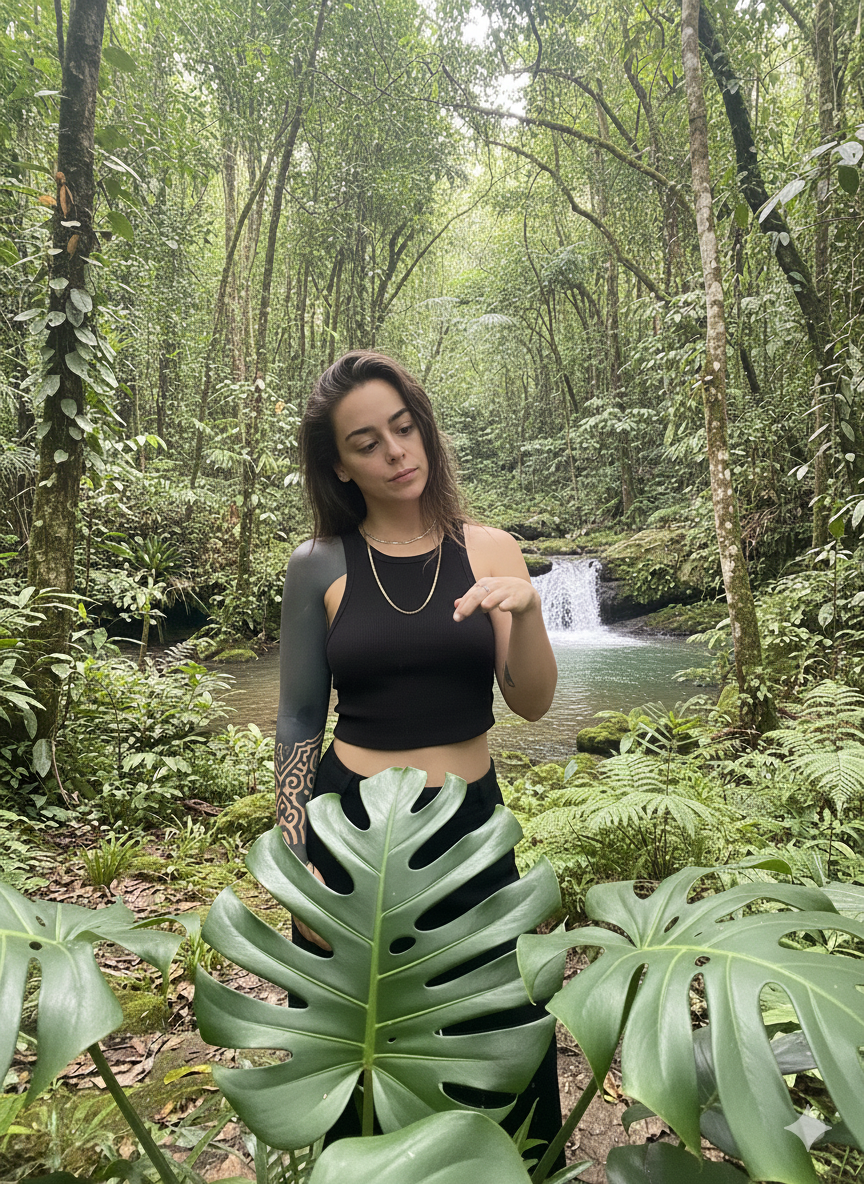
Image courtesy of the author
Semioticians analyze symbols, so for this series, we’ve asked 25 of our semio colleagues from around the world to explicate the symbolism of… one of their own tattoos.
When I moved to Europe, about five years ago, I entered a state of cultural and personal flux. Suddenly, people started labeling me “Latina,” a term virtually absent from my lived experience back home. This external labeling was startling; in Colombia, that identity is so fundamental it goes unrecognized. Experiencing this distance made me realize how vital my culture was; it initiated a deep search for authentic belonging.
Simultaneously, I needed to transform an old tattoo, a collection of unrelated figures I had completely outgrown. They felt like a costume, and I craved a mark that held real meaning. This quest led me to the profound wisdom of the Indigenous Emberá people of Colombia, whose traditional use of the jagua fruit to create dark, spiritual body art touched me. I chose to cover the old figures with an Emberá-inspired pattern because I was not just choosing ink; I was choosing a force: the color black itself, as interpreted by their tradition.
For the Emberá, this pigment is a spiritual shield. It symbolizes protection, ancestral connection, and harmony with the jungle, acting as a bridge to the supernatural world.
When the jagua-inspired black first covered my skin, transforming the outdated art, it initially looked heavy. But that feeling quickly changed; it began to feel grounding. The darkness was no longer a concealment; it was a deep connection. The tattoo became a second skin, a declaration of identity carried proudly. Over time, its significance has only deepened. What began as a personal reclamation has grown into a daily reminder of my connection to my culture and nature.
TATTOO YOU: Nicola Zengiaro (Italy) on CORAL OF LIFE | Su Luo (Taiwan) on AN ISLAND, A TREE | Thierry Mortier (Sweden) on LIJFSPREUKEN | Cristina Voto (Italy) on JELLYFISH | Charles Leech (Canada) on SURF WAVES | Mariane Cara (Brazil) on BECOMING’S TRIAD | Chris Martin (Canada) on PUNK ROCK HEART | Angie Meltsner (USA) on ENJOY EVERY SANDWICH | Samuel Grange (France) on POLYMORPHOUS | Inka Crosswaite (Germany) on LAYERED FRAGMENT | Al Deakin (England) on FAMILY STAR | Hibato Ben Ahmed (France) on HENNA HAND | Max Matus (Mexico) on KALINGA REDOX | Whitney Dunlap Fowler (USA) on IN THE UNTETHERED | Chirag Mediratta (India) on THE SONG OF THE BUTTERFLY | Alexandra Ncube (England) on LIMINAL ROOTS | Josh Glenn (USA) on FALLING ANGEL | Aarushi Chadha (India) on PART-TIME PEOPLE PERSON | Serdar Paktin (Turkey/UK) on RESISTANCE & SURRENDER | Tatiana Jaramillo (Colombia/Italy) on EMBERÁ BLACKOUT | Antje Weißenborn (Germany) on FADED STAR | Sundari Sheldon (USA) on SUN | Roberta Graham (England) on SUNFLOWER.GUNMETAL.
Also see these global semio series: MAKING SENSE (Q&As) | SEMIOFEST SESSIONS (monthly mini-conferences) | COVID CODES | SEMIO OBJECTS | COLOR CODEX | DECODER (fictional semioticians) | CASE FILE | PHOTO OP | MEDIA DIET | TATTOO YOU (semioticians’ tattoos).