

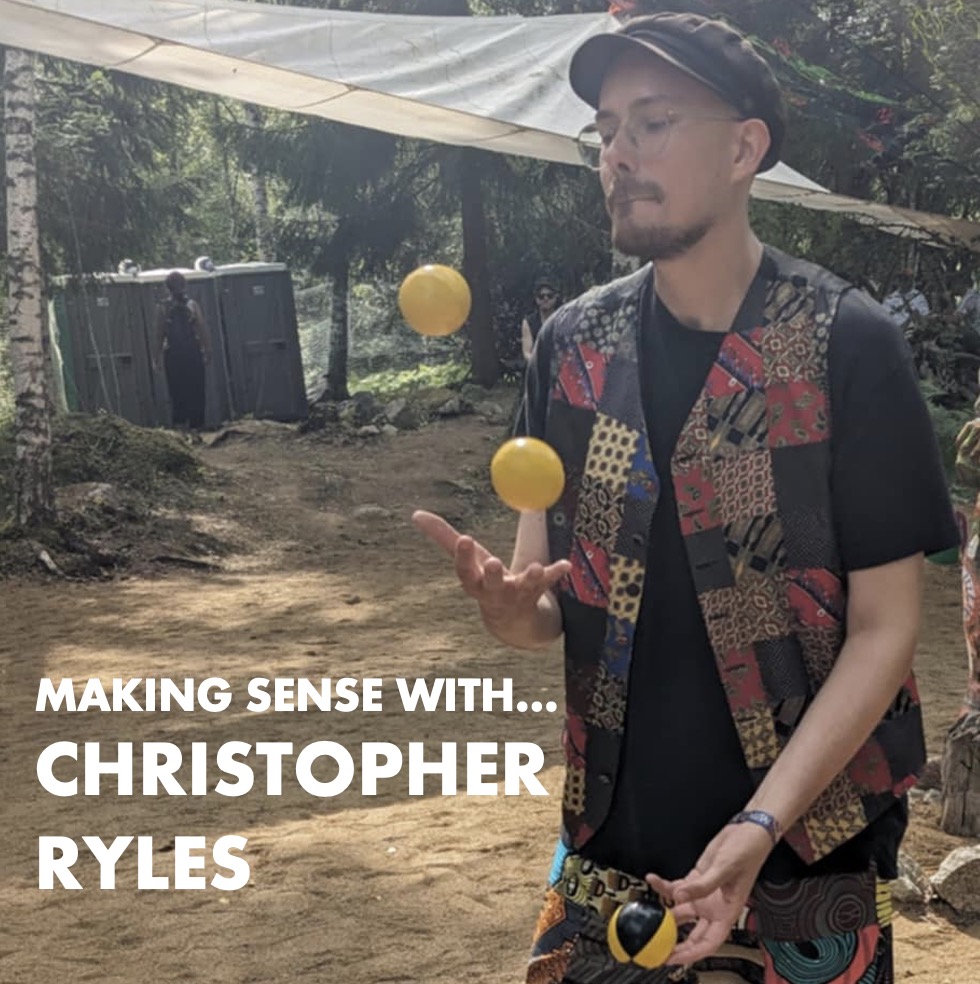
Photo courtesy of CR
What makes a semiotician tick? SEMIOVOX’s Josh Glenn has invited his fellow practitioners in the field of commercial semiotics, from around the world, to answer a few revealing questions.
Helsinki…
SEMIOVOX
When you were a child/teen, how did your future fascination with symbols, cultural patterns, interpreting “texts,” and getting beneath the surface of daily life manifest itself?
CHRISTOPHER RYLES
When I was a kid I was really into mathematics. I loved that feeling when suddenly everything clicks and you can see how the pieces of the puzzle made sense all along. I had a whole phase of being fascinated by Graham’s Number, the largest number ever used in a practical proof at the time. It’s a number so big that there’s not enough space in the universe to write it down fully, but there was this special kind of notation that means you can fit it onto just a few lines. I remember finding that kind of intoxicating, that there was this whole abstract world that was too big to ever see, but with the right set of symbols I could still understand it.
I’m probably still chasing that high, still trying to find the ways to make all the big complicated things make sense with just a few little symbols.
SEMIOVOX
Describe your first encounter(s) with the theory and practice of semiotics.
CHRISTOPHER RYLES
I was studying literature at university and my first-year modules touched on a little bit of Saussure. I still remember the example, it was that the word “tree” has nothing inherently to do with the living organism outside the window. It felt so obvious and intuitive, but even though it was such a striking moment, I still didn’t grasp that this was a whole field of study that I could go and learn more about.
It wasn’t until I was in my 20s that I started digging into Peirce and Barthes and Latour. Something about this way of thinking got its hooks into me. Instead of our surroundings being these fixed, inert things, they are dynamic. Everything is always evolving.
I now live in Finland and learning Finnish is probably the most difficult thing I’ve ever done. It’s not an Indo-European language, so all of the underlying structures from English can’t really help you. There are whole different ways to express your perception of reality. One quick example: You have to express completeness when describing an action. To say you read a book is necessarily to express whether you read it in whole or in part. To say you shot someone requires disclosing whether they died.
One of the most compelling things you can do is challenge the assumptions you never even knew you had. The unknown unknowns. What continues to attract me to semiotics is the way it forces you to scrutinise the structures beneath your understanding of the world.
SEMIOVOX
How did you find your own way to doing semiotics?
CHRISTOPHER RYLES
I accidentally met the right people. While I was living in Helsinki, I got an internship with Gemic in Berlin, where I met someone who used to work for Space Doctors. Space Doctors offered me a role over in Brighton, where I worked before returning to Helsinki and going independent.
Over here, corporate semiotics is still pretty nascent, so I’m hoping to spread the word a little and let people know this is something you can do for a living.
SEMIOVOX
What are the most important attributes of a good semiotician?
CHRISTOPHER RYLES
Curiosity and humility. For me, being a good semiotician is about being in dialogue with the world. You have to be willing to go searching for strangeness, to interrogate your own blind spots, and be okay with being wrong.
We are not in the business of decoding answers, we are trying to disentangle an ecosystem of relational meanings.
SEMIOVOX
What three books about semiotics have you found the most useful and enlightening in your own work?
CHRISTOPHER RYLES
- Baudrillard’s The Gulf War Did Not Take Place. Since 1991, when Baudrillard published this, the idea of geopolitics as media spectacle is no longer just a provocative philosophical idea. We are living though violence designed more to be consumed than experienced. Whenever I see a TikTok drone strike montage or an AI Studio Ghibli-fied deportation meme, I’m struck by how removed from people’s lived reality these images actually are.
- John Berger’s Ways of Seeing. Properly foundational stuff on the context and consumption of images. Berger breaks down the power relations and intersectional implications of how we see one another. It’s also apparently the first use of the term ‘male gaze’, which feels unlikely coming from a white bloke working for the BBC in the early ’70s, but hopefully that gives a sense of how damn influential this book has been.
- Adam Curtis’ documentary HyperNormalisation. A brilliant documentary on power, complexity, and the strange nature of reality. It’s kind of a visual collage, with stock footage of historical events and Aphex Twin needle drops. Think Core Core videos made by Horkheimer.
SEMIOVOX
When someone asks you to describe what you do, what is your “elevator pitch”? How do you persuade a skeptical client to take a chance on using this tool?
CHRISTOPHER RYLES
“I help organisations to understand culture.” If that gets a blank look I’ll say, “I work with brands on communications, packaging design, and the like.”
If I’m looking to persuade someone, I try to speak to their everyday experience. You have to ground things in the familiar. Find an example of a campaign or activation or piece of brand comms that really clearly communicates the central idea. Something that is sharp. All the better if it’s something the client has seen before. If you can break down why it works, show that semiotics is an effective tool for creating memorable brands that stick, then you’ve got them.
One thing holding semiotics back is this perception that it’s too abstract, too academic, too removed from the everyday nuts and bolts of business. So, you have to make it real.
I genuinely believe that most people understand semiotics intuitively. You can feel when something isn’t right, when there has been a miscommunication, when the vibes are off. What I try to do is give people the tools to be able to make effective communication explicit and reproducible.
SEMIOVOX
What specific sorts of semiotics-driven projects do you find to be the most enjoyable and rewarding?
CHRISTOPHER RYLES
I love the projects that help nail down the edges of a particularly fraught or fast-moving cultural space. I’m a big fan of mapping exercises, particularly when I can bring the client in and help them to see all the facets of the space that they may not have been aware of.
I recently did a map of masculinity codes for an ongoing piece I’m writing — and it was great fun trying to wrangle such a thorny concept into a shape that felt satisfactory. That is the kind of work that gets me rubbing my hands, being able to bring some clarity to the chaos.
SEMIOVOX
What frustrates you about how semiotics is practiced and/or perceived, right now?
CHRISTOPHER RYLES
The most pressing issue has to be the proliferation of LLMs across so much insight and strategy work. I spoke at Semiofest a couple of years ago about how these kinds of models are extremely poor at identifying emergent behaviour or helping us to imagine radical new futures. They are built upon a corpus of the dominant culture and they reflect that dominant culture back at us.
The fantastical idea that AI would replace entire departments seems to thankfully be crumbling under the weight of how much fact-checking is required, but these tools are a part of everyone’s workflows now and that isn’t going anywhere. As practitioners, we need to help build a deep understanding of culture, not just engage in pattern recognition.
SEMIOVOX
Peirce or Saussure?
CHRISTOPHER RYLES
I’m leaving this one alone, the academics can fight over this!
SEMIOVOX
What advice would you give to a young person interested in this sort of work?
CHRISTOPHER RYLES
Don’t listen to how people who’ve been in the industry for years got their jobs. The industry that I started in has already changed radically, and I haven’t even been doing this for that long.
Talk to as many people as you can. Put your name out there and don’t be afraid to ask people for help. In my experience people are far more generous with their time than you might expect.
MAKING SENSE series: MARTHA ARANGO (Sweden) | MACIEJ BIEDZIŃSKI (Poland) | BECKS COLLINS (England) | WHITNEY DUNLAP-FOWLER (USA) | IVÁN ISLAS (Mexico) | WILLIAM LIU (China) | SÓNIA MARQUES (Portugal) | CHIRAG MEDIRATTA (India / Canada) | SERDAR PAKTIN (Turkey / England) | MARIA PAPANTHYMOU (Greece / Russia) | XIMENA TOBI (Argentina) | & many more.
Also see these global semio series: MAKING SENSE (Q&As) | SEMIOFEST SESSIONS (monthly mini-conferences) | COVID CODES | SEMIO OBJECTS | COLOR CODEX | DECODER (fictional semioticians) | CASE FILE | PHOTO OP | MEDIA DIET | TATTOO YOU (semioticians’ tattoos).