

Liminal Roots
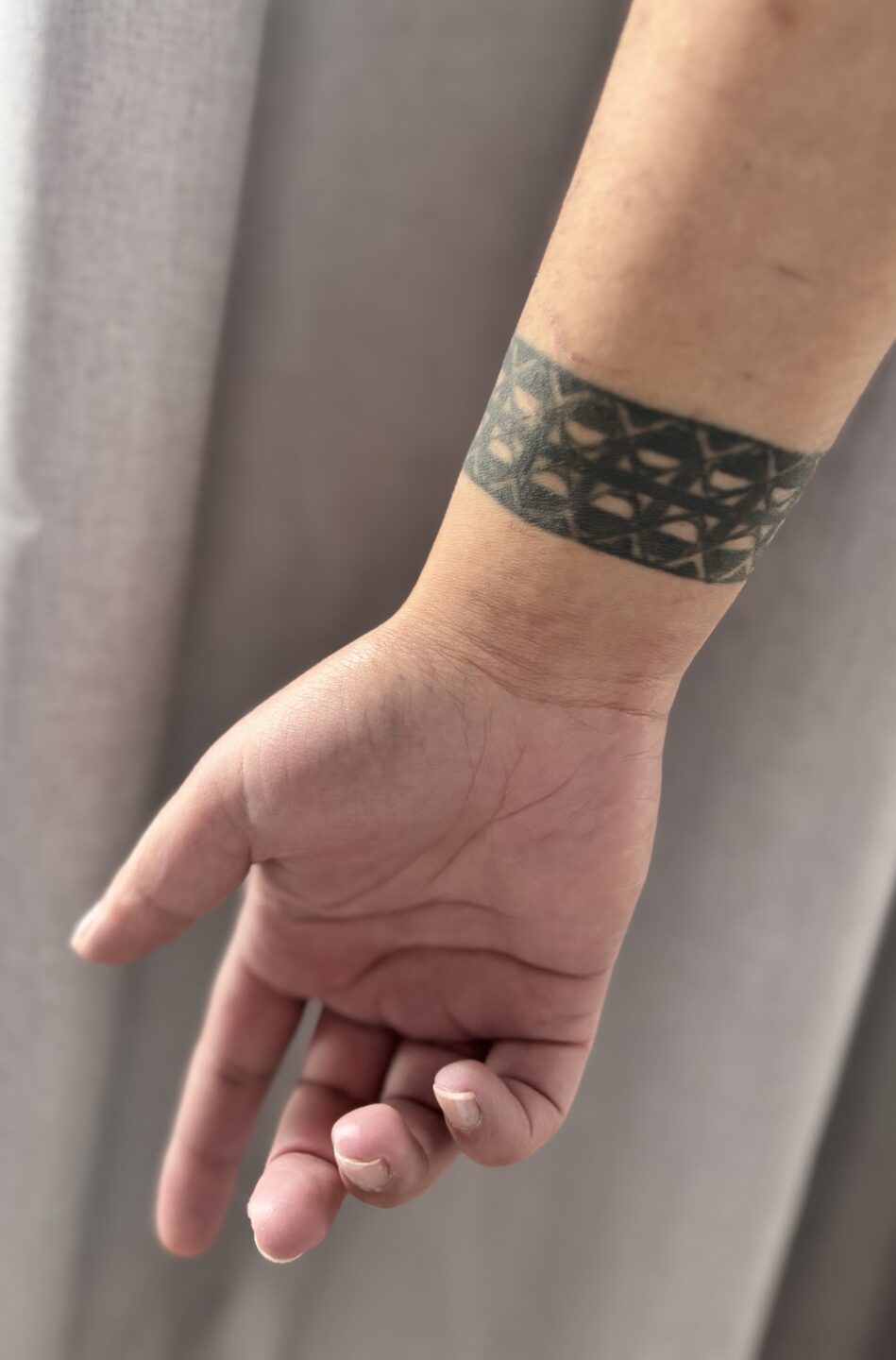
Image courtesy of the author
Semioticians analyze symbols, so for this series, we’ve asked 25 of our semio colleagues from around the world to explicate the symbolism of… one of their own tattoos.
Thoughts about placehood and belonging have played on my mind my whole life. In 2015, during my Masters in anthropology, these reflections became enmeshed in the histories of scarification. Ethnographies teach that so much is and can be communicated by marks on the body; whether as symbols of kinship and community, or as more personal reflections of ‘self’ and individuality. They speak to a kind of rootedness — a declaration of identity.
I began to ponder over my own ‘roots’, asking myself where home really is for an immigrant, and how belonging manifests when you tick too many (or perhaps not enough) boxes of identity. My body felt like, and is, its own melting pot of cultures; a mix of different ethnicities, nationalities, and physical attributes which exist as echoes of my parents and ancestors. The vessel that houses me felt both connected to so much and at the same time, belonging to no ‘single thing’. Rooted and liminal, all at once.
To honour this idea, I got my very first tattoo, a bold patterned bracelet around my wrist. The shapes are a play on light and dark, fullness and incompleteness. They take inspiration from traditional Ndebele art and house paintings, symbols etched in my memory from my childhood in Zimbabwe and my father’s heritage. I’ve always been drawn to representations of duality and continuity, which is why the piece wraps around my wrist without a start or a finish… a metaphor for the infinite.
I worked with a talented Camden tattoo artist on the intricate design and sat through the inking process, which took around four hours to complete. I still remember his diligent warnings about the size and visibility of the ink; “Are you sure about what career path you’ll take?” he quizzed. “Might be difficult to get a job in finance with this on your wrist?” (funnily enough, I did end up doing a stint in corporate finance as a semiotician). My biggest fear at the time was in fact delivering the news of my permanent art to my parents. Neither were keen on tattoos and, given its prominence on my wrist, I knew I could not hide it for long. It was in describing the meaning of the symbolism that they were ultimately moved to love it. They were taken with the concept that it was an expression of home.
Since then, I’ve added to the collection of art on my body and feel proud of all the stories they tell. My inked bracelet is a personal reminder that I carry rootedness with me wherever I go, no matter how liminal my existence may be.
TATTOO YOU: Nicola Zengiaro (Italy) on CORAL OF LIFE | Su Luo (Taiwan) on AN ISLAND, A TREE | Thierry Mortier (Sweden) on LIJFSPREUKEN | Cristina Voto (Italy) on JELLYFISH | Charles Leech (Canada) on SURF WAVES | Mariane Cara (Brazil) on BECOMING’S TRIAD | Chris Martin (Canada) on PUNK ROCK HEART | Angie Meltsner (USA) on ENJOY EVERY SANDWICH | Samuel Grange (France) on POLYMORPHOUS | Inka Crosswaite (Germany) on LAYERED FRAGMENT | Al Deakin (England) on FAMILY STAR | Hibato Ben Ahmed (France) on HENNA HAND | Max Matus (Mexico) on KALINGA REDOX | Whitney Dunlap Fowler (USA) on IN THE UNTETHERED | Chirag Mediratta (India) on THE SONG OF THE BUTTERFLY | Alexandra Ncube (England) on LIMINAL ROOTS | Josh Glenn (USA) on FALLING ANGEL | Aarushi Chadha (India) on PART-TIME PEOPLE PERSON | Serdar Paktin (Turkey/UK) on RESISTANCE & SURRENDER | Tatiana Jaramillo (Colombia/Italy) on EMBERÁ BLACKOUT | Antje Weißenborn (Germany) on FADED STAR | Sundari Sheldon (USA) on SUN | Roberta Graham (England) on SUNFLOWER/GUNMETAL.
Also see these global semio series: MAKING SENSE (Q&As) | SEMIOFEST SESSIONS (monthly mini-conferences) | COVID CODES | SEMIO OBJECTS | COLOR CODEX | DECODER (fictional semioticians) | CASE FILE | PHOTO OP | MEDIA DIET | TATTOO YOU (semioticians’ tattoos).