

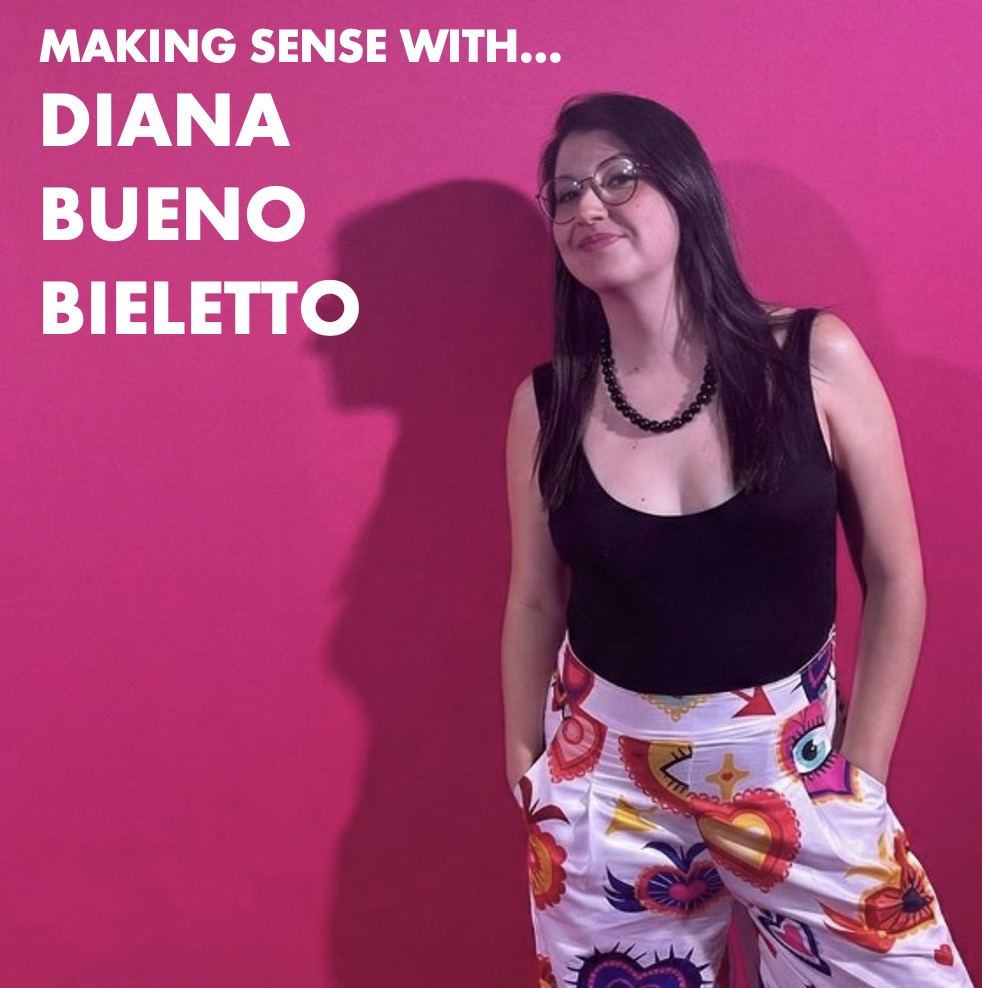
Photo courtesy of DBB
What makes a semiotician tick? SEMIOVOX’s Josh Glenn has invited his fellow practitioners in the field of commercial semiotics, from around the world, to answer a few revealing questions.
Mexico City…
SEMIOVOX
When you were a child/teen, how did your future fascination with symbols, cultural patterns, interpreting “texts,” and getting beneath the surface of daily life manifest itself?
DIANA BUENO BIELETTO
Instead of being the typical teen who likes everything and doesn’t know what to study, I liked nothing except humans and how they think. How people interpret reality, how different worldviews are constructed, and how culture shapes those interpretations were my real interests. By that time, I was already fantasizing about traveling, not for places themselves but for the cultural differences behind them.
SEMIOVOX
Describe your first encounter(s) with the theory and practice of semiotics.
DIANA BUENO BIELETTO
I studied Psychology but wanted to work in Advertising, which at the time felt like a strange decision to everyone around me. Semiotics (and Gestalt theory) helped me bridge that gap: a theory that could actually be applied to advertising! I ended up writing my dissertation on it. Looking back, I still can’t make up my mind whether it was naïve or innovative. I simply felt there had to be some theory behind improving ads beyond just doing whatever “felt right.”
SEMIOVOX
How did you find your own way to doing semiotics?
DIANA BUENO BIELETTO
As a Social and Cultural Psychologist working in consulting, I became a local expert on Mexican culture and Latin American symbols for international agencies. Colleagues later invited me to Semiofest; I also became friends with a semiotics professor from university. From there, things unfolded quite naturally.
SEMIOVOX
What are the most important attributes of a good semiotician?
DIANA BUENO BIELETTO
Relentless observation across all layers of society and an obsession with why.
- Why is this happening?
- Why do some places succeed while others fail?
- Why do we feel at ease in certain environments and stressed in others?
It’s an almost compulsive need to keep asking why, again and again, without settling too quickly on answers.
SEMIOVOX
What three books about semiotics have you found the most useful and enlightening in your own work?
DIANA BUENO BIELETTO
- Roland Barthes’s Mythologies was the essential starting point — the 101. That said, I’m generally more drawn to reading about society than about semiotics itself. [Korean philosopher] Byung-Chul Han’s work on hyper-demanding societies, superficiality, oversharing, and minimalism deeply shaped how I read contemporary symbols.
- [American marketing professor and strategist] Marcus Collins’ For the Culture is a book I didn’t quite enjoy; but precisely because it exposed all my “tricks” as a Social and Cultural Psychologist working in advertising. Its explanation of how culture shapes worldviews and symbols is exactly why I do what I do, even if it made my work feel suddenly transparent.
- [American journalist and author] Derek Thompson’s Hit Makers: The Science of Popularity in an Age of Distraction was truly a hit for me. It answered many of the lingering “whys” behind popularity and taste in pop culture. I’ve carried those insights directly into applied semiotics, because in the end, cultural meaning and cultural success are inseparable.
SEMIOVOX
When someone asks you to describe what you do, what is your “elevator pitch”? How do you persuade a skeptical client to take a chance on using this tool?
DIANA BUENO BIELETTO
I usually say that I culturally and locally assess campaigns that were created abroad and feel “off” when they land here. I help brands understand why something doesn’t work in a specific cultural context and how to adapt it without losing its core idea.
SEMIOVOX
What specific sorts of semiotics-driven projects do you find to be the most enjoyable and rewarding?
DIANA BUENO BIELETTO
The most rewarding projects are those where I assess an existing campaign and adapt or adjust it to Mexican reality without falling into stereotypes. For me, this work has real meaning: it’s a symbolic fight against the clichés that box us in and flatten our diversity as Mexicans and Latin Americans, especially when seen through the lens of the Global North.
SEMIOVOX
What frustrates you about how semiotics is practiced and/or perceived, right now?
DIANA BUENO BIELETTO
It’s still difficult to convince local clients of the value of semiotics because it is thorough, time-intensive, and therefore perceived as expensive. Many clients only truly understand its value after seeing a project unfold and realizing how much deeper it goes than traditional consumer research.
This is increasingly hard in a context where quantitative data is valued more than qualitative insight and where there’s a growing belief that AI can answer any question quickly and “well enough.” I’d like to see more recognition of semiotics as a strategic tool, not a luxury or a nice-to-have.
SEMIOVOX
What advice would you give to a young person interested in this sort of work?
DIANA BUENO BIELETTO
Read. Watch movies. Listen to interviews. Talk to people. Go out and have long, deep conversations with many kinds of people. Be intentional about what you consume and don’t let content consume you. Consciously choosing what your eyes see is increasingly difficult, but it’s also what gives you an advantage over those who simply absorb and repeat other people’s views and opinions.
MAKING SENSE series: MARTHA ARANGO (Sweden) | MACIEJ BIEDZIŃSKI (Poland) | BECKS COLLINS (England) | WHITNEY DUNLAP-FOWLER (USA) | IVÁN ISLAS (Mexico) | WILLIAM LIU (China) | SÓNIA MARQUES (Portugal) | CHIRAG MEDIRATTA (India / Canada) | SERDAR PAKTIN (Turkey / England) | MARIA PAPANTHYMOU (Greece / Russia) | XIMENA TOBI (Argentina) | & many more.
Also see these global semio series: MAKING SENSE (Q&As) | SEMIOFEST SESSIONS (monthly mini-conferences) | COVID CODES | SEMIO OBJECTS | COLOR CODEX | DECODER (fictional semioticians) | CASE FILE | PHOTO OP | MEDIA DIET | TATTOO YOU (semioticians’ tattoos).