

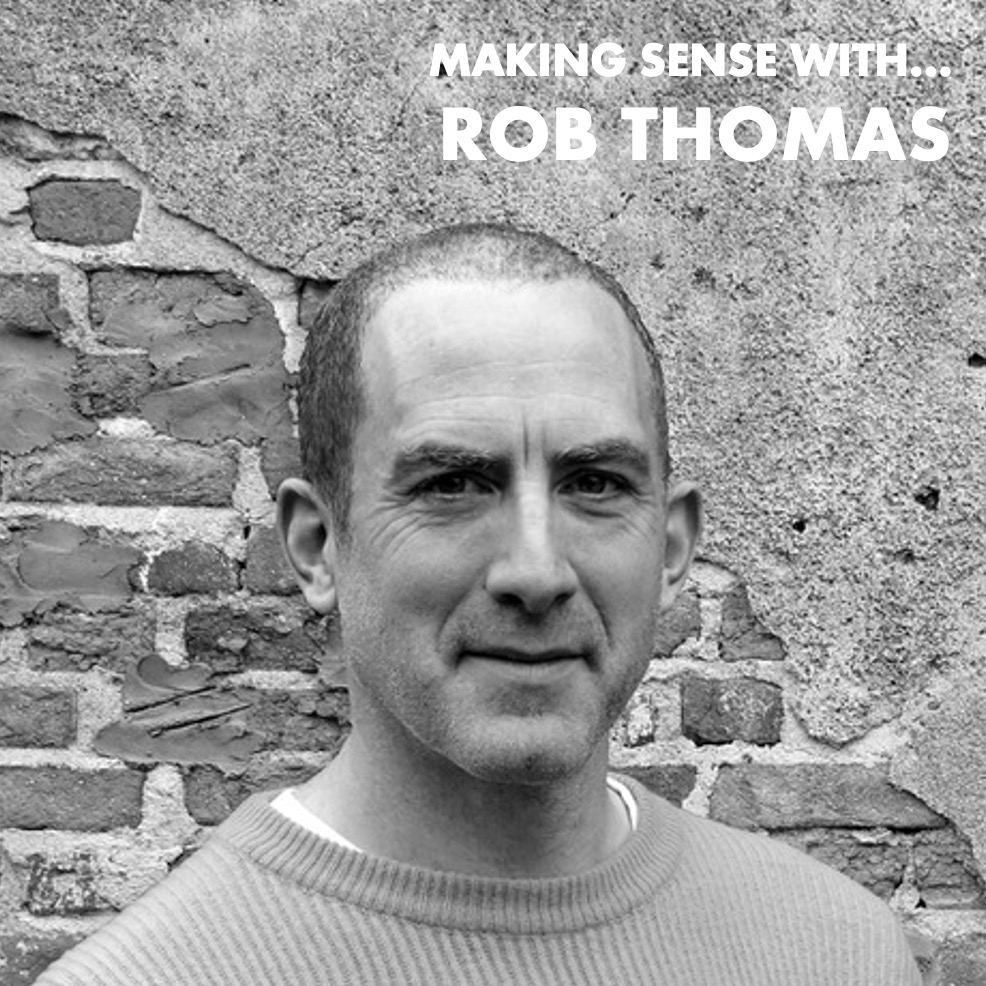
Photo courtesy of RT
What makes a semiotician tick? SEMIOVOX’s Josh Glenn has invited his fellow practitioners in the field of commercial semiotics, from around the world, to answer a few revealing questions.
London / Hay on Wye…
SEMIOVOX
When you were a child/teen, how did your future fascination with symbols, cultural patterns, interpreting “texts,” and getting beneath the surface of daily life manifest itself?
ROB THOMAS
As a child, I was certainly fascinated by signs and symbols. As my mum will tell you, my semiotic bent first showed itself when I pointed at a big poster in my local doctor’s office and asked “why is there an ampersand on the wall?“
As a teen things were different. I had no interest at all in taking my interpretative skills below the surface. It was the 1980s: the surface was where it was at, man!
I was crazy about alternative music, fashion, art, zines… I even managed to persuade our state school librarian to subscribe to Vogue, ID and The Face magazines.
And the mid ’80s was a time of real semiotic festivity. I mean, just take a look at early Boy George or, differently, what Malcolm McLaren was up to. And this stuff was being consumed and enjoyed by everybody.
SEMIOVOX
Describe your first encounter(s) with the theory and practice of semiotics.
ROB THOMAS
Like many Uk semioticians of a certain vintage, my first brush with semiotic theory was probably Terry Eagleton’s undergraduate textbook, Modern Literary Theory. Suddenly, I was surrounded by a bunch of forbidding sounding surnames: Todorov, Saussure, Jakobson, Derrida…
I hated it. I preferred the close reading, brilliance, and human warmth of people like Christopher Ricks, who could talk about Keats, Beckett and rock n roll.
SEMIOVOX
How did you find your own way to doing semiotics?
ROB THOMAS
I was extremely lucky. In the late ’90s, someone introduced me to the legendary Ginny and Monty of Semiotic Solutions. I did a bit of freelancing for them, and as they retired, a few projects fell my way, and it built up from there. I was, for a while, a big fish in a very small pond, for which I am very grateful.
SEMIOVOX
What are the most important attributes of a good semiotician?
ROB THOMAS
There are the obvious things like curiosity and having an interdisciplinary, magpie mind; but personally, I think it’s two things.
One, the ability to see links and equivalences in apparently disparate things: so you can talk about buzzwords, facial expressions, tattoo designs, and corporate logos to illustrate a single big point about culture.
And two, it’s the ability to use straightforward, everyday language to communicate your insights. Semiotics is clever and brilliant. It doesn’t need to try so hard to sound clever and brilliant.
SEMIOVOX
What three books about semiotics have you found the most useful and enlightening in your own work?
ROB THOMAS
I’m going to stick to one: Wittgenstein‘s Philosophical Investigations. This book has been so influential in my thinking that I actually have to work not to mention it in debriefs, as it sounds a little bit wanky!
The book is basically a wide-ranging bunch of questions, comments, and thought-experiments as the great Wittgenstein works stuff out in his own head. There’s no set of conclusions, no overarching system. It’s more about him showing us how our ideas don’t work and don’t fit together and what that tells us about our thinking and false trails. This is pretty much what I do for brands. (Although I have to recommend some ways forward, not just point out the gaps.)
For Wittgenstein, it’s not about “digging for deep meanings,” it’s about close attention. As he says, in one of my favorite lines, “Everything lies open to view.”
SEMIOVOX
When someone asks you to describe what you do, what is your “elevator pitch”? How do you persuade a skeptical client to take a chance on using this tool?
ROB THOMAS
I say, “I help brands and organizations think, talk and act in more meaningful, relevant ways.”
The days of skeptical clients seem to have gone, here in the UK. Everybody’s into it these days — it’s just a question of whether they can find the budget!
SEMIOVOX
What specific sorts of semiotics-driven projects do you find to be the most enjoyable and rewarding?
ROB THOMAS
I like thinking about stuff that is nominally boring. So some of my favourite projects have been about wall coverings, travel insurance, dandruff, and the colour grey! For us semioticians, nothing is boring; it’s just a question of giving things the right attention. (And making sure you have a good, tight brief!)
SEMIOVOX
What frustrates you about how semiotics is practiced and/or perceived, right now?
ROB THOMAS
Twenty years into my career, I’m still having debates about semiotics being nothing more than subjective opinion, dressed up in the language of the academy. Funny that these objections only come from researchers in other disciplines, rather than from clients themselves. Anyway, I like these kind of challenges — they give me the chance to passionately refute them (we coolheaded semioticians don’t often get hot under the collar). Changes to the profession? See my point about jargon and obscurantism.
SEMIOVOX
Peirce or Saussure?
ROB THOMAS
Wittgenstein.
SEMIOVOX
What advice would you give to a young person interested in this sort of work?
ROB THOMAS
Well, young or old, I would say keep yourself close to ordinary, everyday, uncool mass-market culture. As marketing people we tend to forget that that’s where much of the engagement actually takes place. You’ll need a good sense of the mainstream, if you’re going to successfully shake it up.
MAKING SENSE series: MARTHA ARANGO (Sweden) | MACIEJ BIEDZIŃSKI (Poland) | BECKS COLLINS (England) | WHITNEY DUNLAP-FOWLER (USA) | IVÁN ISLAS (Mexico) | WILLIAM LIU (China) | SÓNIA MARQUES (Portugal) | CHIRAG MEDIRATTA (India / Canada) | SERDAR PAKTIN (Turkey / England) | MARIA PAPANTHYMOU (Greece / Russia) | XIMENA TOBI (Argentina) | & many more.
Also see these global semio series: MAKING SENSE (Q&As) | SEMIOFEST SESSIONS (monthly mini-conferences) | COVID CODES | SEMIO OBJECTS | COLOR CODEX | DECODER (fictional semioticians) | CASE FILE | PHOTO OP | MEDIA DIET | TATTOO YOU (semioticians’ tattoos).