

Falling Angel
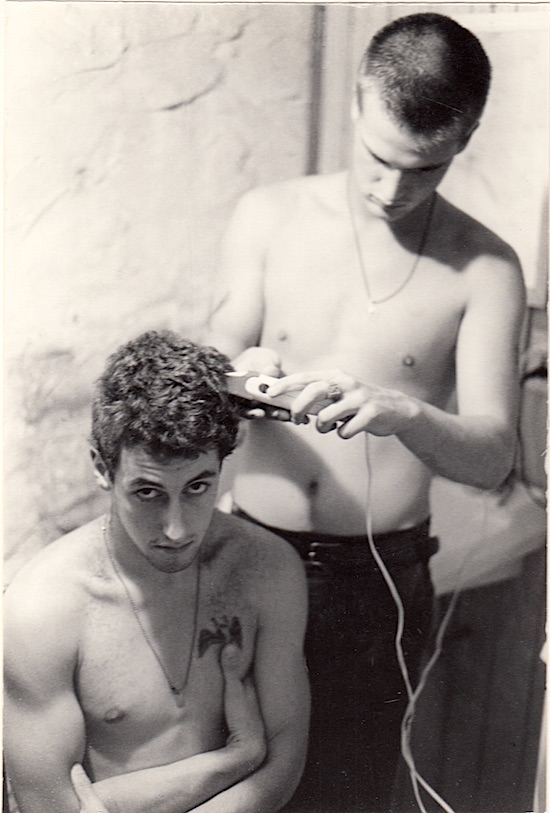
Image courtesy of the author; photo by John Cradock c. 1989
Semioticians analyze symbols, so for this series, we’ve asked 25 of our semio colleagues from around the world to explicate the symbolism of… one of their own tattoos.
In the early to mid-1980s, I was into punk, New Wave, and alt rock. I didn’t grow up in a household where we listened to “classic rock,” a cringey Boomer-appeasing term popularized around that time. Although I would develop an abiding interest in Paul McCartney’s post-Beatles oeuvre, plus The Velvet Underground, The Modern Lovers, and Black Sabbath… I was and mostly remain indifferent to The Rolling Stones, The Who, Aerosmith, Pink Floyd, Fleetwood Mac, The Eagles, et al. Worse, I was and absolutely remain scornful of misguided members of my generational cohort who love that music. I think of them as “Boomer-identified” generational victims.
However… my freshman year in college I was introduced to the majesty and mystery of Led Zeppelin. Jimmy Page’s guitar work (aggressive, heavy; yet delicate, folk-inflected), Robert Plant’s singing (ethereal, expressive; yet raw, wailing), John Bonham’s drumming (groove-heavy; yet so precise)… it came as a quasi-religious revelation. I spent hours sprawled on the floors of dark dorm rooms, transported by Led Zep through sensory-rich landscapes, from eldritch forests to the far edges of the galaxy. But it was never solely about psychedelic thrills, for me. Like T.W. Adorno, who discovered in Schoenberg’s formal musical experimentation an aesthetic antidote to society’s reified consciousness, the tensions in Zep’s extraordinary oeuvre provided me intellectual inspiration. My (ongoing) quest for negative-dialectical notions of the self, truth, and right action in the world found something resembling its embodied counterpart in this cathartic music.
The summer before my sophomore year, Flareball, a friend from the Boston punk scene, persuaded me to accompany him to New Hampshire, where it would be legal for us to get tattooed. I toted my copy of Physical Graffiti — which I’d often listen to, in its entirety, before getting out of bed on a hungover Sunday — to my ex-girlfriend Alice’s South End brownstone, so she could trace the Swan Song label’s logo for me. On this album, you will find a brilliant cover of “In My Time of Dying,” a gospel blues featuring the lyrics “Meet me, Jesus, meet me… / Meet me in the middle of the air. / If my wings should fail me, Lord… / Please meet me with another pair.” (The logo was adapted, by the way, from an 1869–70 artwork — does it depict Apollo? Icarus? Lucifer? it doesn’t really matter — that happens to hang in Boston’s Museum of Fine Arts.) I wanted a falling angel tattoo, I’d decided, as a memento, for my future self, of who I was — and what mattered to me — at that moment.
Later on in college, I’d pore over Harold Bloom’s writing on clinamen, or poetic misprision — an ironic interpretive move wherein a poet creates, by a corrective movement or “swerve,” a sense that their precursor was on the right track… but only up to a point. Bloom points us toward the Epicurean philosopher Lucretius, for whom the atomic “swerve” is what makes change possible in a static universe. He also uses Milton’s falling angel as a model: Though our actions may be predetermined by forces we cannot influence (or even perceive), Paradise Lost teaches us, while plummeting towards our fate we can at the very least swerve. Heady stuff! Which served to super-charge, for me, the meaning of my tattoo.
While visiting Memphis, Tenn., a year or two later, I did a couple of sessions in a flotation tank tucked away in the back of Shangri-La, my friend Sherman’s record store. Nothing happened until I raised my hands over my head, arching my back and bending my knees in order to fit within the tank’s tight confines. Suddenly a babble of competing voices became audible (at last) in my head; I understood these to be the conflicting imperatives of my superego and id, normally mediated and suppressed by my ego — itself revealed, in this moment, as just a construct. This entire psychic apparatus eventually melted away… yet something remained. A consciousness at once ironic and sympathetic, detached and involved. Exiting the tank, I showered and dried off — marveling all the while at the wise alien presence I’d discovered within myself. Then, in the bathroom mirror, I caught sight of my tattoo. Crazy… that’s precisely the posture I’d adopted!
That engaged-ironic consciousness, up to the example of which I’ve tried, with intermittent success, to live ever since? It amuses and inspires me to think of it as my guardian (falling) angel.
TATTOO YOU: Nicola Zengiaro (Italy) on CORAL OF LIFE | Su Luo (Taiwan) on AN ISLAND, A TREE | Thierry Mortier (Sweden) on LIJFSPREUKEN | Cristina Voto (Italy) on JELLYFISH | Charles Leech (Canada) on SURF WAVES | Mariane Cara (Brazil) on BECOMING’S TRIAD | Chris Martin (Canada) on PUNK ROCK HEART | Angie Meltsner (USA) on ENJOY EVERY SANDWICH | Samuel Grange (France) on POLYMORPHOUS | Inka Crosswaite (Germany) on LAYERED FRAGMENT | Al Deakin (England) on FAMILY STAR | Hibato Ben Ahmed (France) on HENNA HAND | Max Matus (Mexico) on KALINGA REDOX | Whitney Dunlap Fowler (USA) on IN THE UNTETHERED | Chirag Mediratta (India) on THE SONG OF THE BUTTERFLY | Alexandra Ncube (England) on LIMINAL ROOTS | Josh Glenn (USA) on FALLING ANGEL | Aarushi Chadha (India) on PART-TIME PEOPLE PERSON | Serdar Paktin (Turkey/UK) on RESISTANCE & SURRENDER | Tatiana Jaramillo (Colombia/Italy) on EMBERÁ BLACKOUT | Antje Weißenborn (Germany) on FADED STAR | Sundari Sheldon (USA) on SUN | Roberta Graham (England) on SUNFLOWER.GUNMETAL.
Also see these global semio series: MAKING SENSE (Q&As) | SEMIOFEST SESSIONS (monthly mini-conferences) | COVID CODES | SEMIO OBJECTS | COLOR CODEX | DECODER (fictional semioticians) | CASE FILE | PHOTO OP | MEDIA DIET | TATTOO YOU (semioticians’ tattoos).