

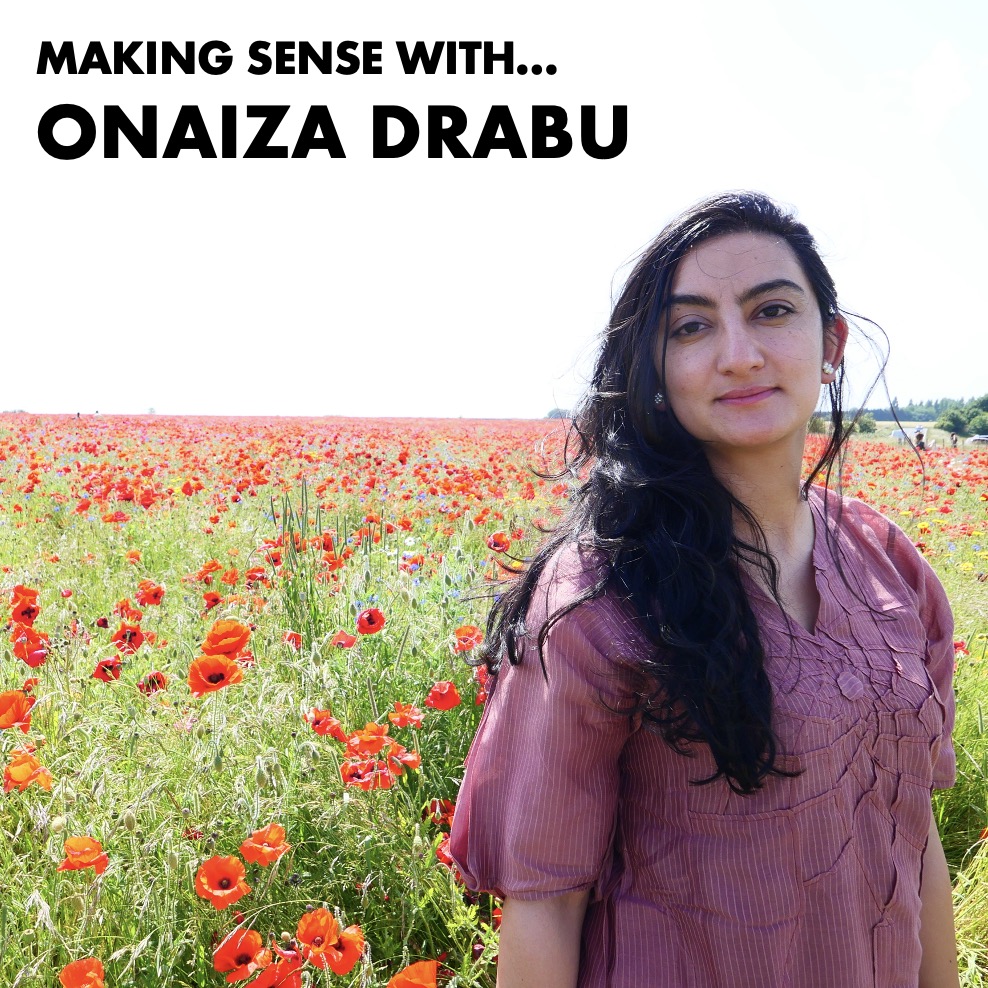
Photo courtesy of OD
What makes a semiotician tick? SEMIOVOX’s Josh Glenn has invited his fellow practitioners in the field of commercial semiotics, from around the world, to answer a few revealing questions.
Srinagar, Kashmir…
SEMIOVOX
When you were a child/teen, how did your future fascination with symbols, cultural patterns, interpreting “texts,” and getting beneath the surface of daily life manifest itself?
ONAIZA DRABU
I grew up in Kashmir and was raised in three languages — English, Urdu, and Kashmiri — at home. In Kashmiri, I was receptively bilingual — able to understand everything yet struggling to speak it. I would, however, enjoy tracing word origins and their journey between Urdu and Kashmiri, both of which borrow Arabic and Farsi vocabulary.
It is a fascination I continue today with my work in translation. However, the first instance was decoding Urdu poetry as a teenager. The process of tashrih (tr. explaining, expounding, dissecting something — in this case, literature) was the first instance of decoding meaning in verse to harken back to cultural traditions. Urdu literature comes from the tradition and in line with a lineage of Arabic and Farsi poetry rife with motifs that derive from Islamic history to philosophical thought.
A lot of the metaphysical poetry we read in our school curriculum would invoke the ‘beloved’, written much like a romance in the voice of the dejected lover. I recall our tutor’s voice, over and over, telling us not to think of the literal meaning of the beloved and go beyond it. What did the ‘beloved’ signify? God, of course. That’s the earliest signifier and signified I remember!
SEMIOVOX
Describe your first encounter(s) with the theory and practice of semiotics.
ONAIZA DRABU
Again a story from high school here! Our school textbook had an interview with Umberto Eco. I recall he said he was “a professor who wrote novels on Sundays” and this to me was the most exciting thought! How aspirational that he found time to work in what he called the interstices of life. The piece described his work with semiotics — the discipline, what it entailed, and what practitioners did. This was possibly my first encounter with the word itself.
Later in life, during my graduate studies in anthropology, I came across semiotic theory. There, it was never commercial semiotics that drew me to it but rather folklore! Much like Eco, I didn’t think it a part of my professional life until later. To me it was part of my life as a writer. I’d always been fascinated by folklore and wrote my first book on it — putting a lens on my own culture and decoding meaning through a rich trove of Kashmiri folklore.
SEMIOVOX
How did you find your own way to doing semiotics?
ONAIZA DRABU
It was by chance completely! I worked with UNICEF in digital transformation and lived in Kenya. An agency was looking for cultural insights work in the region and a friend put me in touch. One thing led to another, and I mentioned my actual region of expertise — South Asia — and slowly I started getting more interest. I’ve never actually worked in-house. I started as an independent consultant and continue to be one.
I’m also a writer and run an arts and culture small business called Daak. So even beyond my work as a semiotician-on-hire, it is a switch that is always on.
SEMIOVOX
What are the most important attributes of a good semiotician?
ONAIZA DRABU
The single most important one is to always be switched on — always be observing. Often when on a project, one doesn’t begin work from scratch. You already have so much knowledge to draw on from your observations — things you’ve noticed, trends you’ve spotted, cultural knowledge unknowingly assimilated, years of training on method. So by the time you sit down, you’re just recalling and distilling.
SEMIOVOX
What three books about semiotics have you found the most useful and enlightening in your own work?
ONAIZA DRABU
- Roland Barthes’ Mythologies is something I revisit often — the section on Myth Today in the book is something I turned to a lot during my work on folklore. Particularly since I was (and continue to) work with a language that is primarily oral.
- The other author I’ve referred back to extensively is Stuart Hall — strictly a cultural theorist — for use during discourse analysis. During a period where I did academic work using semiotics and discourse analyse to determine racism in TV news, I used his book Representation extensively.
- The third I’d pick is a practitioner’s handbook, ideal for helping a client see the work we do come to life. It is [American branding expert] Emily Heyward’s book Obsessed: Building a Brand People Love from Day One. It is a distilled blueprint for someone to take a lot of the big abstract stuff we deal with and to put it all tangibly into practice.
SEMIOVOX
When someone asks you to describe what you do, what is your “elevator pitch”? How do you persuade a skeptical client to take a chance on using this tool?
ONAIZA DRABU
“I help make sense of the world.”
I often ask potential clients for a problem at hand — the most pressing one. And then I describe what tools from the kit of anthropology and semiotics could be used for solving it. Often the tools requires adaptation — even very creative re-imagination — but rather than sticking with a template I’m very happy to adapt. So I make a case for the methodology and tool in the way to which a potential client will be the most receptive.
SEMIOVOX
What specific sorts of semiotics-driven projects do you find to be the most enjoyable and rewarding?
ONAIZA DRABU
Probably the most eye-opening (not to mention challenging) one was when I took on a brand decode for my own stationery brand that I’d run for five years. It was a humbling experience to see how much we miss in the rut and grind of daily operations — only to switch hats and have a whole new perspective.
SEMIOVOX
What frustrates you about how semiotics is practiced and/or perceived, right now?
ONAIZA DRABU
This may be specific to South Asia as a market, but being challenged about the very existence of your work as a practice while pitching can be exhausting!
SEMIOVOX
What advice would you give to a young person interested in this sort of work?
ONAIZA DRABU
Apropos to the previous question, because you’ll have to do a lot of convincing it’s crucial that yourself are convinced about what you do!
And don’t be afraid to adapt as needed, rather than go the conventional route.
MAKING SENSE series: MARTHA ARANGO (Sweden) | MACIEJ BIEDZIŃSKI (Poland) | BECKS COLLINS (England) | WHITNEY DUNLAP-FOWLER (USA) | IVÁN ISLAS (Mexico) | WILLIAM LIU (China) | SÓNIA MARQUES (Portugal) | CHIRAG MEDIRATTA (India / Canada) | SERDAR PAKTIN (Turkey / England) | MARIA PAPANTHYMOU (Greece / Russia) | XIMENA TOBI (Argentina) | & many more.
Also see these global semio series: MAKING SENSE (Q&As) | SEMIOFEST SESSIONS (monthly mini-conferences) | COVID CODES | SEMIO OBJECTS | COLOR CODEX | DECODER (fictional semioticians) | CASE FILE | PHOTO OP | MEDIA DIET | TATTOO YOU (semioticians’ tattoos).