

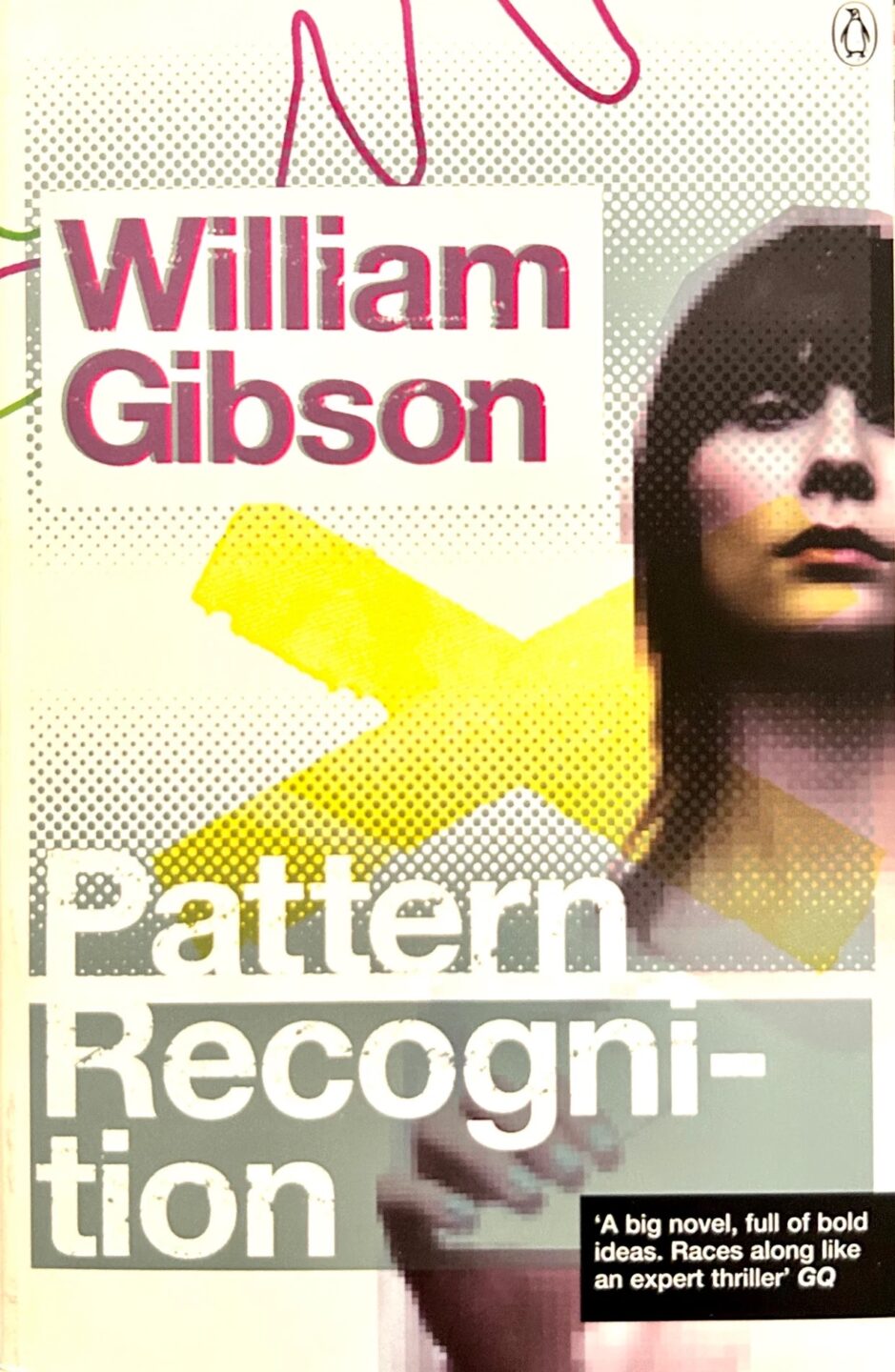
One in a series of posts dedicated to the author’s favorite semiopunk sci-fi. A version of each installment in this series first appeared at our sister site, HILOBROW.
Cayce Pollard’s acute sensitivity to branding has made her a sought-after, highly paid (and absolutely unquestioned) consultant… and also a neurasthenic type, who sands the logos off the buttons of her Levis. Think of her as a mercenary, decidedly un-preachy, and therefore infinitely more interesting and engaging Naomi Klein. * Unlike the preachy Klein, Pollard is haunted by epistemological doubt; she is adept at discerning deep patterns in culture, yet aware that apophenia — discerning patterns where there aren’t any — is an occupational hazard. She’s a self-aware paranoid.
“She can only tolerate things that could have been worn, to a general lack of comment, during any year between 1945 and 2000,” we’re informed about the heroine of William Gibson’s Pattern Recognition (2003). “She’s a design-free zone, a one-woman school of anti whose very austerity periodically threatens to spawn its own cult.”
As is so often the case with Gibson, he appears to poking fun at his own proclivities here. They’re my proclivities too! When I was in high school, my friends and I practiced a form of dandyism we called “Regular Style” — about which I’ve written elsewhere. Also see this 1999 Q&A I did with Daniel Clowes, where I describe Enid Coleslaw’s final look as “post-shtick shtick.” Pollard’s look is post-schtick.
Pollard is a kind of consulting semiotician, albeit one with fantastical abilities, so it’s almost too on-the-nose to include this book in the SEMIOPUNK series. Nevertheless…
A science fiction story set in the present, if such a thing is possible, Pattern Recognition takes as its theme the near impossibility of making sense — and finding meaning — in a postmodern, brand-saturated world.
Hubertus Bigend, head of the marketing agency Blue Ant, which also features in Gibson’s Spook Country (2007) and Zero History (2010), doesn’t care whether Pollard’s patterns are legit. Which is the very definition of bullshit; Bigend — like the real-life, big-ended Donald Trump, for example — is a consummate BS artist. By weaponizing Pollard’s abilities in the world of branding, he has become wealthy. Now, he has a side project for her: He tasks her with figuring out who has been posting a series of artistic film clips online. These are somehow immune to appropriation, almost beyond culture; they’ve gone viral; of course, Bigend wants to exploit the clips’ creator.
Shuttling between New York, London, Tokyo, and Moscow, Pollard ponders what it might portend that the clips — outsider art, essentially — have attracted a cult following, a hive-mind buzzing with mostly wrong-headed ideas. In the course of her quest, she will run afoul of the Russian Mafia… and must rely on talented Internet friends to ride to her rescue. Her mission also sheds light on the mystery of her ex-CIA father, who disappeared in New York City on Sept. 11, 2001, and is presumed dead.
The jaded Pollard is interested in the enigmatic video clips, which exert a melancholy fascination upon legions of viewers… but equally or more interested in the online subcultures of interpretation that have emerged in response to them. “Zaprudered into surreal dimensions of purest speculation, ghost-narratives have emerged and taken on shadowy but determined lives of their own.”
Pollard is interested not merely in what the clips mean, that is to say, but how they mean; the former is Dan Brown’s territory, the latter is Umberto Eco’s.
Working as a consulting semiotician can be fun… but it can take a toll. Pollard’s PTSD-like panic attacks, induced by a glimpse of Louis Vuitton luggage, or by the “terrible eyes” of the Michelin Man, are an amusing conceit. Her response to the Hilfiger brand suggests a deeper malaise: “simulacra of simulacra of simulacra…. There must be some Tommy Hilfiger event horizon, beyond which it is impossible to be more derivative, more removed from the source, more devoid of soul.” There’s also a good line about a fake-authentic Irish pub that Pollard spots: “a pub of such quintessential pubness that she assumes it is only a few weeks old.”
Is culture devouring itself, Ourobouros-like? Bigend certainly seems to think so. “The creative process is no longer contained within an individual skull, if indeed it ever was,” he declaims. “Everything, today, is to some extent the reflection of something else.” He has no problem with the Hilfigerization of culture. What he seeks to understand through cracking the mystery of the tantalizing film clips is how to help his clients’ brands capture attention, generate discussion. How to make a brand mean something… while also remaining ambiguous enough to invite participation in that meaning-making. The marketer’s Holy Grail.
There’s a more socio-political articulation of the Ourobouros problem, too: “We have no future because our present is too volatile… We have only risk management, the spinning of the present moment’s scenarios, pattern recognition.” This is the Hilfiger syndrome writ large.
After a burglar tampers with her laptop, Pollard finds herself on the trail of what may be an international conspiracy… or perhaps merely “an illusion of meaningfulness, faulty pattern recognition.”
Pattern Recognition is itself “to some extent the reflection of something else”: Pynchon’s 1966 apophenic thriller The Crying of Lot 49. In which Oedipa Maas uncovers a centuries-old conflict between two mail distribution companies. (Or is she perhaps merely detecting signals where there is only noise?) This is first-time-as-comedy stuff. Oedipa’s adventures are a picaresque, often comical, never earnest. Even though Gibson manages to avoid earnestness, this novel can be regarded as a tragic remake of the comedic Crying of Lot 49.
Pattern Recognition is also a reworking of Gibson’s own 1986 novel Count Zero. In which Marly Krushkhova, a disgraced art dealer turned art-world coolhunter, is offered unlimited resources by an untrustworthy tycoon. Her mission: Tracking down the maker of mysterious and melancholy boxes. Styled after the work of artist Joseph Cornell, the boxes contain nostalgia items created by… well, that would be a spoiler.
In both Gibson novels described here, the object of the commercial semiotician-like protagonist’s search turns out to be a MacGuffin. The point of Pattern Recognition, in other words, is the search itself — the impossible-to-satisfy search for meaning.