

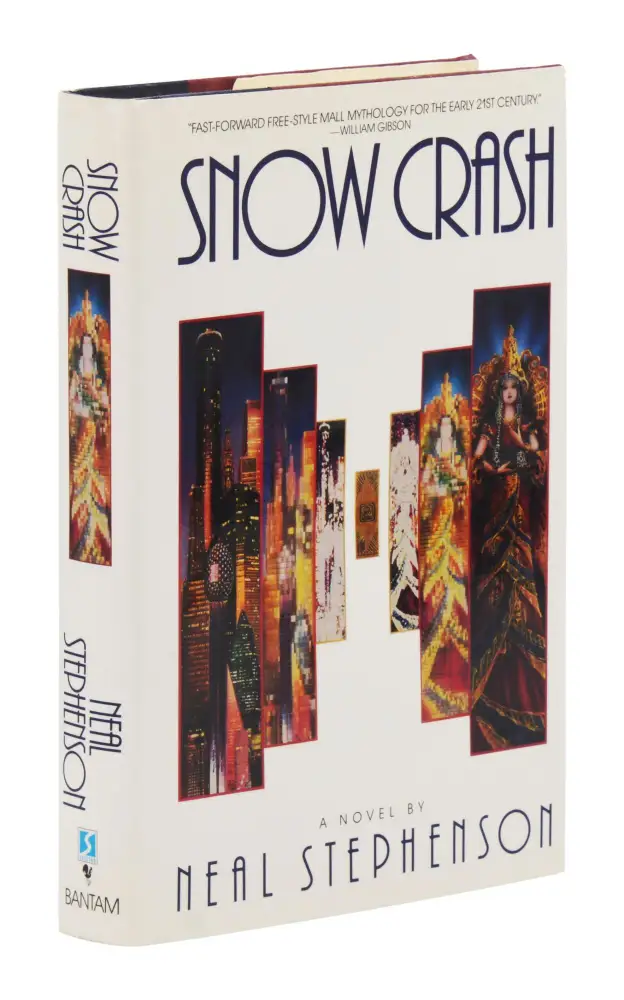
One in a series of posts dedicated to the author’s favorite semiopunk sci-fi. A version of each installment in this series first appeared at our sister site, HILOBROW.
Neal Stephenson’s first sci-fi novel began as a script for a Ghost in the Shell-ish graphic novel. Which helps explain why it’s visionary… yet also goofy. Stylish… yet also stoopid. As Mark Kingwell writes about the book, for HILOBROW: “The slang, the jokes, and the sexual politics have all aged poorly, alas. But the insights about democracy’s spectacular decline into spectral politics of identity, the dissolution of citizenship in a flurry of tech, power, and tribal enthusiasm, remain on point.” Snow Crash is either the last cyberpunk novel or a satirical send-up of cyberpunk. (Perhaps it’s both.) It’s overrated, at this point. Yet I do recommend reading it.
The skateboard-riding courier Y.T. (for “Yours Truly”), and Hiro Protagonist, the half-black, half-Japanese hacker who teams up with her, dwell in a near-future Los Angeles. They also spend much of their time jacked into the Metaverse, a virtual reality-based successor to the Internet — the users of which, whether they be humans or software agents, interact in the form of avatars (a use of this Sanskrit mythological term that Stephenson popularized). Snow Crash‘s Metaverse would influence the development of everything from Second Life to Quake. It’s one of Sergey Brin’s favorite novels; and when they rebranded as Meta, Facebook paid homage to it too.
Within the Metaverse, Hiro is offered a datafile named Snow Crash. Other hackers who’ve encountered Snow Crash (which takes the form of a virus, a drug, and a religion) have suffered not only catastrophic computer problems but brain damage. How? It seems that hackers, much like their computers, process information in binary form; their brains have been semi-digitized. Thus Snow Crash, a neuro-linguistic virus, damages hackers’ neuro-linguistic infrastructure.
A massive infodump informs Hiro, and via him us, that in the ancient past a single language — one linked to ancient Sumerian culture — was used as a literal programming language for the human brain’s deepest structures. (In all this, Stephenson is paying homage to William S. Burroughs’ Nova Trilogy — a “mythology for the space age” that warns of addictive, oppressive systems that from time immemorial have threatened human freedom.) In what Hiro learns of the Sumerian story of the Tower of Babel, the goddess Asherah personifies a neurolinguistic virus that hacks into the deep, hardwired language centers of the human brain; a legendary figure named Enki, meanwhile, created a counter-program that caused humans to speak other languages — thus thwarting Asherah. However, the virus has remained dormant in the human mind ever since.
Throughout human history, a cult has tried to spread the Asherah virus, Hiro learns. In the present timeline, the media mogul L. Bob Rife is attempting to use this ancient programming to control the minds of millions via cable television and a cult called Reverend Wayne’s Pearly Gates. Why does Rife target hackers like Hiro? Because they possess the unique analytical skills to unravel his neurolinguistic virus. It’s up to Hiro and Y.T., guided by the hacker and neurolinguistics expert Juanita Marquez, to get their hands on Enki’s neurolinguistic patch… and defeat Snow Crash.
As Massimo Flore, a strategic analyst with expertise in disinformation and hybrid threats, hs written, in a 2025 meditation on Snow Crash, “this is how modern disinformation operates.”
Not through logical argument or evidentiary persuasion, but through repetition, emotional resonance, and sheer velocity. Memes, slogans, hashtags. These don’t inform; they execute. They work not by expanding understanding, but by collapsing it. They hijack cultural signs and redirect them. Meaning gets rerouted through new authority structures: influencers, algorithms, identity groups. The signal becomes contagious. If you’re immune, you scroll. If you’re susceptible, you transmit.
The notion of figuring out how to bypass the general public’s conscious rationality is one that may make commercial semioticians squirm. While we’re certainly not attempting anything so drastic or unethical as mind control, our clients tend to be less like Hiro… and more like L. Bob Rife. Like Rife, we understand that humans’ conscious thoughts are guided and shaped by powerful symbolic systems; and although the notion of rewriting human consciousness is an absurd one, we do offer our services to those who seek to understand and leverage those symbolic systems for profit.
Here’s something else to chew over. Humans are wired to seek meaning, Hiro discovers… and this wiring renders us easily manipulated. As Juanita puts it, people “have religious receptors in their skulls.” Although those of us who — like the hackers in Snow Crash — spend our time engaged in the analysis of how meaning operates within specific semiospheres (i.e., how things mean what they mean) may think of ourselves as immune to meaning-manipulation, perhaps our brains have as a result of our work become uniquely vulnerable to “crashing” into static. Brrr!