

One in a series of posts dedicated to the author’s favorite semiopunk sci-fi. A version of each installment in this series first appeared at our sister site, HILOBROW.
At a time in which telepaths and “precogs” will have become a nuisance — meddling in business and government operations — it makes sense that an outfit like Runciter Associates, a “prudence organization” that employs “inertials,” which is to say, psychics possessing abilities that can neutralize those of unscrupulous telepaths and precogs, will have become a thriving concern. But Joe Chip, protagonist of Philip K. Dick’s 1969 novel Ubik, is neither an active psychic nor an inertial. Instead, he is a perennially cash-strapped Runciter Associates technician and tester for inertials.
That is to say, Joe is a “minor man,” i.e., the unglamorous yet dogged sort of character who despite his shortcomings, as Dick would put it in a 1970 letter, “asserts himself in all his hasty, sweaty strength.” Forget Tom Cruise, Arnold Schwarzenegger, and other Hollywood heroes who’ve portrayed PKD characters. Joe is more like us.
Charged by his employers — Glen Runciter, not to mention Glen’s dead wife Ella, who is maintained in a state of “half-life,” a form of cryonic suspension that allows the deceased limited consciousness and ability to communicate — with joining a team sent to Luna (the Moon) to secure Earth’s colony there against criminal psychics, Joe makes the trip. Just another job… although he is pleased that Pat Conley, a psychic on whom he has a crush, is part of the team. Pat can change the past in such a way that people don’t realize it, we’re given to understand — by starting “a counter-process that uncovers the prior stages inherent in configurations of matter.”
Alas, the mission turns out to be a trap set by criminal telepaths! A bomb explodes, and Glen Runciter is killed. Joe and the team barely survive, and return safely to Earth. Once there, however, they begin to experience strange alterations in reality. When Joe orders coffee, for example, the cream is sour; and a cigarette crumbles to dust between his fingers. Joe and his Luna mission teammates soon realize that they are slowly moving into the past. Eventually they become “anchored” in the year 1939. Which means that the objects in their lives fade into prior “versions” of themselves: a high-tech audio system reverts to a gramophone, say, and a TV becomes an AM radio.
As if this situation weren’t sufficiently bizarre and troubling, Joe and Pat and the others find themselves surrounded by “manifestations” of Glen Runciter. (For example, his face appears on their money.) He seems to want to communicate with them. What’s worse, as the story progresses, one by one members of the group begin to feel tired and cold, then suddenly die. It’s up to the lowly technician Joe, it seems, to figure out the situation.
Here’s where Ubik becomes a work of semiopunk. One of the key works of this sub-genre, in fact, or so many PKD fans would argue.
I encourage you to think of the altered reality into which Joe and his teammates find themselves thrown as a semiosphere. When we applied semioticians parachute into unfamiliar semiospheres, we’re always discombobulated at first. We scramble to analyze the semiosphere’s norms and forms, seeking clues (or, if you prefer, symptoms) that present themselves via advertisements, product packaging, pop culture, and so forth. This is precisely what Joe sets out to do, as he asks: Why do things keep dissolving, and/or devolving into prior versions of themselves? And what are the manifestations of Glen Runciter trying to communicate?
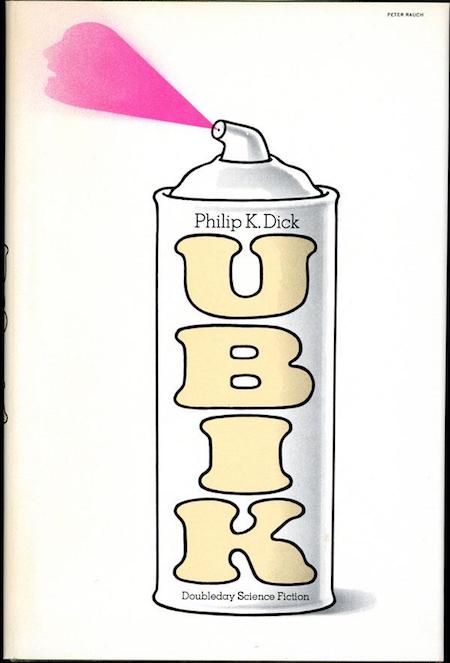
The most important clue of all, Joe decides, is the ubiquitous Ubik. This is a mysterious commercial product that often appears in the form of an aerosol spray (the paradigmatic consumer product of the era in which Dick was writing), though it can take other forms as well. According to the many marketing efforts with which Joe and his teammates are bombarded (each chapter of the novel begins with a cheesy commercial promoting the benefits of this impossible product), Ubik can solve all of their problems. Just one puff of this stuff, and the deterioration that they’re experiencing will be eliminated — as though their situation is akin to the heartbreak of psoriasis. All of which is to say that Joe finds himself acting not merely as a semiotician, but as a commercial semiotician.
By the way, at one point Joe articulates the notion of “residual” cultural elements better than most commercial semioticians ever do. “The past is latent, is submerged, but still there,” he muses, “capable of rising to the surface once the later imprinting unfortunately — and against ordinary experience — vanished.”
So what is going on? Like Dick’s other great books from this era, it’s nearly impossible to say for sure. Are Joe and the others really moving backwards in time? (Or might they have been transported to some other reality?) Are they caught up in a cosmic battle between the forces of light and the forces of darkness — and if so, what is the ultimate source of these forces? Does it all have something to do with Pat’s powers? How do Runciter’s messages appear in TV ads, on billboards, and inside cigarette packages on store shelves? What is Ubik; how can their salvation have possibly been bottled?
Every hypothesis that Joe and his teammates posit, every interpretation of how this semiosphere works, is frustrated. It’s an apophenic adventure. My favorite kind.
The last chapter of the book is prefaced by a quote from Ubik itself, speaking in the first person. It has created and directed the universe, Ubik claims; its real name is unknown and unspoken. At which point we learn something that makes us question everything we’ve come to comprehend (or think we comprehend) about Joe’s situation.
I don’t want to give away any spoilers, so I’ll stop here. However, even the “right” answer to Joe’s conundrum isn’t necessarily validated — or validate-able. Which is a valuable lesson for anyone interpreting any semiosphere.