

One in a series of posts dedicated to the author’s favorite semiopunk sci-fi. A version of each installment in this series first appeared at our sister site, HILOBROW.
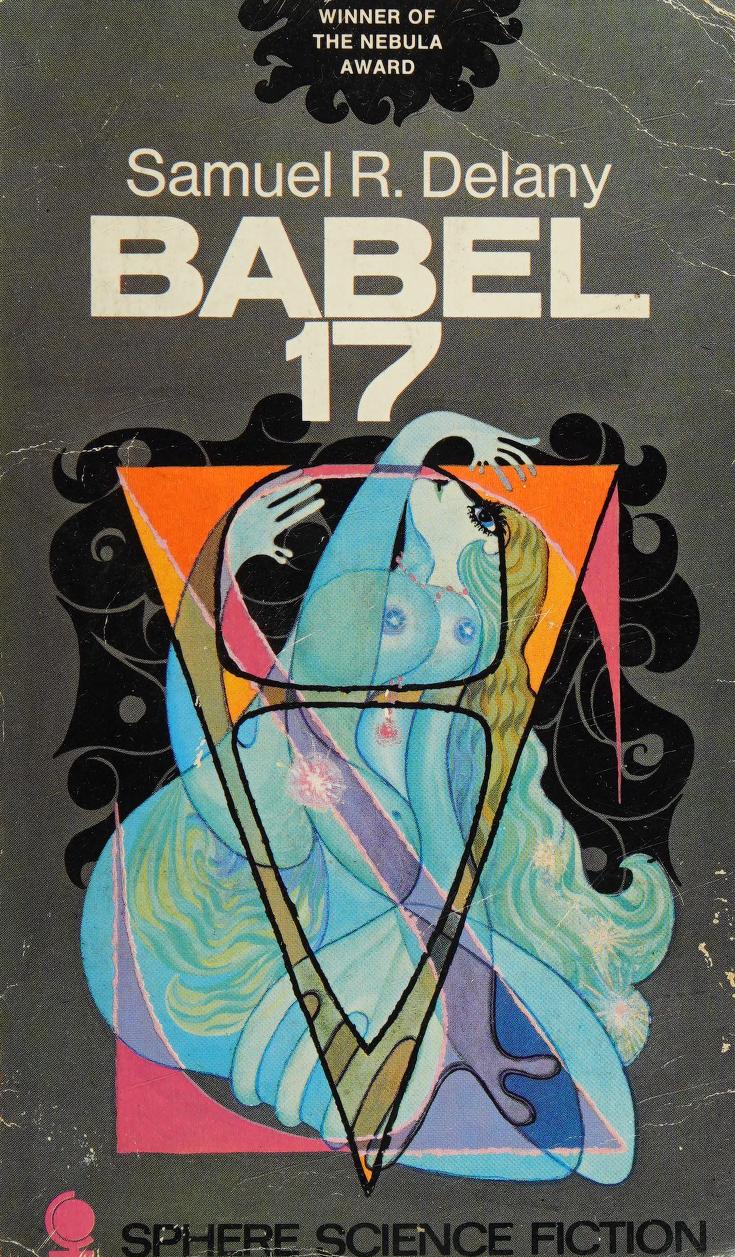
In Samuel R. Delany’s short, semiotics-inspired space opera — released by the pulp sf publisher Ace Books in 1966, it would share a Nebula Award with Flowers for Algernon, while losing out to Dune for a Hugo — humanity has spread itself throughout the galaxy. Now humankind’s galactic Aalliance is at war with an alien culture, the so-called Invaders, who are up to something potentially catastrophic.
The action begins in media res. Starship captain and celebrity poet Rydra Wong has determined that Babel-17, an impenetrable code used to cue Invader terrorist attacks all over the Alliance, is in fact a language. As Rydra, who is also something of a linguistics / semiotics expert, puts it: It’s an independent pattern of symbols with “its own internal logic, its own grammar, its own way of putting thoughts together with words that span various spectra of meaning.”
Babel-17 is a semiosphere, if you will. Full comprehension of Babel-17 isn’t merely a matter of cracking a code, then; it requires understanding of its gestalt: Who is speaking it, to whom, and to what end?
Rydra pulls together a starship team and sets off for space. We discover that Alliance starships have very specific crew requirements. They need to be staffed not only by genetically modified polyamorous trios, but by the consciousnesses of the “discorporate,” i.e., the deceased. A substantial section of the novel is devoted to Rydra’s scouring the East Village-like bohemia inhabited by bio-modding, sexually fluid “Transport” workers — a bohemia looked down on by the non-bohemian types who work in “Customs.”
One is reminded, perhaps, of semioticians and their clients. They need us… but they find us weird and off-putting. In fact, one subplot involves a Customs Officer, a straight and strait-laced white male, losing his resistance to the polymorphous-perverse appeal of the “Transport” demimonde. Fun stuff!
In an unfinished piece of fiction that I published here in 2020, I imagined a semiotics agency (possibly aliens) the members of which were highly specialized: “inductives,” “deductives,” and “abductives.” The crack team of abductives who meets to analyze a pop-culture franchise call themselves, half-jokingly, the “Abduction Squad.”
This isn’t the situation in Babel-17, though; Rydra needs her crew to help her pilot the spaceship, not figure out Babel-17. This is an adventure yarn — a space opera — in which one will find everything from hand-to-hand combat to full-scale spaceship battles. But the real adventure, in the end, is one of ratiocination: Rydra’s puzzling over Babel-17.
Like subsequent sf authors, including Neal Stephenson and Ted Chiang, Delany depicts language as determining thought and experience. He is playing out the dramatic implications of the Sapir-Whorf hypothesis — the idea of linguistic relativity. The structure of a language determines a native speaker’s perception and categorization of experience; the language you speak constrains what you can know, believe, and even perceive.
Babel-17 is full of semiotic insights like this one: “An individual, a thing apart from its environment, and apart from the things in that environment; an individual was a type of thing for which symbols were inadequate, and so names were invented.”
As she learns to speak and think in Babel-17, which is to say as she navigates this alien semiosphere, Rydra discovers that her perceptions and thoughts are altered. Babel-17 is a language of dense precision; each word opens up into a vast idea-complex. Rydra — already something of a telepath — finds her cognitive abilities altering and evolving, making her almost superhuman. She can perceive reality as a concatenation of fine-grained patterns. (This is a semiotician’s dream, of course.)
There’s a downside to Babel-17. Rydra falls in love with the Butcher, an amnesiac violent convict whose Babel-17-shaped speech is bereft of the words “I” or “you.” Without concepts of personhood and relation, the Butcher is amoral. Babel-17 is a machine language, intended for machines with no sense of self — and therefore no compassion. Rydra attempts to teach the Butcher these personhood concepts…
“Are they the same word for the same thing, that they are interchangeable?”
“No, just… yes! They both mean the same sort of thing. In a way, they’re the same.”
“Then you and I are the same.”
Risking confusion, she nodded.
“I suspect it. But you—” he pointed to her — “have taught me.” He touched himself.
“And that’s why you can’t go around killing people. At least you better do a hell of a lot of thinking before you do.”
But this sentimental education is a two-way street, Rydra discovers. She begins to turn against the Alliance. And she begins to become machine-like….
The novel ends with the suggestion that Rydra and the Butcher may achieve galactic peace by endowing Babel-17’s cognitive power with their own moral energy, their insistence that “I” and “you” matter.
Most of us commercial semioticians, I think, can relate.
***
Also see: Ramona Lyons, on Babel-17.