

Resistance & Surrender
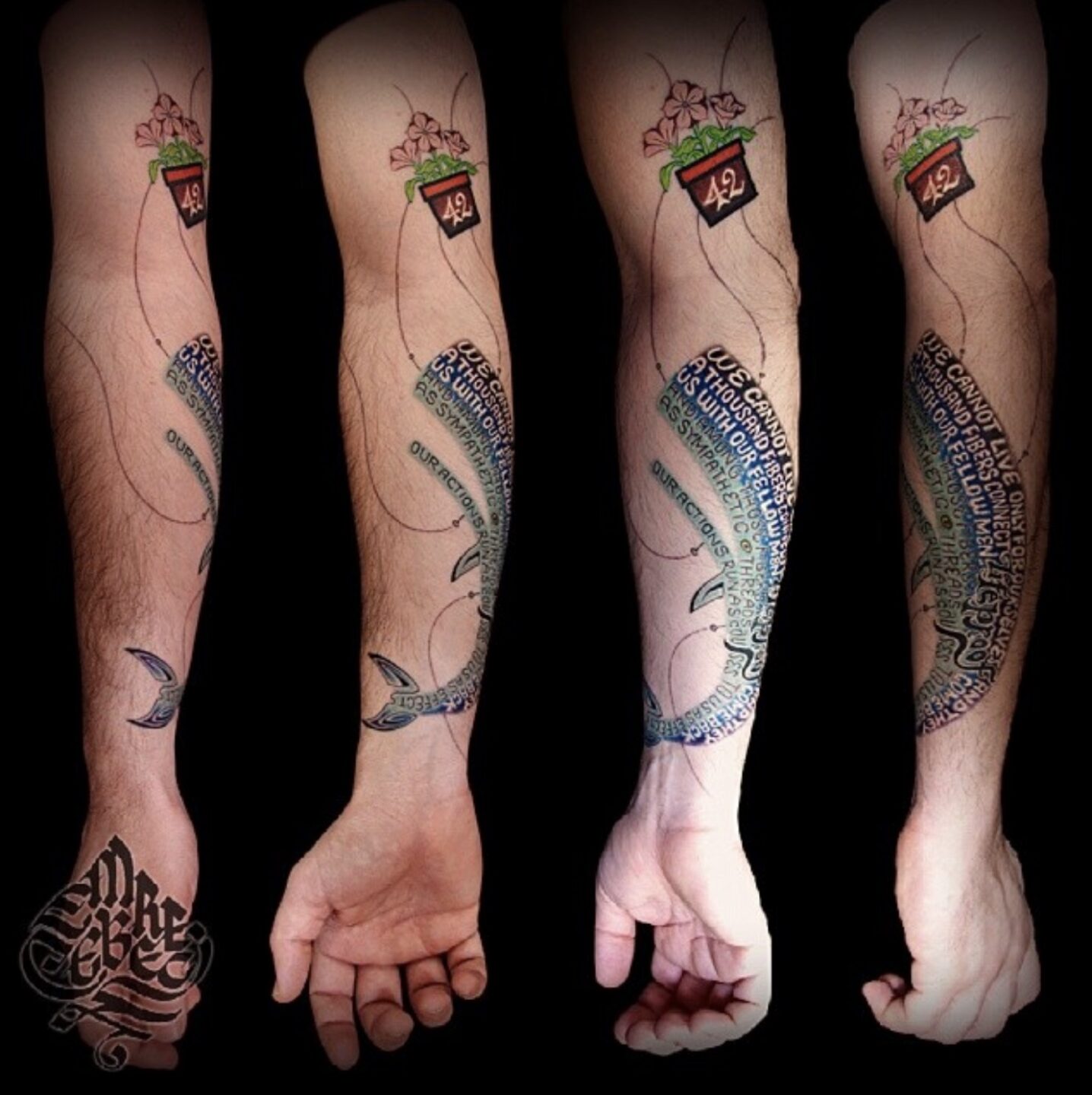
Image courtesy of the author; photos by the tattoo artist, Emre Cebeci [@cebecizade]
Semioticians analyze symbols, so for this series, we’ve asked 25 of our semio colleagues from around the world to explicate the symbolism of… one of their own tattoos.
On my forearm, a whale curves in a spiral of calligraphic text, its body built from Melville’s words; above it, a small bowl of petunias marked with the number 42 tumbles downward, suspended mid-fall. Fine lines — harpoon ropes turned connective threads — arc around them. This tattoo may look whimsical at first glance, but its symbolism crystallised for me over many years.
The story begins with something far less profound: I’d had the word lifeproof tattooed on my arm, a tongue-in-cheek tribute to my youthful certainty that I could withstand anything. With time, this tattoo no longer reflected who I had become or how I understood myself. But instead of removing it, the tattoo artist and I decided to integrate lifeproof into the whale’s body itself. The word now lives within its calligraphic anatomy — not erased, but absorbed. It has become part of the narrative, a reminder that we do not override our past selves; we accumulate them. Their traces remain, shaping the meanings we carry forward.
When I began searching for a symbol expansive enough to hold both who I was then and who I had become, two whales surfaced as the answer.
The first came from Moby Dick, which I read in college while imagining a future as a novelist. Melville’s whale is almost an anti-symbol: a creature onto which humans project meaning, ambition, obsession, rage — none of which it returns. Its indifference fascinated me. Here was a being that resisted anthropocentric narratives and simply was. It taught me something about scale, perspective, and the limits of our interpretive appetite.
The second whale appeared years later during my military service, when I read Douglas Adams’ The Hitchhiker’s Guide to the Galaxy. His whale, materialising out of nowhere and plummeting toward the ground, narrates its own existential awakening in real time. Beside it falls a bowl of petunias whose only thought is, “Oh no, not again.” One whale dramatises the hunger for meaning; the other reduces cosmic absurdity to a single line.
Together, these whales reflect two poles of human experience: the monumental struggle to impose meaning, and the equally human recognition that existence can be arbitrary or humorous, or entirely resistant to interpretation.
When I finally went to the tattoo artist — a calligrapher as well — he shaped the whale from Melville’s quotation: “We cannot live only for ourselves. A thousand fibers connect us with our fellow men…” He turned those fibres into the ropes swirling around my arm, visually linking the whale to the falling petunias. They are not harpoons here but relational lines: semiotic connections and reminders of the links we cast and the consequences that return to us.
Over time, the tattoo has become a map of two existential modes — striving and surrender, pursuit and free-fall. A reminder that meaning is never singular. It sprawls, accumulates, and, like those ropes, leaves space for whatever I choose to connect next.
TATTOO YOU: Nicola Zengiaro (Italy) on CORAL OF LIFE | Su Luo (Taiwan) on AN ISLAND, A TREE | Thierry Mortier (Sweden) on LIJFSPREUKEN | Cristina Voto (Italy) on JELLYFISH | Charles Leech (Canada) on SURF WAVES | Mariane Cara (Brazil) on BECOMING’S TRIAD | Chris Martin (Canada) on PUNK ROCK HEART | Angie Meltsner (USA) on ENJOY EVERY SANDWICH | Samuel Grange (France) on POLYMORPHOUS | Inka Crosswaite (Germany) on LAYERED FRAGMENT | Al Deakin (England) on FAMILY STAR | Hibato Ben Ahmed (France) on HENNA HAND | Max Matus (Mexico) on KALINGA REDOX | Whitney Dunlap Fowler (USA) on IN THE UNTETHERED | Chirag Mediratta (India) on THE SONG OF THE BUTTERFLY | Alexandra Ncube (England) on LIMINAL ROOTS | Josh Glenn (USA) on FALLING ANGEL | Aarushi Chadha (India) on PART-TIME PEOPLE PERSON | Serdar Paktin (Turkey/UK) on RESISTANCE & SURRENDER | Tatiana Jaramillo (Colombia/Italy) on EMBERÁ BLACKOUT | Antje Weißenborn (Germany) on FADED STAR | Sundari Sheldon (USA) on SUN | Roberta Graham (England) on SUNFLOWER/GUNMETAL.
Also see these global semio series: MAKING SENSE (Q&As) | SEMIOFEST SESSIONS (monthly mini-conferences) | COVID CODES | SEMIO OBJECTS | COLOR CODEX | DECODER (fictional semioticians) | CASE FILE | PHOTO OP | MEDIA DIET | TATTOO YOU (semioticians’ tattoos).