

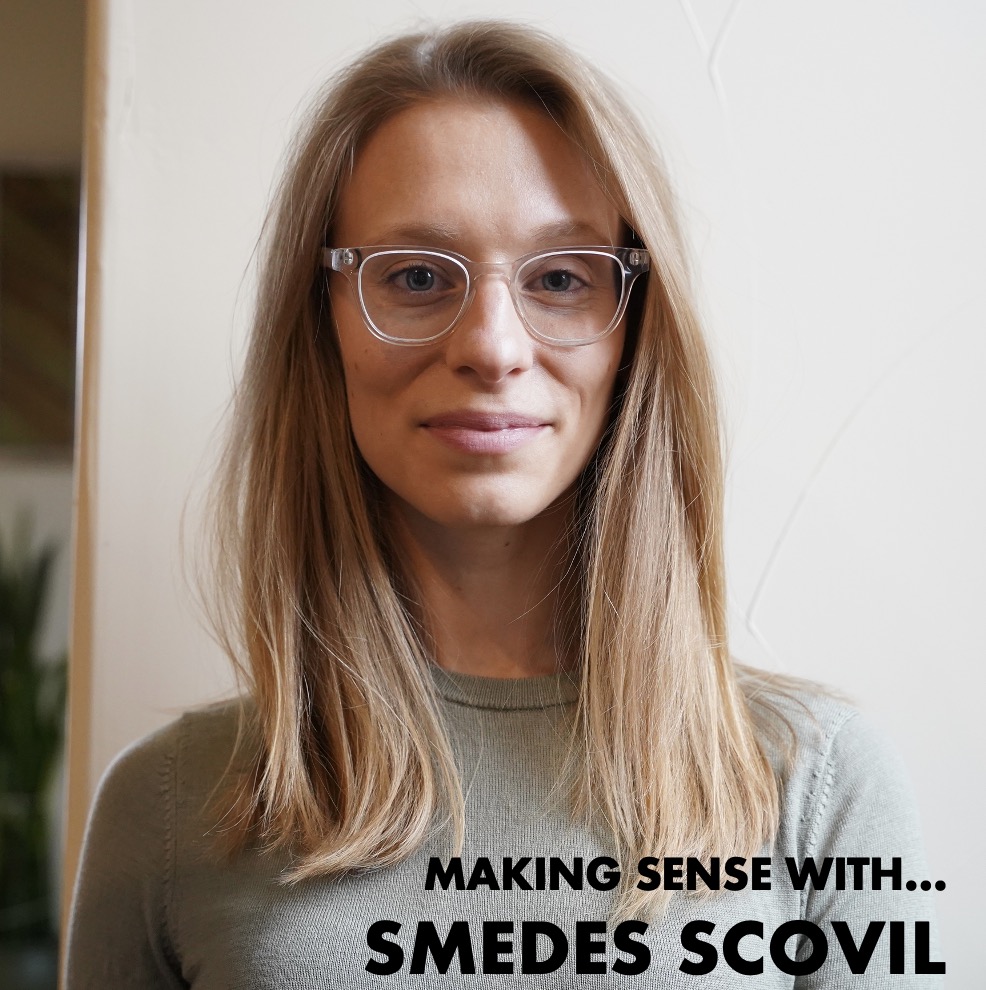
Photo courtesy of SS
What makes a semiotician tick? SEMIOVOX’s Josh Glenn has invited his fellow practitioners in the field of commercial semiotics, from around the world, to answer a few revealing questions.
New York…
SEMIOVOX
When you were a child/teen, how did your future fascination with symbols, cultural patterns, interpreting “texts,” and getting beneath the surface of daily life manifest itself?
SMEDES SCOVIL
Ancient Egypt was a source of deep fascination for me as a child. I dreamed of one day becoming an Egyptologist and spending my days deciphering the meaning and importance of various artifacts. While this career path has yet to pan out, I do approach my work today with the same sense of giddiness.
Growing up in a religious household, raised by an art historian mother, I was immersed in visual and verbal storytelling from birth. Rather passively, I developed the ability to read texts like paintings, sculptures, and stained glass.
In college, I took a freshman seminar on ekphrastic poetry, a practice that opened up an entirely new world of expression. For the first time, I was actively participating in a generative and compounding cycle of meaning.
SEMIOVOX
Describe your first encounter(s) with the theory and practice of semiotics.
SMEDES SCOVIL
I came to semiotics by way of brand strategy. In my early agency days, I was working at a firm that was and is well known for its packaging design prowess. I noticed the pack deconstructs and category codes were the parts of projects that I relished. The idea of thorough analysis and its impact on creative briefs was an instant draw. However, the hours allocated to this phase on a typical design project were limited and I wanted to go deeper.
SEMIOVOX
How did you find your own way to doing semiotics?
SMEDES SCOVIL
For better or worse, I’ve never been one to take things at face value. This serves me well in my work, as I never shy away from grey areas. After exiting full-time agency life and setting out as a solo practitioner, I set my sights on the work that I found most engaging. Several generous mentors introduced me to their networks and I now have a wonderful circle of semiotic minds around me.
While not the entirety of my work, semiotics forms a critical aspect of my approach. Painting a picture of the cultural context within which a product or service exists is paramount to its success.
SEMIOVOX
What are the most important attributes of a good semiotician?
SMEDES SCOVIL
Voracity – Having a robust media diet allows you to readily draw relevant connections when presented with a new challenge.
Determination – I regularly refer to myself as “relentlessly curious.” The practice of semiotics is a marathon of mental focus.
Humility – It’s impossible for anyone to know it all. Participating in a community of diverse thinkers is always a good idea.
I have also found that a background in design thinking is helpful in terms of familiarity with divergent and convergent thinking, as well as avoiding emotional attachment to initial hypotheses.
SEMIOVOX
What three books about semiotics have you found the most useful and enlightening in your own work?
SMEDES SCOVIL
I can’t say I’m a traditionalist or strictly academic when it comes to books about semiotics. Here’s what comes to mind:
- Julia Cameron’s The Artist’s Way. I’m not usually one for self-help or motivational books, so the transformational effect of this one surprised me. Approaching the world with a child-like wonder and engaging in play for its own sake are important reminders for us all.
- Paco Underhill’s Why We Buy. This is an older publication, and while some parts may be out of date, much of the consumer psychology still holds true. It taught me the importance of the context in which texts are encountered and the underutilized sensory aspects of in-person shopping.
- Ray Bradbury’s The Illustrated Man. My bookworm mother gifted this to me when I was in middle school. The 18 short stories blur the lines between the narrator’s interpretation and various fantasy worlds in a way that thrills me as a visual thinker.
I’m also eagerly awaiting the release of Chris Arning’s forthcoming book, Brand Semiotics in 20 Diagrams (2026). I got a sneak peek as a beta reader and am confident it will be an indispensable resource.
SEMIOVOX
When someone asks you to describe what you do, what is your “elevator pitch”? How do you persuade a skeptical client to take a chance on using this tool?
SMEDES SCOVIL
I study how people make sense of the world around them. As humans, we’re constantly making inferences based on our environment, whether consciously or subconsciously. I help brands understand the explicit and implicit meanings behind their choices so that they can more effectively connect with their audience.
When someone is skeptical, I find it’s helpful to note that semiotics also helps us to understand the trajectory of change and highlight key areas of opportunity that will outlive flash-in-the-pan trends that their competitors may be chasing.
SEMIOVOX
What specific sorts of semiotics-driven projects do you find to be the most enjoyable and rewarding?
SMEDES SCOVIL
It’s so affirming to work with teams that sense the value of semiotics and are open to how it can inform their thinking. As someone with a formal education in visual art, I particularly love working closely with design teams.
In recent years I had the thrilling opportunity to work closely with a mentor on a legal case in which they were serving as an expert witness. I wasn’t so much drawn to the idea of pursuing this route for myself (appearing in court terrifies me), but found my role in the process incredibly rewarding. While my work be invisible to those reading headlines announcing the outcome of the case, I was grateful to know my efforts had helped foster change.
A passion area of mine is aging. Specifically, I’m keen to rethink the way we represent aging and design better systems of support. Memory care is a critical part of this and there is so much worthy work to be done in this space.
SEMIOVOX
What frustrates you about how semiotics is practiced and/or perceived, right now?
SMEDES SCOVIL
Semiotics is definitely more established and valued beyond my home market. I do believe the US is catching on, but it’s a harder sell. I think the trend of the moment is smaller budgets and tighter timelines, due in no small part to the proliferation of AI. However, I haven’t lost hope, as the pendulum will inevitably swing in the other direction. I think our biggest challenge now will be to show that AI can be a value-add when used thoughtfully in tandem with real, human brain power.
SEMIOVOX
What advice would you give to a young person interested in this sort of work?
SMEDES SCOVIL
Reach out! I have found this community to be incredibly giving. Though it’s not new advice, always end informational calls with, “Who else should I talk to?” It’s worth asking and you’ll be delighted by who you meet.
I’d also look for online for courses, webinars, and discussions in which to participate. Semiotics can get intimidating and esoteric really quickly if you dive in head first.
Lastly, trust your gut. Chances are, if you have an interest in semiotics, you are already a curious being, and what a wonderful thing to be.
MAKING SENSE series: MARTHA ARANGO (Sweden) | MACIEJ BIEDZIŃSKI (Poland) | BECKS COLLINS (England) | WHITNEY DUNLAP-FOWLER (USA) | IVÁN ISLAS (Mexico) | WILLIAM LIU (China) | SÓNIA MARQUES (Portugal) | CHIRAG MEDIRATTA (India / Canada) | SERDAR PAKTIN (Turkey / England) | MARIA PAPANTHYMOU (Greece / Russia) | XIMENA TOBI (Argentina) | & many more.
Also see these global semio series: MAKING SENSE (Q&As) | SEMIOFEST SESSIONS (monthly mini-conferences) | COVID CODES | SEMIO OBJECTS | COLOR CODEX | DECODER (fictional semioticians) | CASE FILE | PHOTO OP | MEDIA DIET | TATTOO YOU (semioticians’ tattoos).