

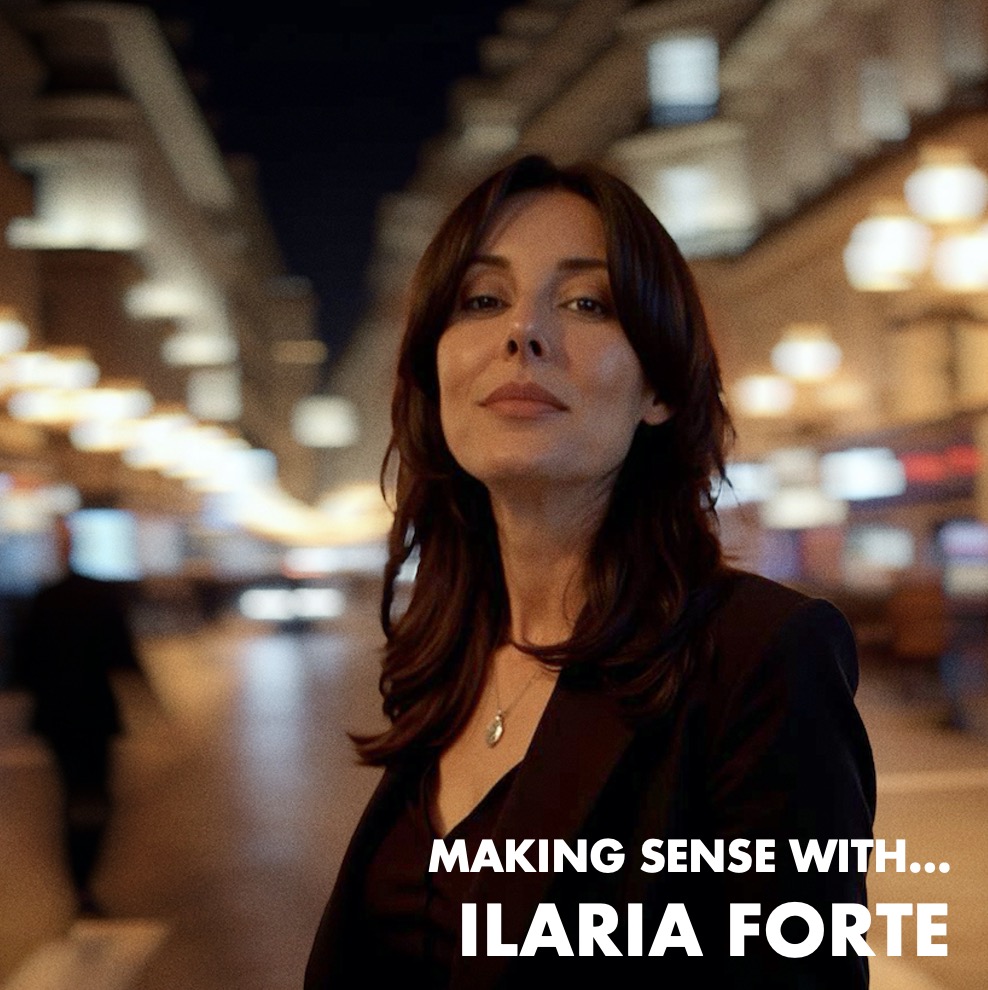
Photo courtesy of IF
What makes a semiotician tick? SEMIOVOX’s Josh Glenn has invited his fellow practitioners in the field of commercial semiotics, from around the world, to answer a few revealing questions.
Hamburg…
SEMIOVOX
When you were a child/teen, how did your future fascination with symbols, cultural patterns, interpreting “texts,” and getting beneath the surface of daily life manifest itself?
ILARIA FORTE
Since I was a child, I’ve been obsessed with sacred objects and symbols. The cross, above all. Growing up in Italy, it was an unavoidable presence. The cross is everywhere, and somehow inside everything. Embedded in the walls of a wayside chapel, hanging above doorways at kindergarten, pressed against sunburned skin. I was fascinated by its minimal architecture. Two lines meeting so perfectly at a single point, without dissolving, without overlapping. That point of contact still draws me in. Above and below, left and right, matter and spirit, earth and sky, here and elsewhere. A manifestation of tension that can hold contradiction without forcing resolution.
My great-grandmother used to trace a small cross on my forehead with her ring whenever I was sick. I still wear that ring. It reminds me that a gesture can carry a whole cosmology, a promise, a protection, a story about what suffering means and what care can do. That’s where it began for me. Not in a library, but in the texture of daily life, learning to read what wasn’t said.
Italy also trains you, almost against your will, in cultural literacy. You walk down a street and multiple eras overlap beneath your feet. A Baroque church built over a Paleochristian one built over a pagan temple. A Renaissance palazzo with a McDonald’s at ground level. The sacred merged with the profane, the ancient and the contemporary touch without interruption. Every façade, statue, and coat of arms tells you who held power, who lost it, who wanted to be remembered, and how. Italian cities are open-air living archives, inhabited, worn down by daily use.
Inside that density and richness, you learn to interpret early. I was drawn to the meanings that travel between systems, the glance that rearranges a room, the hand that blesses or dismisses, the “yes” spoken while the body says “no.” The table ritual that establishes invisible hierarchies, who belongs, who performs, who gets to take up space. We are always inside a performance. That early education became my most transferable training. Very young, I sensed something that never left me: meaning isn’t fixed; it’s generated. Built, negotiated, revised. That insight is both liberation and responsibility. If meaning can be built, it can be rebuilt, and once you see that, you realize you’re already participating in change. Every conversation, every gesture, every silence is a form of world-making.
Which brings me to the core question I keep returning to, and the one I bring into every boardroom, every strategy session, every workshop: What is the world we want to see emerging? It is not enough to understand the world as it is. We must ask ourselves what future we are catalysing with every word, every frame, every object, every product, every narrative we release into the world. That’s where semiotics becomes not just a decoding tool, but a transformative one — an intervention in the living tissue of culture.
SEMIOVOX
Describe your first encounter(s) with the theory and practice of semiotics.
ILARIA FORTE
My first encounter with semiotics happened while I was studying public relations, communication, and consumer studies. And it felt immediately like a portal. Not a door you walk through and return from, but a threshold that changes the quality of your perception permanently. It was a lesson on advertising. The Marlboro Man. What Leo Burnett created in the 1950s wasn’t a cigarette campaign. It was the resurrection of an American founding myth. The lone cowboy on the frontier, sovereign, untethered, answerable to no one but the open land. Millions of men didn’t buy a cigarette. They bought an identity, a posture, a promise of belonging to something larger and older than themselves. The product was almost irrelevant. The myth did all the work.
Semiotics gave me discipline. A way to name what I had always sensed but never had the tools to articulate: that culture is a living system of signs, and we are constantly being shaped by it, often without noticing, often without consent. It gave me a language for the invisible agreements we keep repeating. The codes that feel “natural” only because they have been rehearsed for so long they have forgotten they are codes. And that forgetting is where power hides. This is also where the business implications became impossible to ignore. Every brand, every product category, every organizational culture runs on codes, most of them unexamined. When you can read those codes, you can see not just what a company is communicating, but what it is unconsciously enacting. What futures it is foreclosing. What desires it is (mis)directing.
That diagnostic precision is what I bring to clients: not just insight, but a map of where meaning is leaking, hardening, or ready to shift. What didn’t attract me, right from the beginning, was the temptation to turn semiotics into a closed game. Brilliant readings that stay safely inside theory. Sparkling interpretations that never return to life. I didn’t want semiotics as a room you enter to feel clever yet alone. I use semiotics as a practice with consequences and with ethics. Because if meaning is constructed, then those who construct it, consciously or not, hold enormous power. And those who can read the construction hold the possibility of something else: refusal, reimagination, redesign. That’s why I still think of semiotics as a way out. Almost soteriological. Not because it saves you from the world, but because it gives you a chance to see the world’s scripts, and therefore, the chance to rewrite them. I stand for a practice of semiotics that could walk outside. In markets. In interfaces. In politics. In habits. In the stories nobody questions. A semiotics that stays accountable to life.
SEMIOVOX
How did you find your own way to doing semiotics?
ILARIA FORTE
I never quite think of this as “doing semiotics for a living.” What drives me is the inquiry itself. The freedom I allow myself while writing, mapping, analyzing, interpreting, without the weight of commercial interest pressing down on the work. Basquiat once said, “I start with a picture and then finish it. I don’t think about art while I work. I try to think about life.” That’s how I work. Because the moment the work becomes a mere instrument, it loses its purpose. So I learned to protect the inquiry, from the rush to simplify, the pressure to produce a neat conclusion that can be easily sold. Semiotics, for me, is the opposite of that. It is the practice of staying with complexity long enough for something radical to emerge. A refusal to reduce culture to a set of “insights,” people to “targets,” and meaning to “messaging.”
And yet, I am extremely practical when working on a client challenge. Analytical depth must be coupled with strategic, actionable recommendations. That translation is hard. It is a distillation process where lateral thinking collides with rigorous analysis, where the poetic and the operative must hold each other without one destroying the other. That tension never fully resolves, and the moment it resolves too cleanly, something has been lost, either the depth or the utility. The craft is learning to live inside that tension productively. You are the point where two lines meet.
My academic path gave me foundations. But it was real projects with real consequences that trained my craft. Over time I understood that symbols are operative. They contain instructions. They organize perception and belonging. They distribute power. They tell bodies what to do before the mind has even formed an opinion. Once you learn to read that infrastructure, you start seeing how often organizations move inside inherited choreographies they no longer recognize. They repeat codes and myths they did not actively choose. They are fluent in a language they have never consciously learned. Semiotics is the work of making that fluency visible, not to manipulate it, but to take responsibility for it. This is how I ended up here. Not by deciding on a career, but by following a question into the places where meaning is produced, contested, and repaired.
Somewhere along the way I understood that semiotics is a form of surgery. Not the dramatic kind. More like careful intervention in the living tissue of culture. You diagnose the hidden inflammation beneath a brand narrative. You locate the taboo inside a category. You notice when a system is addicted to an old myth it can no longer metabolize. And then you operate, not to dominate meaning, but to restore circulation.
At the end of a project, a client doesn’t just receive a report. They receive a new way of seeing their own system, the hidden codes that have been running quietly underneath strategy, communication, and culture. And with that new vision, the ability to make genuinely different and conscious choices.
SEMIOVOX
What are the most important attributes of a good semiotician?
ILARIA FORTE
A good semiotician? Before I answer, let’s move beyond the judgement embedded in the question itself. “Good” according to whom? For what purpose? In what context? There are genius minds who produce absolutely inspiring analyses that can be difficult to access. And there are practitioners who may not go as deep or as far, but who deliver findings that are clear, actionable, and useful. I think we need both. And frankly, if we don’t learn to hold that tension, the machine will replace us sooner than we’d like to admit, not because it will understand more, but because it will package faster. Which is exactly why responsibility matters more than ever.
To me, a skillful semiotician is someone who can stay in the space-between, walk at the edge. Curious without being naïve. Precise without becoming rigid. Able to see patterns across noise — codes, myths, rituals, oppositions, tensions — without flattening the living complexity of a culture. Someone who listens with humility, who allows reality to contradict their first interpretation, who understands that knowledge is always positioned, and that meaning-work is always power-work.
And then there is the rarest quality: translation. The ability to carry complexity into C-level rooms where decisions are made, without betraying it, without turning it into a slogan. A semiotician is not there to impress. They are there to clarify, to cut through the noise, to restore orientation. To give leaders a new map of the territory they thought they already knew.
And ideally, they hold an ethical spine. They keep asking who benefits, who is harmed, what gets erased, what gets normalized, what becomes thinkable, and what becomes impossible. Not everything we design can be inclusive in every way, for everyone, in every circumstance, but we can be accountable. We can name trade-offs instead of hiding them. We can design with consequences in mind, and shape stories, products, and futures that minimize harm and widen the space of equality, justice, and fairness.
SEMIOVOX
What three books about semiotics have you found the most useful and enlightening in your own work?
ILARIA FORTE
Oh. If you ask me for three books, my first impulse is to answer like Eco would: I’m a bibliophile. And if you force me to choose, I feel immediate guilt for the ones left out, because in semiotics, every book is also a doorway into a different ecology of meaning. So before I choose, I need a criterion that feels fair. Not “my favorites.” Let me reframe it as the three books that have truly been world-shifters.
- Roland Barthes’ Mythologies. The book that made everything click. The ideology doesn’t announce itself. It hides inside the obvious and the taken-for-granted. Each one a mythology masquerading as common sense. This is still the book I recommend to every client who wants to understand why their category feels “stuck”. They stagnate because their founding myths have become invisible.
- Umberto Eco’s A Theory of Semiotics. Demanding and architecturally magnificent. But more than the theory, what I absorbed from Eco was the discipline of staying with a problem long enough to see its full structure. In an era of instant insight and rapid synthesis, that discipline feels almost countercultural. And essential.
- For the third, I choose a small chorus rather than a single voice. Lotman’s Universe of the Mind, Kristeva’s Séméiôtiké, Baudrillard’s The System of Objects, Lakoff and Johnson’s Metaphors We Live By, Haraway’s A Cyborg Manifesto. I know that is not three, and they go well beyond semiotics. But that is precisely the point. The most generative semiotic thinking has always happened at the edges, where semiotics bleeds into cultural theory, cognitive science, political philosophy, feminist epistemology. The border is where the work gets interesting. And where the most useful tools for reading contemporary culture are actually forged.
SEMIOVOX
When someone asks you to describe what you do, what is your “elevator pitch”? How do you persuade a skeptical client to take a chance on using this tool?
ILARIA FORTE
I help organizations read culture so they can act with clarity. I help them see the hidden rules shaping perception, desire, trust, and resistance. I turn “signals” into maps, and maps into strategy. With skeptical clients, I sell semiotics as risk reduction and opportunity detection. Because if you don’t understand the cultural codes around your category, you can spend millions producing the wrong meaning, accidentally signaling exclusion, arrogance, emptiness, irrelevance. Semiotics helps you design messages, products, and experiences that land not because they are louder, but because they resonate with how meaning actually moves, through bodies, through contexts, through time, through the relational space between us.
Many organizations are not lacking intelligence. They are lacking circulation. Meaning gets blocked. Trust gets inflamed. A narrative becomes scar tissue that no longer stretches. A brand speaks, but the body of culture rejects it like a transplant without compatibility. So we look for the underlying code causing the rejection. The old myth that keeps producing the same symptoms. The place where the story is technically correct and emotionally dead. And I always insist on aftercare. Because every intervention changes the organism. Semiotics isn’t just interpretation. It’s responsibility and care.
SEMIOVOX
What specific sorts of semiotics-driven projects do you find to be the most enjoyable and rewarding?
ILARIA FORTE
The projects I love most are the ones where semiotics becomes a lever and a springboard, where insight changes something real, tangible, and disruptive. I love cultural code mapping in moments of transition. Because you can feel the future forming inside language, aesthetics, and rituals, arriving not as a plan, but as an emergence. These are the moments when a careful reading of what is shifting at the edges of culture gives an organization a six-month, twelve-month, sometimes five-year advantage over what the data will eventually confirm. What I bring to these projects is a genuinely transcultural eye: having worked across Europe, the Americas, Asia, and the Middle East, I’ve learned that what feels “universal” is almost always local in disguise. The most dangerous codes are the ones that travel invisibly, mistaken for nature when they are really just one culture’s habit.
I love narrative architecture when it goes beyond surface storytelling, when it becomes a deep story system that aligns identity, ethics, and action across an entire organization. Not a campaign. A coherent grammar that holds from the boardroom to the product to the customer relationship.
I love radical innovation work rooted in cultural tensions, because it proves that semiotics is not only interpretation. It is a way of creating conditions for new meanings to take root. The best innovations don’t solve a problem, they dissolve the frame that made the problem inevitable. Radical, for me, has always meant this: going to the root. Not disruption for its own sake, but the kind of change that reaches this generative layer beneath the level of expression, under the skin. That has been my work from the beginning.
And I am most moved by projects that touch the collective psyche — care, belonging, climate, technology, dignity — because in those spaces, a precise shift in code can become a catalyst for systemic change. This is where the transdisciplinary nature of my work matters most. I don’t arrive at these projects with a single lens. I arrive with semiotics in conversation with systems thinking, futures research, cognitive science, philosophy, and embodied knowledge from contemplative traditions. This is what allows me to map the full architecture of a challenge, not just its surface symptoms, but the deeper codes producing them.
SEMIOVOX
What frustrates you about how semiotics is practiced and/or perceived, right now?
ILARIA FORTE
Semiotics gets reduced, too often, to a trend accessory, It gets domesticated into a style: fast takes, clever labels, glossy moodboards. Insight porn in the purest sense: arousing, shareable, and structurally harmless. Insights that excite but don’t change decisions. In work settings it often looks like: endless decks, frameworks, “signals,” cultural observations, with no clear so what / now what, no owner, no next step, no experiment. Semiotics, as I understand it, is not the cherry we put on the cake. It’s a discipline with responsibilities: method, context, and humility in the face of living cultures. And yet ethical thinking is too often treated as an optional footnote. But meaning-work is never neutral. It scripts behavior. It can reproduce stereotypes, extract from communities, rebrand harm as “values,” and aestheticize exploitation until it becomes invisible. The shift I want is simple and radical: more depth, more humanity, more accountability. Less certainty for sale, more orientation inside complexity. And semiotics invited upstream, where decisions are born, not hired downstream to make them sound inevitable. I stand for a conscious semiotics that is historically awake, culturally sensitive, connected to impact.
SEMIOVOX
What advice would you give to a young person interested in this sort of work?
ILARIA FORTE
Learn theory deeply and then be brave enough to let it go. Use it to cross the river. Once you reach the other shore, leave it there. Don’t carry the framework on your back like a heavy stone. Don’t get stuck in the semiotic square. The most important move, always, is to begin your research from a place of not-knowing. That’s where the real work starts. Read, yes, but also observe, interview, listen, and test your interpretations against life. Train your eye across media, because language, images, interfaces, spaces, rituals, algorithms. Everything is semiotic, and everything has consequences. Stay ethically awake. Ask what meanings you amplify, who they serve, and who they silence.
Practice translation. Your value isn’t only in producing insights; it’s in making those insights usable without flattening complexity. That’s the hardest skill, and the most necessary. Create your own method. A way of seeing you can repeat, test, refine, and trust. And keep your wonder. Because semiotics, at its best, is both a tool for systems change and a form of devotion to the invisible architectures shaping our lives, and to the possibility of reshaping them with awareness and care.
MAKING SENSE series: MARTHA ARANGO (Sweden) | MACIEJ BIEDZIŃSKI (Poland) | BECKS COLLINS (England) | WHITNEY DUNLAP-FOWLER (USA) | IVÁN ISLAS (Mexico) | WILLIAM LIU (China) | SÓNIA MARQUES (Portugal) | CHIRAG MEDIRATTA (India / Canada) | SERDAR PAKTIN (Turkey / England) | MARIA PAPANTHYMOU (Greece / Russia) | XIMENA TOBI (Argentina) | & many more.
Also see these global semio series: MAKING SENSE (Q&As) | SEMIOFEST SESSIONS (monthly mini-conferences) | COVID CODES | SEMIO OBJECTS | COLOR CODEX | DECODER (fictional semioticians) | CASE FILE | PHOTO OP | MEDIA DIET | TATTOO YOU (semioticians’ tattoos).