

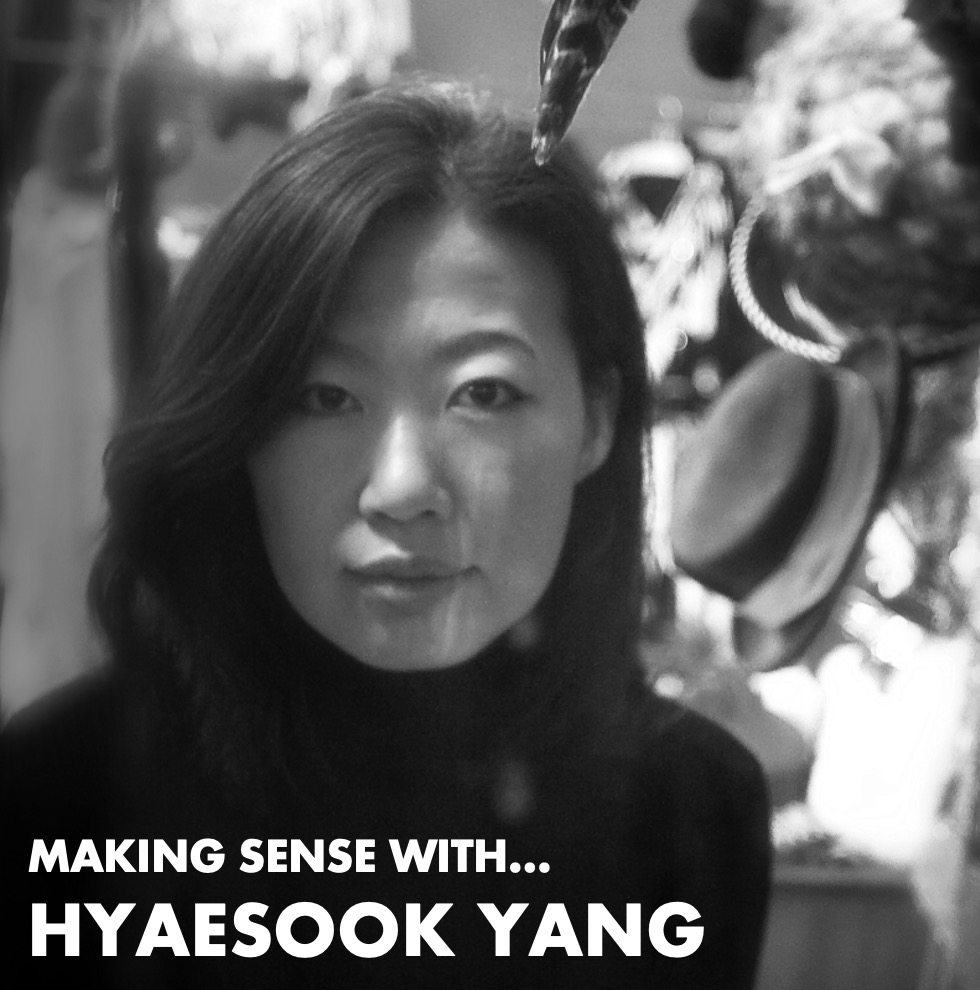
Photo courtesy of HY
What makes a semiotician tick? SEMIOVOX’s Josh Glenn has invited his fellow practitioners in the field of commercial semiotics, from around the world, to answer a few revealing questions.
Seoul…
SEMIOVOX
When you were a child/teen, how did your future fascination with symbols, cultural patterns, interpreting “texts,” and getting beneath the surface of daily life manifest itself?
HYAESOOK YANG
When I was a child, my favourite toy was an American telemarketing catalogue. I was especially drawn to printed images, and for me, my father — who was a career soldier at the time — would bring home telemarketing catalogues from U.S. military bases stationed in Korea. They were free, well printed, and impressively thick.
Every day, I carefully examined the products in those catalogues, imagining their purposes on my own. I was deeply fascinated by their exotic aesthetics. More than anything, through the images and objects they contained, I sensed cultures entirely different from the place where I was living at the time.
I particularly loved dolls in those catalogues, and I clearly remember dolls that wore traditional Korean hanbok while being made in the face of Western dolls. Although they were undeniably Korean in subject, they felt strangely unfamiliar. Through images, I began to perceive cultural differences and hierarchies — American products appeared naturally advanced, images of the future, while the Korean products I used felt outdated, something to be erased as quickly as possible. These cultural contrasts and aesthetic collisions became a kind of toy in themselves for me.
Later, my interest in images naturally shifted toward advertising. Every day I obsessively studied newspaper ads and clipped the ones I liked from magazines. The poses of female celebrities in Soju (Korean traditional alcohol) advertisements, the expressions of male celebrities in whiskey ads, and the objects used affordance-wise to signify meaning — such as locks in bank advertisements — were always compelling subjects to me.
SEMIOVOX
Describe your first encounter(s) with the theory and practice of semiotics.
HYAESOOK YANG
I began to engage more seriously with semiotics and semiotic research during my master’s studies at Goldsmiths university. By good fortune, I was able to take a lesson taught by Malcolm Evans, one of the figures involved in establishing semiotic research. His lectures transformed semiotics — which had always felt like a vague cloud to me (and I still sometimes confuse the signifier and the signified) — into an experience that felt more like engaging in enjoyable, intelligent conversation. It was easy to understand, intellectually stimulating, and, above all, highly practical.
I became deeply fascinated by the analysis of cultural codes, by the idea of viewing brands and images as coherent systems of meaning, and especially by the understanding that meaning can shift depending on the end user. The notion that meaning is never singular, but always open to multiple interpretations, was particularly compelling to me.
At the time, I already had substantial experience as a designer. Through semiotic research, I felt that I was finally given a kind of legitimacy — and a new language — for addressing the limitations I had long sensed in my design practice. These were elements that I intuitively felt were important yet could not previously be discussed within design decision-making processes. Learning semiotics felt like acquiring a new language that could be spoken in another country; it gave me a profound sense of freedom.
SEMIOVOX
How did you find your own way to doing semiotics?
HYAESOOK YANG
I believe it was chance and luck. Although these factors play a crucial role in shaping personal meaning.
By great good fortune, my very first experience in semiotic research was working with Virginia Valentine of Semiotic Solutions, one of the key figures involved in the early development of semiotic research. Looking back, the project could now be described as a relatively simple exercise in cultural interpretation. However, working with her became a decisive moment that led me to choose semiotic research, even after more than ten years of experience as a designer.
I consider it a rare kind of luck in life to be able to work with good people. At the time, I did not know who she was, nor did I fully understand what kind of work I was doing. Virginia and I stacked the magazines, carefully collect photographs one by one, and spend long hours talking through them together. They are moments I deeply miss. We sometimes disagreed over which cultural code a particular image belonged to. Had I known then who she was, I would have accepted her opinions without a single doubt. Instead, she clearly acknowledged my perspective and told me that I had a talent for semiotic research. When was the last time I had been praised by someone at work? In Korea, being praised by a manager or colleague is rare — surprisingly so. At least, that was my experience. For someone like me, Virginia’s words felt almost magical. Whether or not I truly had talent is another matter.
In truth, while her praise meant a great deal to me, what excited me even more was the act of seriously discussing meanings that often go unnoticed, in a space that felt genuinely open. I knew I wanted to continue doing this work, and fortunately, with the help of those around me, I was able to do so. Through an internship at Space Doctors, I was lucky enough to be introduced to other researchers as “a semiotic researcher from Korea.” As the influence of Korean culture gradually expanded on a global scale, the scope of what I could contribute also grew.
I believe semiotic research is one of the most effective ways to communicate how culture can be understood. And, like many other things in life, I have been able to continue this work thanks to the people I have met along the way. On a personal level, I feel that semiotic researchers tend to be good people — perhaps because they share a fundamental openness toward understanding cultures other than their own.
SEMIOVOX
What are the most important attributes of a good semiotician?
HYAESOOK YANG
A good person. A kind heart. Someone who knows how to care for others. An open mind that seeks to understand how meaning is formed by others. The ability to look at things in their initial state, without rushing to conclusions. The capacity to question what feels natural and unquestionable — for example, asking something as extreme as, “Why do we find cockroaches disgusting?” — and to recognize the value of such questions in themselves.
SEMIOVOX
What three books about semiotics have you found the most useful and enlightening in your own work?
HYAESOOK YANG
- George Lakoff and Mark Johnson’s Metaphors We Live By. This book demonstrates that metaphor is one of the most fundamental ways through which we understand the world. In particular, its argument that metaphors arise from embodied experience has been extremely influential in shaping my approach to semiotic research.
- The writings of Joseph Campbell. Together with Jung, Campbell’s work has helped me understand the processes through which meaning is generated in mythology.
- The writings of Byung-Chul Han. A Korean-born philosopher and cultural theorist working in Germany, Han reflects on the lives of contemporary individuals living under neoliberalism and in the digital age. His position between Germany and Korea, and his engagement with digital modernity, often reminds me of artists such as Nam June Paik or the contemporary composer Isang Yun. For me, his work has been invaluable in understanding Korea, the world, and the present moment.
SEMIOVOX
When someone asks you to describe what you do, what is your “elevator pitch”? How do you persuade a skeptical client to take a chance on using this tool?
HYAESOOK YANG
I think this answer needs the condition within Korea. For global brand projects, I usually join after other researchers have already convinced the clients, so I rarely have the chance to directly persuade global brand clients myself. Also, since I am often invited as a specialist semiotic researcher in Korea, there is often no need for additional persuasion.
Semiotic research is still not well known in Korea, so I introduce myself and my work very carefully. Instead of emphasizing the term “semiotics” or the methodology, I usually explain it by comparing it to more familiar design research or other research methods. My experience working with well-known global brands helps me gain trust with Korean clients.
I tend to approach clients whose brands are more open to culture and creativity, differentiating semiotic research from other types of research. Rather than focusing on specific success stories, I highlight the discomfort or limitations they may have felt with existing processes and propose semiotic research as a solution. I describe it more as an invitation than a hard sell, sometimes portraying semiotics as a mysterious field. This is because Korean brands still tend to be skeptical about the practical use of culture-focused qualitative research.
Moreover, given how rapidly the Korean market changes, offering a single, clear solution doesn’t make much sense. Instead, I emphasize the importance of taking a longer-term view to understand overall cultural trends and maintaining some control over their interpretation.
To me, semiotic research is less like Western medicine that identifies and removes problems, and more like traditional herbal medicine that strengthens a brand’s immunity. This may sound a bit too ideal, but because of this, rather than focusing on immediate results backed by numbers, I focus on building relationships with clients over time through conversations and shared, gradually felt benefits.
SEMIOVOX
What specific sorts of semiotics-driven projects do you find to be the most enjoyable and rewarding?
HYAESOOK YANG
It’s always rewarding to see successful changes in brands from a distance through my research. I genuinely enjoy all the methodologies and processes involved in semiotic research. Finding codes and interpreting culture is always fascinating. Sometimes my ideas may seem far-fetched, but I feel a strong sense of accomplishment knowing they can offer brands fresh perspectives.
But above all, what I enjoy the most is meeting new people, encountering new ideas, and developing my own unique way of seeing the world. Recently, a couple of my projects involved research on early teenagers and very elderly seniors. I feel truly grateful for the opportunity to explore and understand worlds I might never have approached or even considered if it weren’t for the work I do.
SEMIOVOX
What frustrates you about how semiotics is practiced and/or perceived, right now?
HYAESOOK YANG
Rather than a criticism of semiotic research itself, I have a personal interest in bio-semiotics. I often find myself thinking about what comes next for semiotics in the face of sudden environmental changes and the age of AI. This might sound broad and vague, but the signs created by humans are overwhelmingly anthropocentric. Because of this, I believe there are inherent limitations. The meanings we experience, and produce come from beings with two eyes, one nose, and one mouth — essentially, the world as perceived by humans. However, we share our environment with other beings whose bodies and sensory “antennas” experience meaning differently. I want to learn more about semiotics that considers the external environment and its role as a signifying agent beyond just humans. I have tentatively called this perspective “eco-semiotics.”
From the semiotic research perspective I currently provide to brands, I question the tendency to interpret Korean cultural trends through Western ways of thinking. For example, the global popularity of K-pop should be understood less by looking at K-pop content itself and more by understanding the people who enjoy it and the environment surrounding them. In an extreme sense, understanding the fandom behind Korean culture is more important than the culture itself.
Although this observation comes somewhat late, my interest lies less in the narrative or formal completeness of Squid Game than in the reasons its story was embraced by Western viewers. (The popularity of K-pop Demon Hunters can be seen as an evolved iteration of Korean cultural production.) From this point of view, a recent talk organized by Coco Wu, a Chinese semiotic researcher, about Asian perspectives on semiotics was very fascinating to me.
SEMIOVOX
Peirce or Saussure?
HYAESOOK YANG
I’m still exploring, but personally, I believe that Peirce’s concept of Semiosis — the idea that meaning is generated and expanded within the world — offers a way for humans to transcend their own limitations.
SEMIOVOX
What advice would you give to a young person interested in this sort of work?
HYAESOOK YANG
Welcome to this world. Acknowledge your own Umwelt and listen more closely to the meanings of others.
MAKING SENSE series: MARTHA ARANGO (Sweden) | MACIEJ BIEDZIŃSKI (Poland) | BECKS COLLINS (England) | WHITNEY DUNLAP-FOWLER (USA) | IVÁN ISLAS (Mexico) | WILLIAM LIU (China) | SÓNIA MARQUES (Portugal) | CHIRAG MEDIRATTA (India / Canada) | SERDAR PAKTIN (Turkey / England) | MARIA PAPANTHYMOU (Greece / Russia) | XIMENA TOBI (Argentina) | & many more.
Also see these global semio series: MAKING SENSE (Q&As) | SEMIOFEST SESSIONS (monthly mini-conferences) | COVID CODES | SEMIO OBJECTS | COLOR CODEX | DECODER (fictional semioticians) | CASE FILE | PHOTO OP | MEDIA DIET | TATTOO YOU (semioticians’ tattoos).