

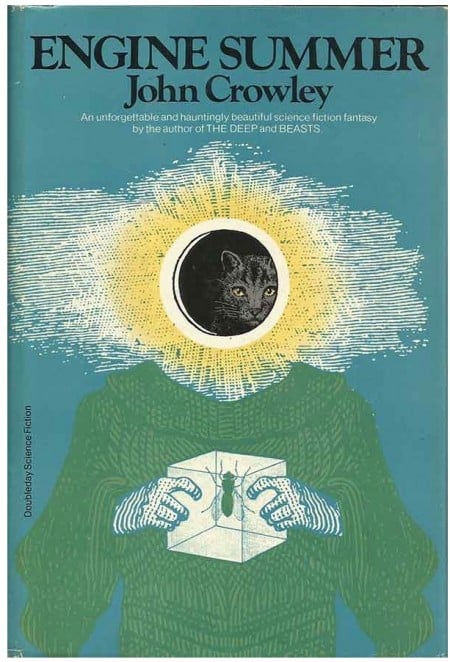
One in a series of posts dedicated to the author’s favorite semiopunk sci-fi. A version of each installment in this series first appeared at our sister site, HILOBROW.
John Crowley is best known for Little, Big (1981), an amazing family saga and gnostic adventure that Ursula K. Le Guin insisted “all by itself calls for a redefinition of fantasy,” and which Harold Bloom called “the most enchanting twentieth-century book I know.” In addition to his fantasy novels, including the Ægypt series, Crowley has written gem-like sci-fi novels and novellas, including The Deep (1975), Beasts (1976), Engine Summer (1979), and Great Work of Time (1989). These ought to be much better-known to sf fans.
Rush That Speaks, protagonist of Engine Summer, is 14 when he leaves Little Belaire, a village populated by “truthful speakers” in what, if you ask me, is situated — as is Edgewood, in Little, Big, not to mention Blackbury Jambs, in the Ægypt series — in a version of New York’s Hudson Valley. (In this case, perhaps in the shadow of Catskill Park’s Belleayre Mountain.) Rush’s community — the post-apocalyptic descendants of anti-technology, Gurdjieffian-ish hippies and radical feminists, which (if you know the Hudson Valley) checks out — harvests and sells “St. Bea’s bread,” a smokeable and psychotropic nutrition source the origin of which, we’ll figure out, is not Earth.
Once a Day, a girl whom Rush loved when they were children, has run off with a strange nomadic group, Dr. Boot’s List, which trades (for St. Bea’s bread) the medication that allow women in this future world to get pregnant. This telepathic cat-worshipping group’s strangeness, Rush will learn, once he tracks the group south to the ruins of Service City, turns out to be a function of their use of an ancient artifact — in the form of a transparent globe — capable of imposing a personality, from a mind-recording, temporarily over one’s own. An unintended consequence of which is an addictive rush of returning self-knowledge as that effect wears off.
Rush is also curious about the pre-catastrophe past, relics and rumors of which confound and amaze him. Over the course of his slow journey to find Once a Day, he will spend time in the company of the scavenger Blink, a devoted scholar of pre-catastrophe America (one whose exegetical interpretations, the reader wants to tell Rush, are often incorrect); and of Zhinsinura, a nurturing spiritual guide who challenges Rush to “uncurl” and expand his consciousness. Thanks to these and other interlocutors, Rush will come to understand that pre-catastrophe America was a technologically advanced yet deeply screwed-up society that brought ruin upon itself.
It’s the interval with Blink and Zhinsinura that I think would appeal to my fellow semioticians. Like a semiotician who has spent too long brooding over disconnected fragments, Rush yearns to experience the “aha!” moment where all the dots finally connect up.
“When I was conceiving [Engine Summer],” Crowley has said in an interview, “I thought I knew one thing about the future — that it was certain not to resemble our imaginings and projections. So I discarded all the things that looked likely, based on current trends: technological advances, overpopulation, international networks of trade and competition, advanced weaponry. I erased cities, governments, even literacy, and yet I imagined that out of the unlikeliest bits of the present, new spiritual trends could arise, and a new language in which to express them.” This is the opposite of how science fiction — “hard” science fiction, anyway — usually works. It’s defamiliarizing… a story about a future in which everyone is obsessed with hearing stories about the past — our present.
“When you are putting things together in this way and you have a character who is trying to ponder the bits and pieces he’s found or discovered,” Crowley mused in another interview, “what that character — if he’s a thinker, as many of the characters I write tend to be heavy thinkers, hard thinkers anyway — would think about is, How am I putting this together? Is this an actual thing I’m putting together, or am I fooling myself? Is it totally lost and am I creating a new thing out of what I found, or am I actually finding a way back to a lost world? I think that’s what we do in our daily lives, a lot of the time, even when we try to construct our own past.”
Crowley describes here the semiotician’s central dilemma. Are the structural schemas we painstakingly puzzle out and construct accurate representations of the way meaning works within a particular “semiosphere”? Or are we apophenically hallucinating?
A thriller this isn’t. It’s quiet, slow-moving, richly detailed… and then suddenly, at the end, all finally becomes more or less clear.
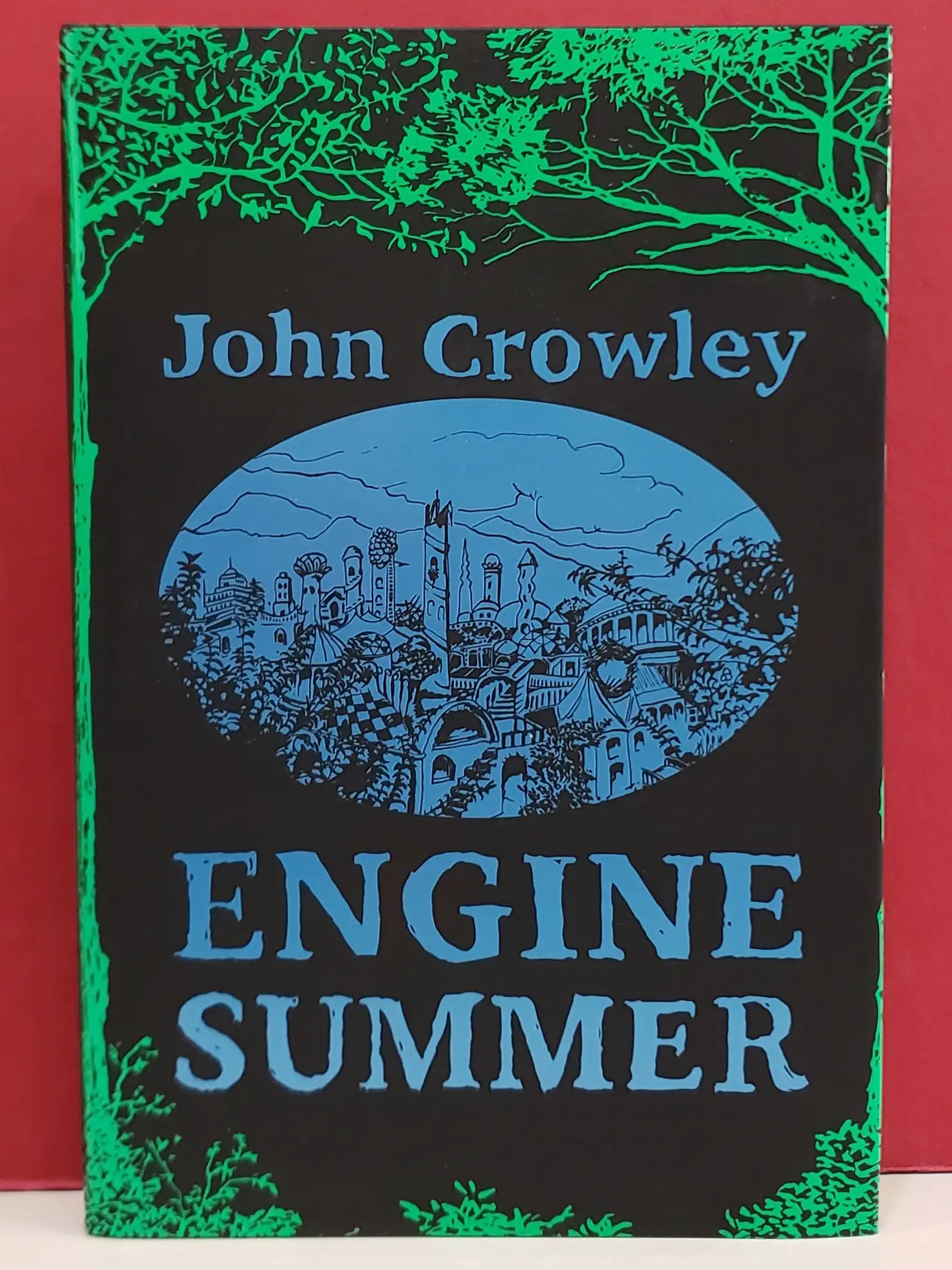
While dwelling with Blink, Rush rejoins linked artifacts — a high-tech ball and glove — that have been separated for centuries. This action sends a long-awaited signal to the “angels” whom Rush already suspected of hovering overhead, “above the clouds, below the sky”; one of these beings intercepts Rush and records his story. Which it seems we’re experiencing not directly from Rush… but from a kind of amalgam of recorded Rush and whoever it is that is temporarily inhabiting his memories. It’s a deus ex machina moment, in which a divine being descends from above to resolve a plot conflict… except that in this case there are all sorts of things left unresolved.
Harold Bloom himself admitted that he wasn’t able to fully “solve” Engine Summer… and that’s OK. Crowley’s wonderful little book is not a puzzle so much as it is a kind of globe into which the reader inserts his or her head, thus inviting a rather inscrutable stored consciousness to take up residence for a while.
And yes, it’s an addictive experience.