

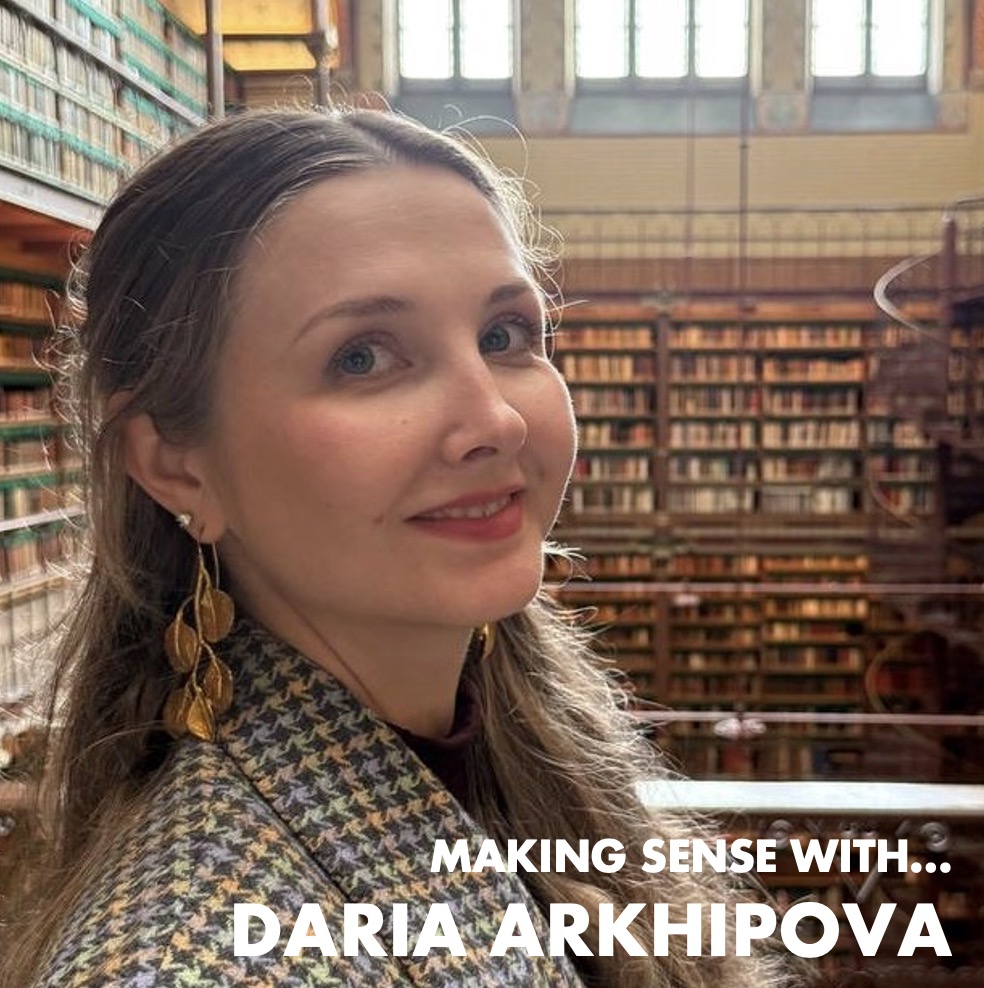
Photo courtesy of Daria Arkhipova
What makes a semiotician tick? SEMIOVOX’s Josh Glenn has invited his fellow practitioners in the field of commercial semiotics, from around the world, to answer a few revealing questions.
Turin…
SEMIOVOX
When you were a child/teen, how did your future fascination with symbols, cultural patterns, interpreting “texts,” and getting beneath the surface of daily life manifest itself?
DARIA ARKHIPOVA
I grew up in a small town but my parents traveled often, so I always felt a bit “out of context” as a kid.
In middle school, I was completely fascinated by Ancient Egypt — especially hieroglyphs and how they were interpreted. While most of my classmates wanted to hang out, I preferred staying home writing stories about brave adventurers deciphering secret symbols and discovering ancient treasures. I never became a teen literary star (as I hoped), but that passion led me to a degree in communications — which, beneath the surface, involved countless hours studying literature, languages, and philology. That’s when I first discovered semiotics and the work of Yuri Lotman.
SEMIOVOX
Describe your first encounter(s) with the theory and practice of semiotics.
DARIA ARKHIPOVA
Not many people are familiar with Lotman’s Soviet-era TV series Talks about Russian Culture (Беседы о русской культуре), but I found it incredibly vivid and insightful — even for understanding contemporary issues. I think it was inevitable that I’d end up studying semiotics in Tartu.
When I began the program in 2014, we were immediately immersed in biosemiotics, zoosemiotics, and the work of Jakob von Uexküll. At first, I struggled to connect my love for Lotman’s cultural semiotics with these other branches. But a few years later, I was given Robert Sapolsky’s book on how life works in baboon societies — and through that seemingly biological lens, I came to deeply appreciate biosemiotics, zoosemiotics, and even endosemiotics. Semiotics offers uniquely powerful ways to interpret both cultural and natural phenomena.
SEMIOVOX
How did you find your own way to doing semiotics?
DARIA ARKHIPOVA
During my MA in semiotics at the University of Tartu, I shared a dorm apartment with Lyudmyla Zaporozhtseva, who was doing her PhD at the time. We used to dream in our tiny kitchen about starting a semiotics agency together. I guess the course on applied semiotics by Chris Arning and Malcolm Evans was a crucial point in all these. Years later, we actually did end up working together — along with other colleagues in applied semiotics — helping brands improve how they communicate with their audiences.
One especially formative experience was working with Ruth Somerfield in the UK. She gave me valuable insights into how the British market approaches applied semiotics, and I’m deeply grateful for her mentorship and the opportunities she gave me.
In 2020, I began my PhD with Prof. Massimo Leone, focusing on Semiotics and Artificial Intelligence. I had a great time researching how AI-generated recommendations shape user behavior, and collaborated on projects across the UK, France, and Russia. After finishing my PhD, I had the honor of joining the EUFACETS project, where we used semiotic insights to design an app for elderly users. Today, I’m part of a team exploring how semiotics and AI can be used to interpret animal communication and support the regulation of Indigenous ecosystems.
SEMIOVOX
What are the most important attributes of a good semiotician?
DARIA ARKHIPOVA
The same as those of a good human being: critical thinking. And that includes recognizing that you don’t have all the answers. A good semiotician is always curious, always learning, and always open to new methodologies and challenging case studies.
SEMIOVOX
What three books about semiotics have you found the most useful and enlightening in your own work?
DARIA ARKHIPOVA
- My current read is [Italian semiotician] Dario Martinelli’s A Critical Companion to Zoosemiotics. It goes beyond animal communication — it’s a powerful reflection on how our own human-animal dimension shapes daily communication. The longer I work in semiotics, both academic and applied, the more I realize how important it is to embrace a holistic perspective that includes our biological and social experiences of meaning.
- Bankov’s Digital Mind is essential reading in today’s world. If your clients have any sort of online presence — which is basically everyone — this book offers groundbreaking insights into how digital environments are transforming communication. It also had a major influence on my own research into how AI shapes user behavior on social media.
- I can’t choose between [American neuroscientist] Terrence Deacon’s The Symbolic Species and [American neuroscientist] Robert Sapolsky’s monumental Behave. Both explore how we create meaning and make decisions, and both challenge us to think deeply about human behavior and free will. I like to imagine an alternate universe where Deacon and Sapolsky co-author a book — that would be a thrilling read!
SEMIOVOX
When someone asks you to describe what you do, what is your “elevator pitch”? How do you persuade a skeptical client to take a chance on using this tool?
DARIA ARKHIPOVA
It’s funny, but more and more people actually know what semiotics is! Recently, I told someone I work in semiotics and she said, “Oh, I took a course on that in undergrad — I loved it!”
Many businesses already understand the value of using cultural insights in branding. The key is showing them how semiotics can work specifically for their goals and audiences. Once they see that, the rest is easy.
SEMIOVOX
What specific sorts of semiotics-driven projects do you find to be the most enjoyable and rewarding?
DARIA ARKHIPOVA
Some days I love diving into academic research on AI; other days I’m immersed in applied projects for pharmaceutical brands. That’s the beauty of semiotics — it’s never boring, and it always requires you to find new ways of answering complex questions.
Presenting my research — whether to colleagues or clients — is especially rewarding. The questions people ask push me to think deeper and refine my ideas.
SEMIOVOX
What frustrates you about how semiotics is practiced and/or perceived, right now?
DARIA ARKHIPOVA
I teach applied semiotics at IULM University in Milan, which focuses on business communication. My job is to equip students with the strongest skillset possible in just 50 hours. I challenge them to analyze a phenomenon using the frameworks of Greimas, Lotman, and Eco — and some of them produce projects so solid they could present them to real clients.
Their success often comes down to persistence, curiosity, and a talent for working with “texts.” Today, we have tools like GPTs to help us, but it’s important to remember that while large language models can generate text, they don’t generate meaning. Strong analysis still requires digging deep and understanding a phenomenon holistically. Algorithms just aren’t there yet.
SEMIOVOX
Peirce or Saussure?
DARIA ARKHIPOVA
Haha, this is always a fun one! I don’t think it’s fair to compare them — and I tell my students the same. Most people can grasp Saussure pretty quickly; almost no one can claim to fully grasp Peirce in all his complexity. But both are foundational, and both continue to shape the semiotics we practice today.
SEMIOVOX
What advice would you give to a young person interested in this sort of work?
DARIA ARKHIPOVA
Enjoy your youth — and invest in yourself. Study semiotics, maybe in a new country. Meet people. Learn. As ethnosemioticians say, our bodies are part of our research tools — experience matters. It’s not just about hours in the office; it’s about the life you live.
In 2025, I already feel so much deeper in my research than I did in 2019 or 2020 — and I can only imagine how much more I’ll learn by 2030.
MAKING SENSE series: MARTHA ARANGO (Sweden) | MACIEJ BIEDZIŃSKI (Poland) | BECKS COLLINS (England) | WHITNEY DUNLAP-FOWLER (USA) | IVÁN ISLAS (Mexico) | WILLIAM LIU (China) | SÓNIA MARQUES (Portugal) | CHIRAG MEDIRATTA (India / Canada) | SERDAR PAKTIN (Turkey / England) | MARIA PAPANTHYMOU (Greece / Russia) | XIMENA TOBI (Argentina) | & many more.
Also see these global semio series: MAKING SENSE (Q&As) | SEMIOFEST SESSIONS (monthly mini-conferences) | COVID CODES | SEMIO OBJECTS | COLOR CODEX | DECODER (fictional semioticians) | CASE FILE | PHOTO OP | MEDIA DIET | TATTOO YOU (semioticians’ tattoos).