

Layered Fragment
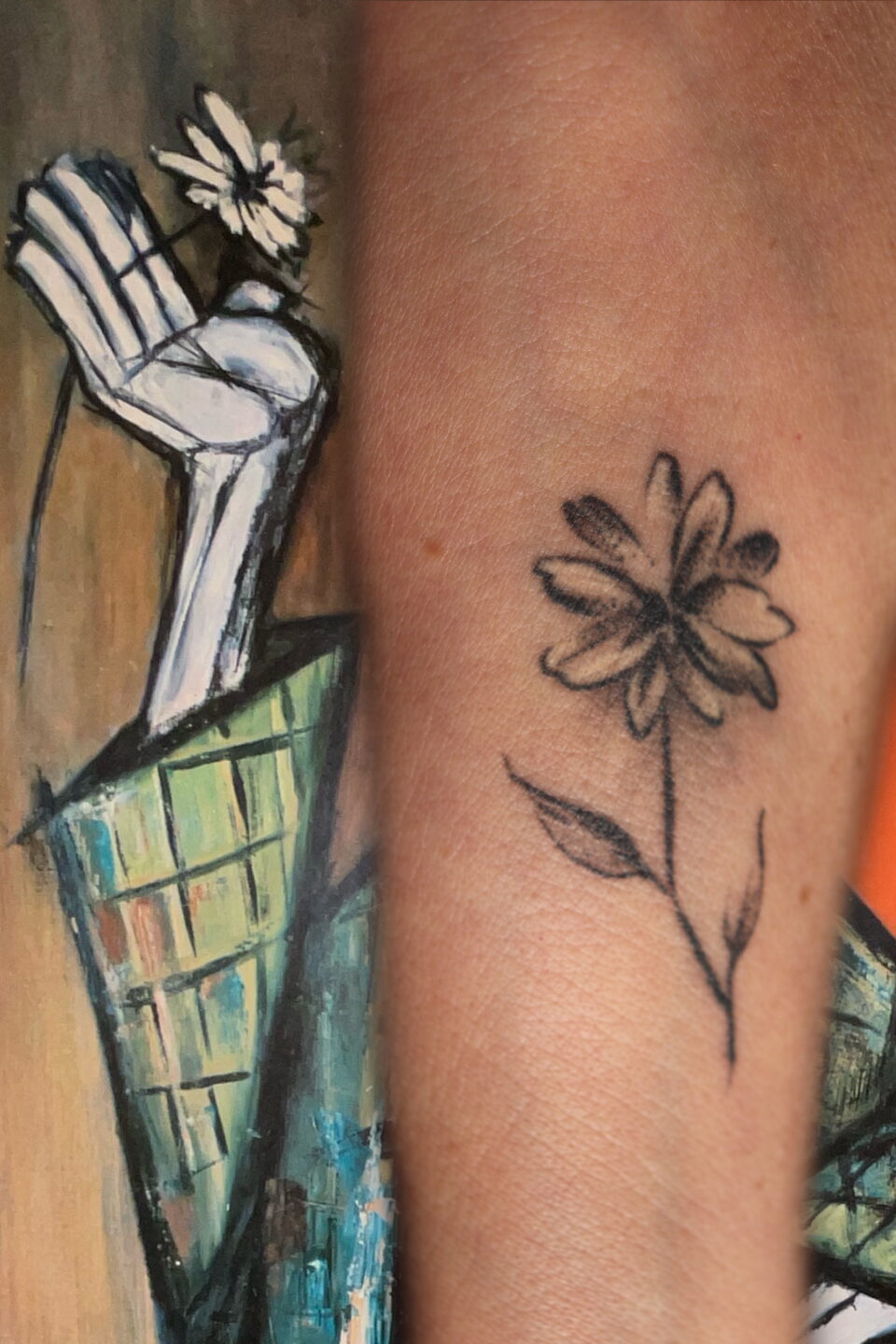
Image courtesy of the author
Semioticians analyze symbols, so for this series, we’ve asked 25 of our semio colleagues from around the world to explicate the symbolism of… one of their own tattoos.
A Marguerite daisy, drawn from a painting my father once bought in France, now rests on my arm. It is a small detail, a fragment of a much larger scene: a clown gently holding the same flower. That painting moved with our family over the years. First it hung in my parents’ home, then later in mine, quietly entering the rhythm of daily life and becoming part of what felt familiar.
My son Ray grew up seeing the painting, perhaps barely aware of how present it always was. During his training as a tattoo artist, he chose the clown as a tribute to his childhood and in memory of his grandfather. In response, I chose the daisy. It links the three of us: my father, my son, and me. A shared reference point, carried now not on a wall but on skin.
The Marguerite daisy itself carries a particular resonance. It is an unassuming flower, often overlooked, yet it holds a long tradition of symbolism: innocence, endurance, and the ability to thrive in overlooked places. It speaks to the small things that stay with us, the visual anchors and recurring motifs that gain meaning through repetition and time. They do not demand attention, but they build continuity.
By isolating a single fragment of the original painting, the tattoo shifts the story. What was once only a detail becomes central. It reflects how meaning often condenses into specific objects or images that travel with us through different phases of life. Each time I see it, I am reminded of the movement of time and of the ties that have shaped me across generations.
The tattoo is both private and visible. It is a discreet sign that others may interpret in their own way. For me, it is a calm reminder of origin and connection, expressed through a flower that is quietly significant. It is a fragment that continues the story simply by being there, carried forward as life moves on.
TATTOO YOU: Nicola Zengiaro (Italy) on CORAL OF LIFE | Su Luo (Taiwan) on AN ISLAND, A TREE | Thierry Mortier (Sweden) on LIJFSPREUKEN | Cristina Voto (Italy) on JELLYFISH | Charles Leech (Canada) on SURF WAVES | Mariane Cara (Brazil) on BECOMING’S TRIAD | Chris Martin (Canada) on PUNK ROCK HEART | Angie Meltsner (USA) on ENJOY EVERY SANDWICH | Samuel Grange (France) on POLYMORPHOUS | Inka Crosswaite (Germany) on LAYERED FRAGMENT | Al Deakin (England) on FAMILY STAR | Hibato Ben Ahmed (France) on HENNA HAND | Max Matus (Mexico) on KALINGA REDOX | Whitney Dunlap Fowler (USA) on IN THE UNTETHERED | Chirag Mediratta (India) on THE SONG OF THE BUTTERFLY | Alexandra Ncube (England) on LIMINAL ROOTS | Josh Glenn (USA) on FALLING ANGEL | Aarushi Chadha (India) on PART-TIME PEOPLE PERSON | Serdar Paktin (Turkey/UK) on RESISTANCE & SURRENDER | Tatiana Jaramillo (Colombia/Italy) on EMBERÁ BLACKOUT | Antje Weißenborn (Germany) on FADED STAR | Sundari Sheldon (USA) on SUN | Roberta Graham (England) on SUNFLOWER/GUNMETAL.
Also see these global semio series: MAKING SENSE (Q&As) | SEMIOFEST SESSIONS (monthly mini-conferences) | COVID CODES | SEMIO OBJECTS | COLOR CODEX | DECODER (fictional semioticians) | CASE FILE | PHOTO OP | MEDIA DIET | TATTOO YOU (semioticians’ tattoos).