

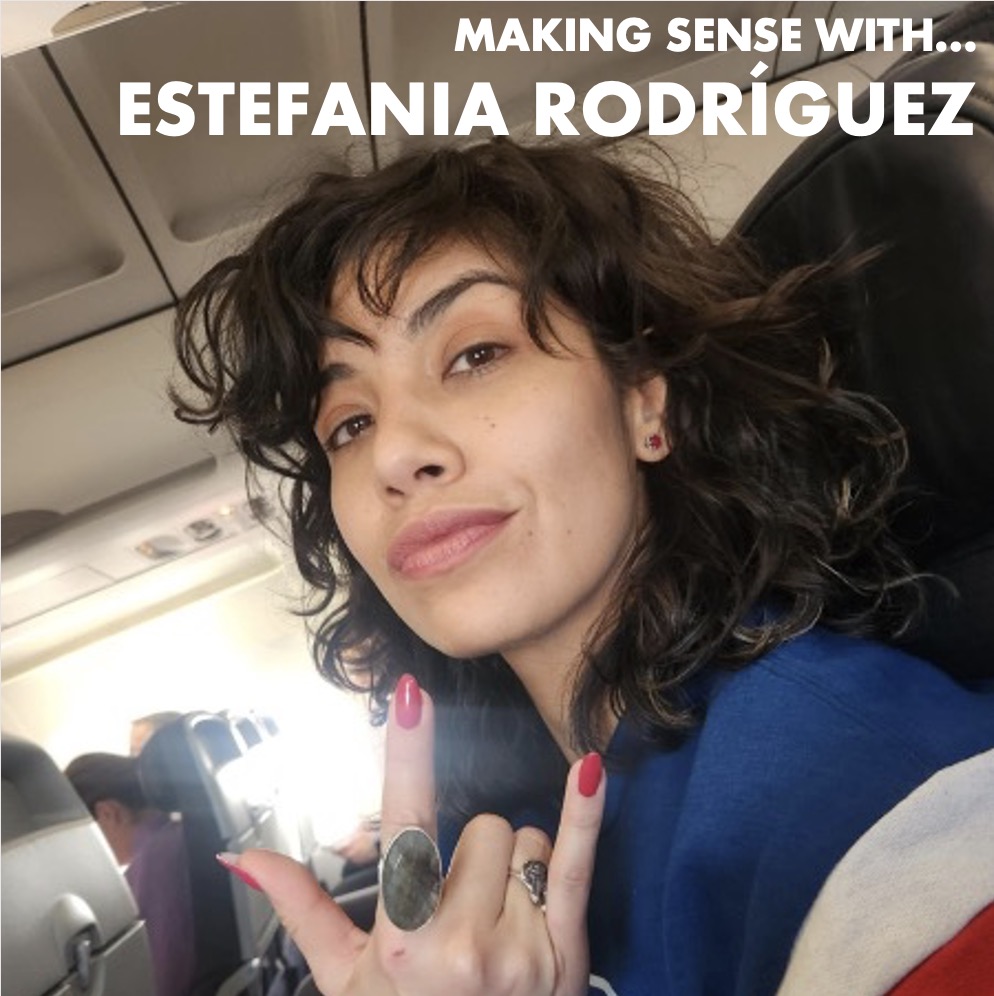
Photo courtesy of ER
What makes a semiotician tick? SEMIOVOX’s Josh Glenn has invited his fellow practitioners in the field of commercial semiotics, from around the world, to answer a few revealing questions.
Mexico City…
SEMIOVOX
When you were a child/teen, how did your future fascination with symbols, cultural patterns, interpreting “texts,” and getting beneath the surface of daily life manifest itself?
ESTEFANIA RODRÍGUEZ
I have always been curious about why people act the way they do and how they live their lives. Ever since I was a child, I played at being an anthropologist. I would pack a backpack with a blanket, water, and useful items to set up camp anywhere I could. Then, I would wander around the house in search of a place to settle down. Typically, I would end up sleeping in my mother’s bed, where I would become immersed in my surroundings. As a teenager, I read Marvin Harris’s Cultural Anthropology and realized that I had to pursue a career as a professional anthropologist (and semiologist!). I felt there was no other path for me. It was my chance to explain the reasons behind cultural phenomena.
SEMIOVOX
Describe your first encounter(s) with the theory and practice of semiotics.
ESTEFANIA RODRÍGUEZ
The first time I heard “semiotics” was at an anthropology conference. At the time, it didn’t mean anything to me, and I was eager to find my path, which I thought was already determined by my studies in anthropology. A professor advised me, “Give it a try, and if you don’t like it, you can leave.” I quickly came to understand what the semiotics discipline had to offer, and that was 14 unforgettable and transformative years ago. Later, I realized there is a tautological relationship between anthropology and semiotics; explaining one often involves explaining the other. This realization has led me to combine both disciplines seamlessly. Semiotic theory is intellectually stimulating because it is complex, yet it can also be exhausting. Fortunately, I have never considered giving up. I am truly delighted to have both anthropology and semiotics in my life.
SEMIOVOX
How did you find your own way to doing semiotics?
ESTEFANIA RODRÍGUEZ
It was thanks to my professor and now friend, Max Matus. He was too busy to take on a semiotic consulting project. It involved evaluating deodorant packaging for a prestigious brand. I had never applied semiotic theory in practice before! The most I knew was about Roland Barthes, so I applied a structural analysis and succeeded. They paid me very little (I still didn’t know how to charge). Then someone told me that Millward Brown was looking for a semiotics analyst. That Tuesday, I sent my CV, and the next day I took a big three-day test. On Saturday, they called me to invite me to work for the company. There, I charged what I wanted — and boy, were they generous!
SEMIOVOX
What are the most important attributes of a good semiotician?
ESTEFANIA RODRÍGUEZ
You need to be a good listener. You need to be understanding and compassionate, emotionally intelligent, disciplined, passionate, and patient.
SEMIOVOX
What three books about semiotics have you found the most useful and enlightening in your own work?
ESTEFANIA RODRÍGUEZ
- Roland Barthes’s Mythologies serves as an excellent introduction to semiology and effectively demonstrates how to apply theory in practice. What I appreciate most about this work are its insights into ideology from a Marxist perspective and the concept of myth, which differs from traditional anthropology.
- Jean-Marie Floch’s Sémiotique, marketing et communication: sous les signes, les stratégies clearly distinguishes between constructivist and relativist semiotics. This book offers a practical and dynamic explanation of what semiotics entails — and what it does not.
- Claude Lévi-Strauss’ Anthropologie structurale. Between the lines, Lévi-Strauss offers us his structural semiology in a delightful dialogue with anthropology (you have to pay close attention!).
SEMIOVOX
When someone asks you to describe what you do, what is your “elevator pitch”? How do you persuade a skeptical client to take a chance on using this tool?
ESTEFANIA RODRÍGUEZ
The simplest way to explain my profession is to say, “Semiotics is the study of signs.” When someone responds with a confused look, I add, “Or symbols,” and they often respond with an understanding, “Ah!” In the past, I would say, “Semiotics is the construction of meaning,” but that phrase became increasingly difficult to explain.
Recently, after 12 years of experience, I’ve started saying, “Semiotics is like quality control in a production chain. We ensure that your message—everything you want to communicate—is in perfect harmony.” This explanation has worked better for me.
SEMIOVOX
What specific sorts of semiotics-driven projects do you find to be the most enjoyable and rewarding?
ESTEFANIA RODRÍGUEZ
I specialize in label analysis, packaging evaluation, and identity creation. I have a passion for colors, textures, and shapes. I am very attuned to communication needs and enjoy deciphering what people, as we say in Spanish, have “on the tip of their tongue” or “stuck in their minds,” but find difficult to express. I love being asked to create and evaluate pre-launch products.
SEMIOVOX
What frustrates you about how semiotics is practiced and/or perceived, right now?
ESTEFANIA RODRÍGUEZ
I used to feel frustrated whenever I lost contracts, especially during a time when many people started exploring semiotics, which led to a decline in my job opportunities. Fortunately, as the saying goes, “the truth came out,” and many of those projects returned to me for revision, as semiotics must be considered seriously. Today, I no longer mind losing contracts as long as they are in the hands of professional semioticists. I have great respect for my colleagues in the field.
SEMIOVOX
Peirce or Saussure?
ESTEFANIA RODRÍGUEZ
Saussure is my favorite theorist. I appreciate Peirce as well, but I want to express my gratitude for Saussure. Thank you, Saussure!
SEMIOVOX
What advice would you give to a young person interested in this sort of work?
ESTEFANIA RODRÍGUEZ
Be passionate. Go crazy. This is the only way to do semiotics. Above all, take semiotics seriously.
MAKING SENSE series: MARTHA ARANGO (Sweden) | MACIEJ BIEDZIŃSKI (Poland) | BECKS COLLINS (England) | WHITNEY DUNLAP-FOWLER (USA) | IVÁN ISLAS (Mexico) | WILLIAM LIU (China) | SÓNIA MARQUES (Portugal) | CHIRAG MEDIRATTA (India / Canada) | SERDAR PAKTIN (Turkey / England) | MARIA PAPANTHYMOU (Greece / Russia) | XIMENA TOBI (Argentina) | & many more.
Also see these global semio series: MAKING SENSE (Q&As) | SEMIOFEST SESSIONS (monthly mini-conferences) | COVID CODES | SEMIO OBJECTS | COLOR CODEX | DECODER (fictional semioticians) | CASE FILE | PHOTO OP | MEDIA DIET | TATTOO YOU (semioticians’ tattoos).