

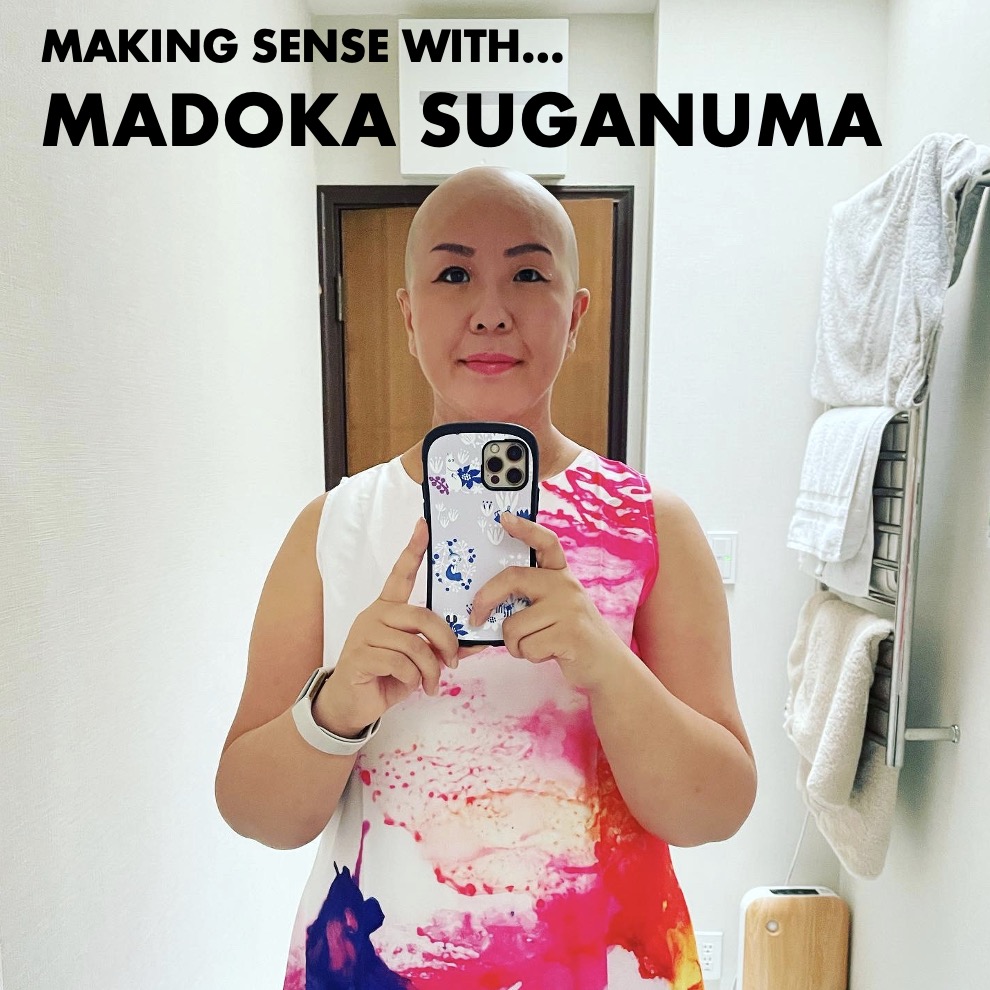
Photo courtesy of MS
What makes a semiotician tick? SEMIOVOX’s Josh Glenn has invited his fellow practitioners in the field of commercial semiotics, from around the world, to answer a few revealing questions.
Tokyo…
SEMIOVOX
When you were a child/teen, how did your future fascination with symbols, cultural patterns, interpreting “texts,” and getting beneath the surface of daily life manifest itself?
MADOKA SUGANUMA
As a child of a diplomat, I moved around a lot internationally, starting at age 3 to Pakistan. I changed schools eight times or so, going back and forth between Tokyo, Islamabad, Brussels, Vienna, Wales, Moscow, and Singapore.
It wasn’t just that I needed to learn a new language — I needed to adapt to new environments and cultures. As an adult you have some idea what it might mean to move to a different country and culture, but at that age no one explained it to me. I had to figure it out on my own.
For example, I had to deal with differences in cultures as I returned from going to an American international primary school to a Japanese one. What did it mean when in one school I was given a lot of verbal encouragement and hugs, but in the new school there’s absolutely none of that? Does it mean I am bad? Is there something I am missing? It was a matter of survival for me, trying to navigate through vastly different cultural systems. So I started early in trying to understand cultural patterns.
SEMIOVOX
Describe your first encounter(s) with the theory and practice of semiotics.
MADOKA SUGANUMA
It was through my freelance qualitative research career. Space Doctors contacted me and said they needed someone to do this kind of work in Japan. I was open to it and learned through doing projects for them. I later took Chris Arning’s course where I was able to learn how to explain what I’d been doing in practice.
SEMIOVOX
How did you find your own way to doing semiotics?
MADOKA SUGANUMA
As mentioned above, I started because there was a need for it, and continue to do Semiotics work as part of my qualitative research career and offering.
SEMIOVOX
What are the most important attributes of a good semiotician?
MADOKA SUGANUMA
Understanding the many aspects of culture; the ability to explain things clearly within a cultural context; and having the means to put ideas into words (so a wide vocabulary helps). I’m always learning about Japanese culture as it evolves; the second one I get to practice through my work; I am still working on the last one.
SEMIOVOX
What three books about semiotics have you found the most useful and enlightening in your own work?
MADOKA SUGANUMA
- Marcel Danesi’s The Quest for Meaning. This book was recommended to me as an introduction to Semiotics when I started out. It gives a solid exploration of the theory of Semiotics.
- Rachel Lawes‘ Using Semiotics in Marketing. This book is full of real-life applications and examples of how Semiotics can be used in marketing, including exercises to try. I’ve found this book to be very useful in my work.
- [Japanese graphic designer] Yukimasa Matsuda’s War and Design. While this book is not explicitly about Semiotics, it explores the semiotics of war and propaganda in depth — including colourful visuals, flags, signs, posters and film stills.
SEMIOVOX
When someone asks you to describe what you do, what is your “elevator pitch”? How do you persuade a skeptical client to take a chance on using this tool?
MADOKA SUGANUMA
“I analyze brand communications and dive into cultural topics to understand cultural spaces.”
If I go into a bit more detail, I say: “There are two approaches: First is to assess and analyze how brands are communicating, be it a visual, video or product labels. Second is to dive into specific cultural areas to identify what codes there are within that area and identify what’s the dynamics of residual, dominant and emergent. By understanding what codes are present, you can plot them onto a grid structure and understand which areas are more crowded and less crowded, giving you an advantage in deciding what kind of code you might want to tap into for your own product or service messaging.”
SEMIOVOX
What specific sorts of semiotics-driven projects do you find to be the most enjoyable and rewarding?
MADOKA SUGANUMA
I love diving into deep and sometimes taboo topics with rich cultural history and social and cultural context to unpack. I did a number of projects around sexual wellness and, separately, the future of gender in Japan. I like naming and describing what’s usually left unsaid, diving into the darker side of things, and uncovering how they show up (or do not) in communications.
SEMIOVOX
What frustrates you about how semiotics is practiced and/or perceived, right now?
MADOKA SUGANUMA
Outside of those who practice it academically, and a handful of those who do it commercially, it seems mostly unknown in Japan. I would like for it to be used more commonly — as it is so useful for brands. I would like to be able to have more lively discussions about the commercial use of Semiotics in Japan as well.
SEMIOVOX
Peirce or Saussure?
MADOKA SUGANUMA
Peirce, because he emphasises the role of the person in identifying the interpretant, as in what sense was made by the interpreter. It is important to know your own biases due to your own background and who you are, since someone else with a different cultural background may interpret things differently. I may associate certain signs differently than someone who grew up in the Kansai region of Japan, for example. Even within Japanese culture, there are different regional cultures, and within them, micro-cultures, all of which may interpret certain signs differently.
SEMIOVOX
What advice would you give to a young person interested in this sort of work?
MADOKA SUGANUMA
It is important to be curious and not be intimidated by practicing Semiotics. I would encourage them to join courses and discussions (such as Semiofest), as it has been very enriching for me to learn how others think and speak about Semiotics.
MAKING SENSE series: MARTHA ARANGO (Sweden) | MACIEJ BIEDZIŃSKI (Poland) | BECKS COLLINS (England) | WHITNEY DUNLAP-FOWLER (USA) | IVÁN ISLAS (Mexico) | WILLIAM LIU (China) | SÓNIA MARQUES (Portugal) | CHIRAG MEDIRATTA (India / Canada) | SERDAR PAKTIN (Turkey / England) | MARIA PAPANTHYMOU (Greece / Russia) | XIMENA TOBI (Argentina) | & many more.
Also see these global semio series: MAKING SENSE (Q&As) | SEMIOFEST SESSIONS (monthly mini-conferences) | COVID CODES | SEMIO OBJECTS | COLOR CODEX | DECODER (fictional semioticians) | CASE FILE | PHOTO OP | MEDIA DIET | TATTOO YOU (semioticians’ tattoos).