

Media Diet
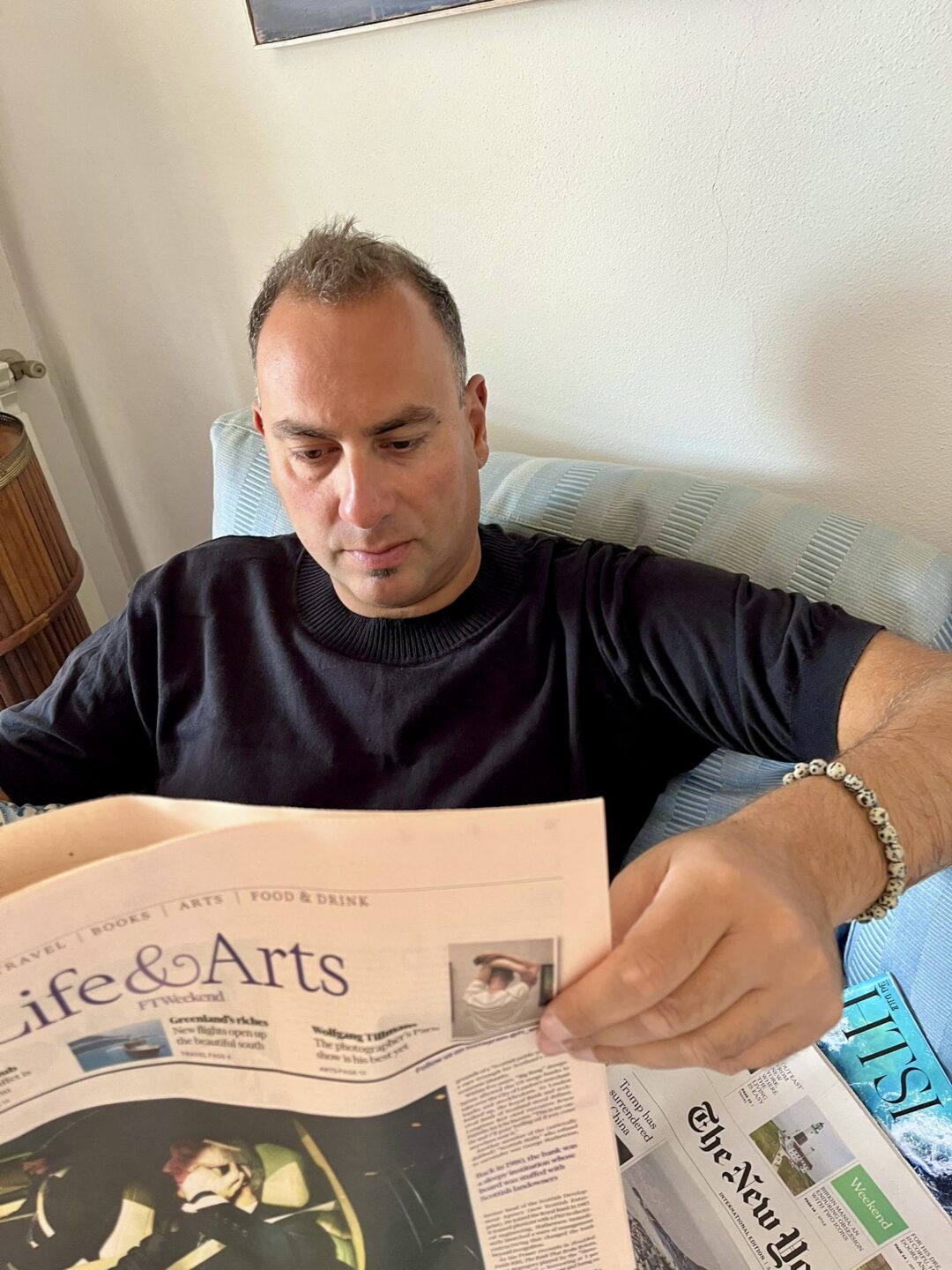
Image courtesy of AB
A series exploring the media “input” of a group of people — our commercial semiotician colleagues, from around the world — whose “output” we admire.
London…
SEMIOVOX
What’s the best movie you’ve ever seen?
ANDREA BASUNTI
Lisbon Story by Wim Wenders is one of the most captivating films I’ve ever seen, for a series of reasons. I was immediately drawn in by its singular fusion of intellectual (meta) material and sensorial richness. It’s a film about making a film, yes, but also about listening — attentively, deeply — to the world around us and to the pulsating rhythms of a city.
The story revolves around an attempt to capture Lisbon’s unique soundscape: from the murmuring of the Tagus River to the clatter of old tramways… the hum of life lived slowly. As a musician myself, I was especially taken with its elevation of sound — not simply as a backdrop, but as a multi-faceted protagonist. It also introduced me to Fado, with all its emotional immediacy: mournful, grounded and defiant at once. And most importantly, it prompted me to visit Lisbon — a city I’m still deeply in love with!
Originally intended as a documentary showcasing the (then under-recognised) cinematic textures of Lisbon, it morphed (in typical Wenders fashion) into something looser and dreamier. A film not just about a place, but about (the art of) perception itself. About surfacing the ineffable — which might just be one of the better definitions of what semiotics ultimately is.
SEMIOVOX
What work of literature (old or new) would you recommend to someone trying to make sense of today’s world?
ANDREA BASUNTI
I’ve just finished reading Le Perfezioni, a novel by Vincenzo Latronico. It’s beautifully written, each sentence unfolding in an almost poetic rhythm — and has a uniquely addictive style. (Though a warning: the absence of dialogue might bore some.)
What I find especially compelling is how sharply it captures the lives of Millennials and late Gen Zs. Its quasi-anthropological style offers both distance and empathy, allowing the reader to observe and perhaps even identify at the same time. It’s a piercing critique of early 2010s hipsterism — often evoked through vivid, telegraphic imagery that function as cultural markers, fetishising the scene’s ‘background’: a reclaimed-wood dining table, laid with a creased cotton cloth. The book feels like a mate-sipping farewell to Berlin’s hipster heyday.
There’s also a lot in it that resonates with my own story — from its focus on the expat community, to the experience of finding your way in a foreign city (the thrill and disillusionment alike), to the idiosyncratic lives of freelance creative types.
As someone who teaches and mentors younger generations, I feel a responsibility to better understand how they see the world (on and off screen, though inevitably mediated by the former). The novel resists the lazy generational clichés we so often fall back on. Though at times darkly satirical in tone, it manages to illuminate the more nuanced, conflicted texture of millennial and Gen Z lives — their search for meaning and authenticity in a world that rarely seems to offer either.
SEMIOVOX
Do you subscribe to any magazines or newsletters that you’d strongly recommend?
ANDREA BASUNTI
I’m an avid reader of magazines of all kinds — from the more mainstream, like Wired, to the niche, like 032c or Drift. As a semiotician and cultural strategist, I value publications that help me make sense of contemporary culture.
I’m old-school and still prefer the print format: it forces you to slow down, and engage all your senses. While some of these magazines can be read in one sitting, I always try to pause and remain mindful of the editorial craft that makes something feel so effortlessly readable.
One I never miss is HTSI, the weekend supplement of the Financial Times, alongside the Life & Arts section. These are my weekend indulgences (often against an instrumental jazz sonic backdrop). Thoughtfully curated by the brilliant Jo Ellison and Horatia Harrod, HTSI and Life & Arts consistently feed my curious mind — with just the right touch of hedonism.
Even when the subject matter leans into ‘first-world indulgences’, the thinking around it is often so sharp (and so culturally attuned), that it feels time well-invested. At their best, these pieces often remind me of Roland Barthes’ writing on everyday objects and fashion systems. I do miss Vanessa Friedman’s witty take on fashion — she’s now at The New York Times, which I’ve started subscribing to as well.
What draws me most is the almost interdisciplinary sprawl of subject matter: perfectly suited to my ever-curious, happily distracted mind. Like a modern flâneur, I want to shed light on whatever I come across. I suspect I’m a bit of an aesthete at heart — chasing the ineffable soul of beauty across all things — and HTSI delivers on that beautifully.
MEDIA DIET: GIANLLUCA SIMI (Brazil) | HIBATO BEN AHMED (France) | MARIE LENA TUPOT (USA) | EUGENE GORNY (Thailand) | YOGI HENDLIN (Netherlands / USA) | INKA CROSSWAITE (Germany / South Africa) | SÓNIA MARQUES (Portugal) | ĽUDMILA LACKOVÁ BENNETT (Czechia) | BRIAN KHUMALO (USA / South Africa) | JIAKUN WANG (Shanghai) | FRANCISCO HAUSS (China / Mexico) | ASHLEY MAURITZEN (England) | STEFANIA GOGNA (Italy) | BECKS COLLINS (England) | ANTJE WEISSENBORN (Germany) | MARIANE CARA (Brazil) | MARTHA ARANGO (Sweden) | PAULINA GOCH-KENAWY (Poland) | COCO WU (Singapore / China) | JOSH GLENN (USA) | JENNIFER VASILACHE (Switzerland) | ANDREA BASUNTI (England) | SARAH JOHNSON (Canada) | VICTORIA GERSTMAN (Scotland) | MARIA PAPANTHYMOU (Greece).
Also see these global semio series: MAKING SENSE (Q&As) | SEMIOFEST SESSIONS (monthly mini-conferences) | COVID CODES | SEMIO OBJECTS | COLOR CODEX | DECODER (fictional semioticians) | CASE FILE | PHOTO OP | MEDIA DIET | TATTOO YOU (semioticians’ tattoos).