

Media Diet
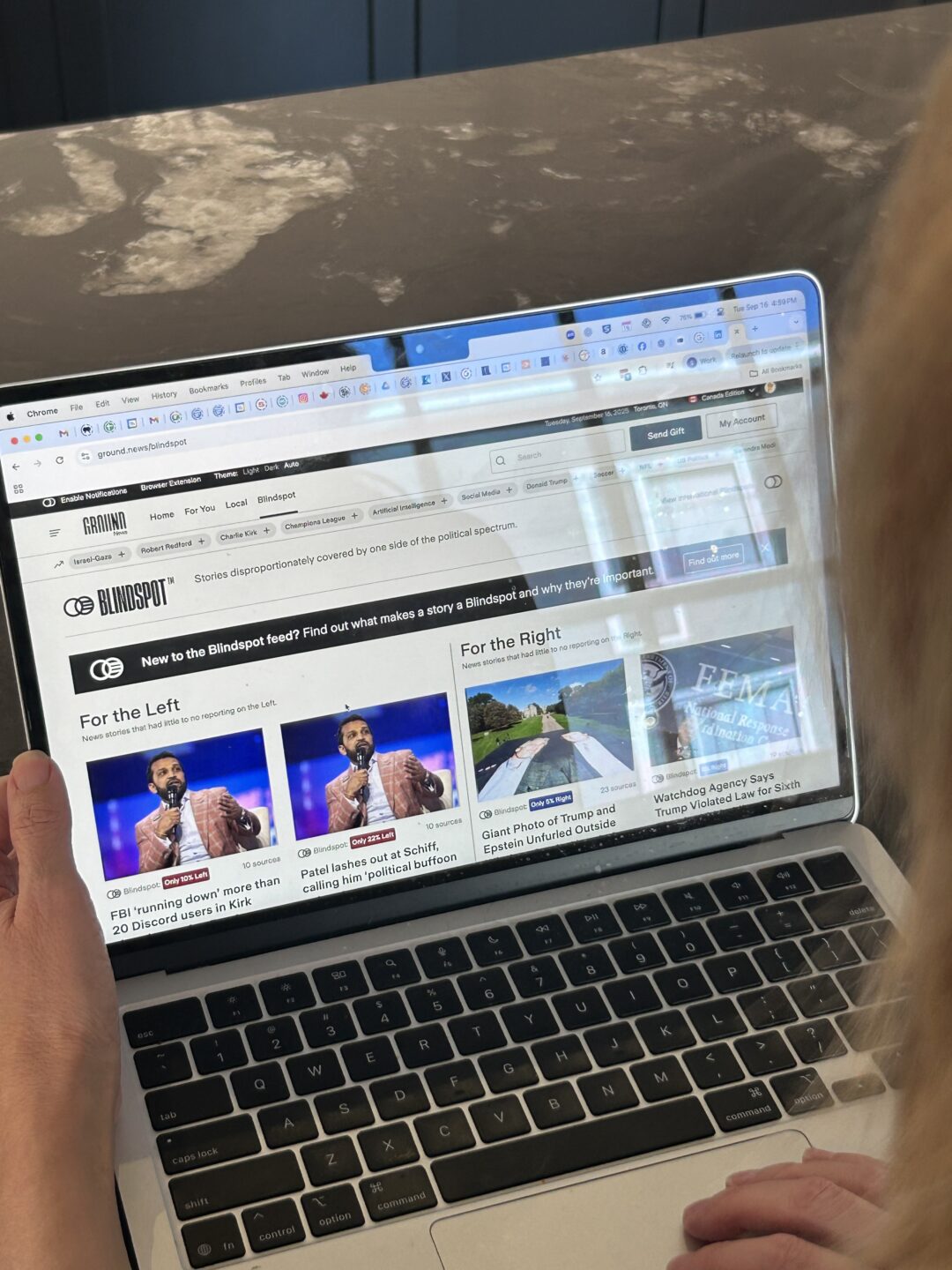
Image courtesy of SJ
A series exploring the media “input” of a group of people — our commercial semiotician colleagues, from around the world — whose “output” we admire.
Toronto…
SEMIOVOX
What forms of media do you “take in” the most regularly/frequently, during a typical day or week?
SARAH JOHNSON
I consume news media through Apple News, which gives me access range of news publications from across the world and across the political spectrum. I like to see what all sides are saying. I also subscribe to Ground News, which compares how the same stories are covered from the left, right and centre, and shows what facts are reported or not reported depending on a source’s political orientation.
In these crazy times I am listening to a lot of current events podcasts, trying to make sense of complex geopolitical events that are changing very quickly. I also listen to various cultural podcasts, such as the BBC’s The Food Programme, which covers the social and political context of how food is produced and consumed and 99% Invisible, “about all the thought that goes into the things we don’t think about — the unnoticed architecture and design that shape our world”. I listen to podcasts like this both because I am a nerd, but also because I believe that to be a successful semiotician, you just have to know as much as possible about the world around you: the history of how things have come to be, emerging trends, and more.
I also watch a ton of TV. My taste ranges from little old lady (lots of mysteries and costume dramas) to cultural maven (whatever is the most talked about show of the moment). There are definitely talked-about shows I haven’t been able to stick with, though. Anything where I can’t root for at least one character can’t keep my attention.
SEMIOVOX
What work of literature (old or new) would you recommend to someone trying to make sense of today’s world?
SARAH JOHNSON
Definitely both Brave New World and 1984. Brave New World is great for helping see how we are all segmented into classes with no possibilities for meaningful interaction, and also for how consumerism and pop culture can become opiates that just numb us out from dealing with reality. 1984 is, of course, masterful for showing the insidiousness of propaganda and how it denies us the ability to articulate what we see and feel.
SEMIOVOX
What work of nonfiction (old or new) would you recommend to someone trying to make sense of today’s world?
SARAH JOHNSON
Prisoners of Geography: Ten Maps that Explain Everything About the World, by Tim Marshall. This is the first book in Marshall’s Politics of Place series, and I want to press it into the hands of everyone I know. It describes how the physical geography of different regions drives so much of geopolitics, creating intractable issues at a level most of us don’t realize. It explains so much of what is happening in the world news headlines.
SEMIOVOX
What are your reading habits?
SARAH JOHNSON
I always have at least one book on the go, usually more. Generally, a mix of fiction and non-fiction. I read them on my kindle or listen to them on my audible app. I read every day, on public transit, or after dinner. I also listen to books when I am cleaning the house or going for a walk. I also have a pile of physical books I keep meaning to get to, but I keep defaulting to the digital version. I try not to buy new books, because I have so many.
SEMIOVOX
What music did you love as a teenager?
SARAH JOHNSON
As a teen my idols were David Bowie and Talking Heads, because they were both so interesting and ever-changing. Bowie in particular was such a polymath that he exposed me to so many new ideas, words, sounds and images. He really stretched me as a person. I still listen to him all the time and feel I still have so much to learn about and from him.
SEMIOVOX
How do you use social media, these days?
SARAH JOHNSON
I use Facebook Messenger to stay in touch with old friends, Facebook proper to monitor various interests (e.g. Gen X nostalgia) through groups in my feed, Instagram for comedians, and, gasp, X. There’s a lot of nastiness to wade through on X, but you also learn stuff you don’t get in the mainstream media, and there are some great pundits to follow there.
MEDIA DIET: GIANLLUCA SIMI (Brazil) | HIBATO BEN AHMED (France) | MARIE LENA TUPOT (USA) | EUGENE GORNY (Thailand) | YOGI HENDLIN (Netherlands / USA) | INKA CROSSWAITE (Germany / South Africa) | SÓNIA MARQUES (Portugal) | ĽUDMILA LACKOVÁ BENNETT (Czechia) | BRIAN KHUMALO (USA / South Africa) | JIAKUN WANG (Shanghai) | FRANCISCO HAUSS (China / Mexico) | ASHLEY MAURITZEN (England) | STEFANIA GOGNA (Italy) | BECKS COLLINS (England) | ANTJE WEISSENBORN (Germany) | MARIANE CARA (Brazil) | MARTHA ARANGO (Sweden) | PAULINA GOCH-KENAWY (Poland) | COCO WU (Singapore / China) | JOSH GLENN (USA) | JENNIFER VASILACHE (Switzerland) | ANDREA BASUNTI (England) | SARAH JOHNSON (Canada) | VICTORIA GERSTMAN (Scotland) | MARIA PAPANTHYMOU (Greece).
Also see these global semio series: MAKING SENSE (Q&As) | SEMIOFEST SESSIONS (monthly mini-conferences) | COVID CODES | SEMIO OBJECTS | COLOR CODEX | DECODER (fictional semioticians) | CASE FILE | PHOTO OP | MEDIA DIET | TATTOO YOU (semioticians’ tattoos).