

One in a series of posts dedicated to the author’s favorite semiopunk sci-fi. A version of each installment in this series first appeared at our sister site, HILOBROW.
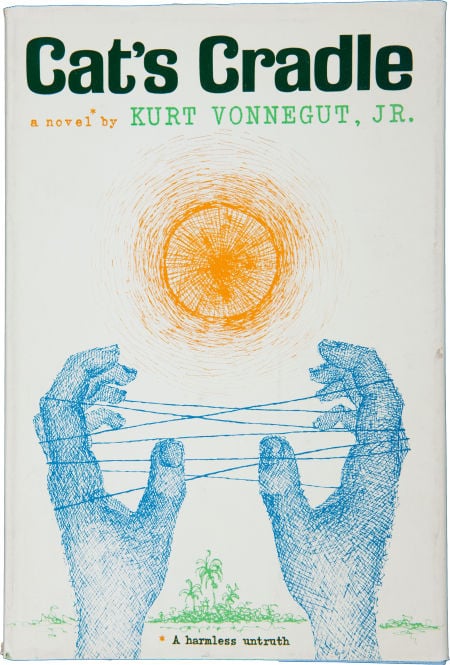
Cat’s Cradle is a 1963 satirical sci-fi novel narrated by John, a journalist interviewing the children of the late Felix Hoenikker, a brilliant physicist who’d helped develop the atomic bomb.
John accompanies Hoenikker’s children — Franklin, Angela, and Newt — to a Caribbean island, San Lorenzo. He learns that Hoenikker invented “ice-nine,” a substance that transforms liquid water into ice. Which seems harmless… but should ice-nine ever come into contact with one of the world’s oceans, the result would be catastrophic. Hoenikker, driven by scientific zeal, never worried about such matters.
Instrumental reason decoupled from moral reason isn’t Vonnegut’s only target here. He’s also interested in religion — specifically, the notion of a religion that might provide happiness and meaning to life without requiring its adherents to believe in any superstitious nonsense, such as the idea that human existence has inherent purpose. San Lorenzo, we find, is home to Bokononism, a religious movement dreamed up by a gentle absurdist. It combines irreverent observations about life and God’s will with eccentric rituals.
In his 1974 essay collection Wampeters, Foma & Granfalloons (the title of which is composed of Bokononist terms from Cat’s Cradle), Vonnegut writes admiringly about the founder of Theosophy. Madame Blavatsky’s genius, he would have us understand, lay in her ingenious solution to both the shortcomings of organized religion and the cold empiricism of science. For the benefit of those of us dissatisfied not only with religious orthodoxies but with science’s materialist orthodoxies, Theosophy offered an imaginative, engaging alternative.
Was Blavatasky a bit of a charlatan? Did she garble — or invent — some of the ancient wisdom she claimed to have surfaced? Yes, he says… but that’s OK. What religion’s untruths have to offer us — comfort and hope — is good thing. It’s only a problem if you start to believe in these untruths.
Vonnegut’s Blavatskyan concept, in Cat’s Cradle, is foma: harmless untruths. Bokonon’s absurdist, cynical-yet-kindly commandment: “Live by the foma that make you brave and kind and healthy and happy.” This is an engaged form of irony; and Bokononists, it seems, are very well-adjusted indeed.
As any honest semiotician will tell you, a semiotic schema — not to mention the signs and codes that make up its various nodes — is an example of foma. It’s not nonsense — but neither is it objective fact. We encourage our clients to accept our semi-scientific, semi-invented schemata not because they are true in some absolute sense… but because if they accept our schemata, things will go well for them. Some of our more guru-like semio colleagues are Blavatskyan frauds; the rest of us are Bokononists.
Cat’s cradle is is a traditional two-person string game that creates a series of geometric figures passed between hands, often starting with the “cradle” and progressing to shapes like Candles, Manger, Diamonds, Cat’s Eye, and Fish in a Dish. We used to play at the Martin Luther King Jr. school, during recess and lunch. A semiotic schemata is also a game of sorts, one that uses geometry to demonstrate how meaning works — how it emerges and evolves, how its constituent parts are interdependent — in a given product category, say, or cultural territory. As long as we semios think of our schemata as playful experiments providing useful insights and inspiration, we’re on safe ground. But when our clever inventions come to seem natural, inevitable, eternal — when they’re reified — that leads to trouble.
Vonnegut’s character Newt Hoenikker is someone who’s grown impatient with reified schemata. He delivers one of the best lines (other than Bokonon quotes, that is) in the book:
Newt remained curled in the chair. He held out his dainty hands as though a cat’s cradle were strung between them. “No wonder kids grow up crazy. A cat’s cradle is nothing but a bunch of X’s between somebody’s hands, and little kids look and look and look at all those X’s…”
“And?”
“No damn cat, and no damn cradle.”
He’s right, of course. But he’s wrong. The cat and the cradle are there, and not there too.
As it turns out, Franklin Hoenikker is in possession of ice-nine; the story ends with eco-catastrophe. As with Beckett’s Endgame, a much less whimsical exercise in absurdist science fiction, in Cat’s Cradle we discover that our everyday social and cultural norms and forms — which seem so tangible and necessary, during the ordinary course of our lives — offer no real help when we’re faced with the end of everything.
Bokononism, however, into which is baked the premise that our everyday social and cultural norms and forms are ultimately nonsensical, offers solace. Here’s a poem of Bokonon’s that addresses humankind’s futile and self-sabotaging drive to find inherent meaning in our existence:
Tiger got to hunt, bird got to fly; Man got to sit and wonder “why, why, why?” / Tiger got to sleep, bird got to land; / Man got to tell himself that he understand.
Vonnegut isn’t suggesting that life is meaningless; but he would remind us that meaning is partially discovered, and partially invented. Which is exactly what semioticians understand about meaning.
PS: In 1971 the University of Chicago awarded Vonnegut a master’s degree in Anthropology — for Cat’s Cradle.