

A spiritual diagram of the universe
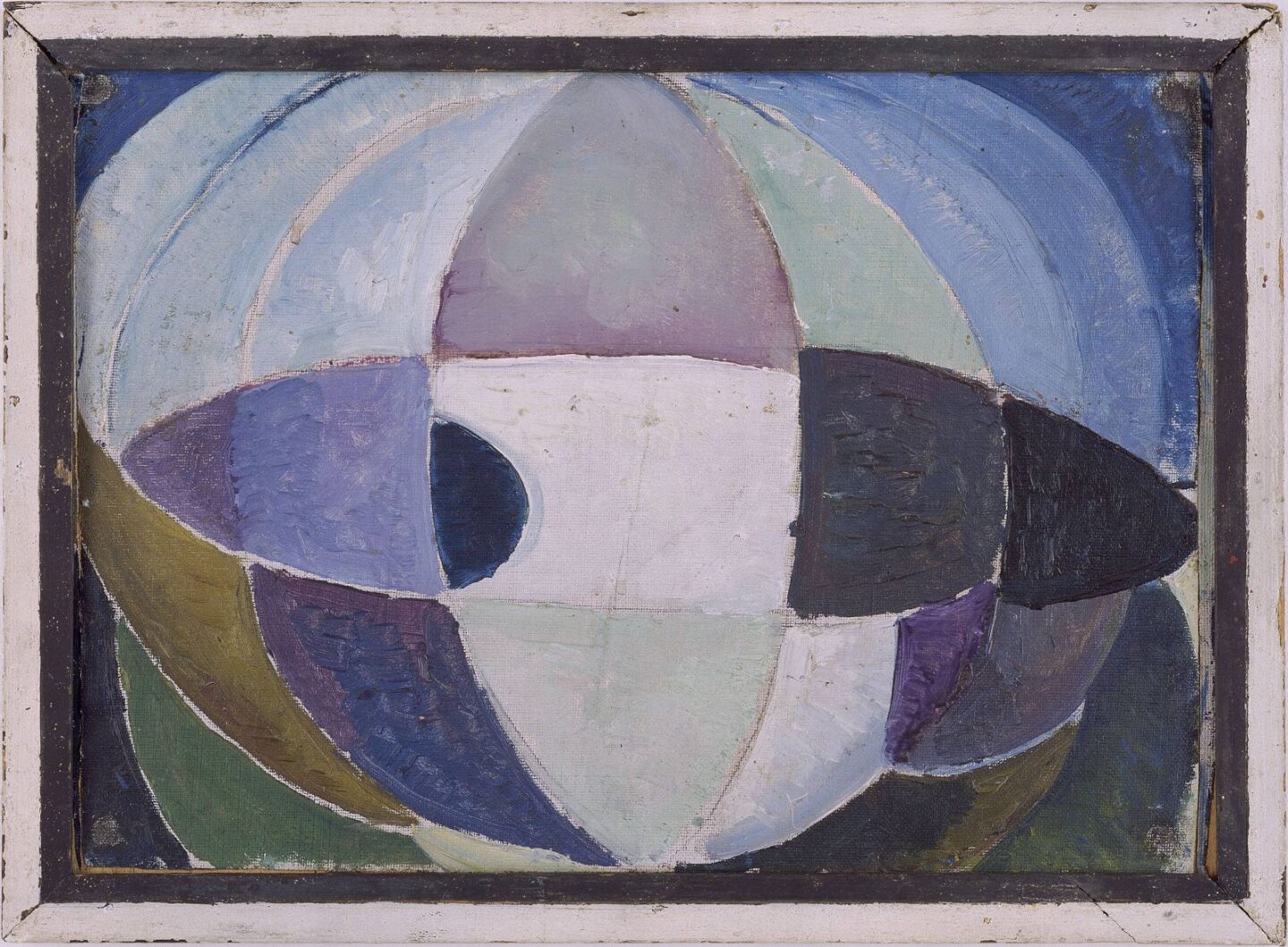
Theo van Doesburg's "Sfeer" (Sphere, 1916)
Theo van Doesburg was one of the founders of the abstract-art movement De Stijl (1917–1931). Sphere — the artist’s first abstract painting, predating De Stijl — is constructed from abstract shapes such as intersecting circles or parts thereof. We read at the Museum de Lakenhal’s website: “During this period [Van Doesburg] developed a new concept of space, based in part on Einstein’s theory of relativity.”
I’ve also seen this painting described as a “spiritual diagram of the universe.” (From the series ‘City of Paint’, in Leidsch Dagblad, 2010.)
I’ve recently been revisiting Shelley’s 1820 play Prometheus Unbound. Check out this passage:
A sphere, which is as many thousand
spheres;
Solid as crystal, yet through all its mass
Flow, as through empty space, music and
light;
Ten thousand orbs involving and involved,
Purple and azure, white, green and golden,
Sphere within sphere; and every space
between
Peopled with unimaginable shapes,
Such as ghosts dream dwell in the lampless
deep;
Yet each inter-transpicuous; and they
whirl
Over each other with a thousand motions,
Upon a thousand sightless axles spinning,
And with the force of self-destroying swiftness,
Intensely, slowly, solemnly, roll on,
Kindling with mingled sounds, and many
tones,
Intelligible words and music wild.
With mighty whirl the multitudinous orb
Grinds the bright brook into an azure mist
Of elemental subtlety, like light
Eventually Van Doesburg would find Neoplasticism, i.e., Mondrian’s version of De Stijl, lacking in variety, movement, and energy — particularly so since abstraction’s unique value was, in his thinking, its ability to achieve social order and universal harmony via precise, orderly geometry and vibrant, contrasting colors.
I enjoy this and similar images which seem to illustrate what William James says about our “pluralistic universe” — in which “each part hangs together with its very next neighbors in inextricable interfusion” in which he describes as a “strung-along type” of connection. Which is close as it is possible to get, he wrote, contra the “monist” philosophers (for whom the diversity of reality is just an illusion; ultimately all is one, and one is all), to oneness. The semiosphere is a “turbid, muddled, gothic sort of affair,” to quote James describing his pluralistic empiricism to an audience at Oxford in 1907.
A spiritual diagram of the universe — that’s as good a definition of a semiosphere schema as any other.
A selection from a series of posts — originally published by our sister website, HILOBROW — attempting to depict the intellectual and emotional highs and lows of developing a semiotic schema.