

Media Diet
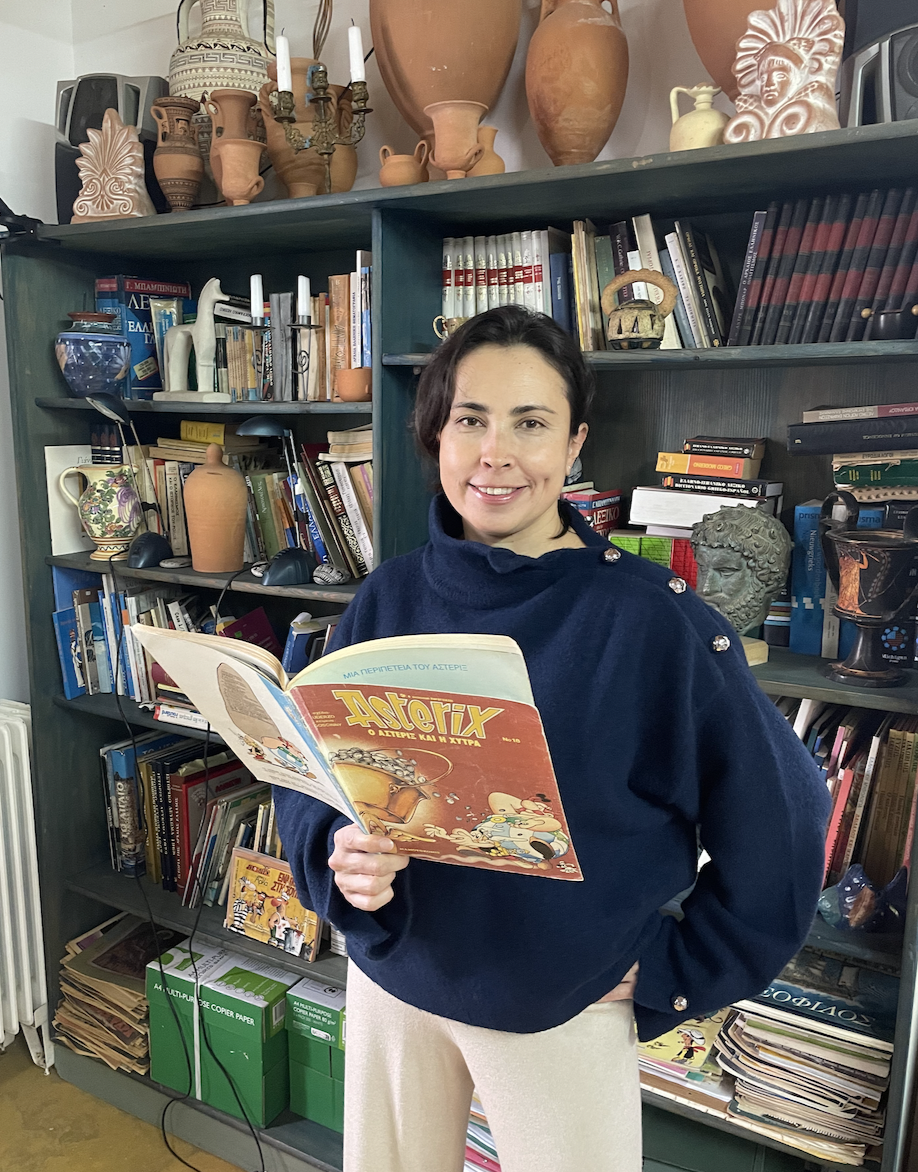
Image courtesy of MP
A series exploring the media “input” of a group of people — our commercial semiotician colleagues, from around the world — whose “output” we admire.
Ikaria…
SEMIOVOX
What forms of media do you “take in” most regularly during a typical day or week?
MARIA PAPANTHYMOU
My media consumption is quite eclectic.
Most of the time I read or watch materials related to the semiotic projects I am working on. Fortunately, the topics are always great. This year I studied the semiotics of technology, leadership, closeness, the mythology of home, the role of the “helper,” and the culture of lightness across different generations. I often use Perplexity for literature searches now.
The deeper I go into semiotics, the more interested I become in other sciences about meaning. I am currently taking an online course in cognitive science provided by the University of Edinburgh.
Every weekend I watch something together with my younger child; he still prefers cartoons and Harry Potter films — we know them almost by heart.
In my free time, I listen to podcasts and watch long YouTube videos on broader topics such as politics, history, health, and quantum physics. I usually combine listening with other activities, like cooking or walking.
One of this year’s discoveries for me was the YouTube channel of Armen Zakharyan, dedicated to literature. Listening to Armen is a deeply hedonistic experience. He has an exceptional grasp of context, notices subtle nuances, and speaks in a way that resembles an expressive theatrical performance. When he discusses texts I already know, it feels like discovering secret rooms in a familiar house. When he talks about works I haven’t read, I feel as if I’m absorbing essential fragments of human culture in a very concentrated form.
Here is a link to Armen’s short talk about his Joyce project “Ulysses in 18 weeks and 18 videos.”
SEMIOVOX
What work of literature (old or new) would you recommend to someone trying to make sense of today’s world?
MARIA PAPANTHYMOU
Some time ago, in a reading club, we read Plato’s Socratic dialogue Gorgias, which deals with rhetoric and ethics. We read it aloud as a role play, and this format allowed participants to experience the dialogue as if it was happening in real time, in front of us. The text itself felt strikingly relevant to contemporary reality.
This is what fascinates me about reading the classics: human nature seems remarkably stable, the same questions arise again and again, and the same dilemmas return in different historical forms.
Gorgias examines the nature, purpose, and moral value of rhetoric. One of the most striking observations that emerges from the dialogue is that Socrates appears to hold a distinctly anti-democratic position. He suggests that power should belong to those “who know the truth,” while the crowd is largely ignorant and incapable of sound judgment. Rhetoric, in his view, is a hypocritical and manipulative craft that ultimately makes things worse.
The alternative he proposes is philosophy — the practice of seeking truth, examining oneself, and speaking in a way that aims at the genuine good of the soul rather than persuasion for its own sake. More concretely, this means argument grounded in knowledge rather than the desire to win; dialogue instead of performance; moral inquiry instead of emotional manipulation; and, perhaps most importantly, care for the soul rather than the pursuit of power.
This inevitably makes me reflect on the practice of commercial semiotics. Are we engaging in rhetoric or in philosophy, in Socrates’ sense of these terms? It often seems that the aim of the job is focused primarily on convincing the audience, rather than seeking truth.
SEMIOVOX
What are your reading habits?
MARIA PAPANTHYMOU
To be honest, I don’t often read full-length books at the moment. In the photo here, I am reading Asterix comics in Greek. When I was growing up, comics were not very popular in the USSR — I was reading Tolstoy at the age of seven or eight — so now I feel like I’m compensating for that. Comics are also a good way for me to improve my Greek.
SEMIOVOX
What music — genres, artists, or songs — do you listen to during a typical day?
MARIA PAPANTHYMOU
I enjoy ethno-inspired rock and pop music, especially projects drawing on the musical traditions of indigenous Ural and Siberian cultures, such as Bashkir and Tuvinian music. Here is a link; here is another.
MEDIA DIET: GIANLLUCA SIMI (Brazil) | HIBATO BEN AHMED (France) | MARIE LENA TUPOT (USA) | EUGENE GORNY (Thailand) | YOGI HENDLIN (Netherlands / USA) | INKA CROSSWAITE (Germany / South Africa) | SÓNIA MARQUES (Portugal) | ĽUDMILA LACKOVÁ BENNETT (Czechia) | BRIAN KHUMALO (USA / South Africa) | JIAKUN WANG (Shanghai) | FRANCISCO HAUSS (China / Mexico) | ASHLEY MAURITZEN (England) | STEFANIA GOGNA (Italy) | BECKS COLLINS (England) | ANTJE WEISSENBORN (Germany) | MARIANE CARA (Brazil) | MARTHA ARANGO (Sweden) | PAULINA GOCH-KENAWY (Poland) | COCO WU (Singapore / China) | JOSH GLENN (USA) | JENNIFER VASILACHE (Switzerland) | ANDREA BASUNTI (England) | SARAH JOHNSON (Canada) | VICTORIA GERSTMAN (Scotland) | MARIA PAPANTHYMOU (Greece).
Also see these global semio series: MAKING SENSE (Q&As) | SEMIOFEST SESSIONS (monthly mini-conferences) | COVID CODES | SEMIO OBJECTS | COLOR CODEX | DECODER (fictional semioticians) | CASE FILE | PHOTO OP | MEDIA DIET | TATTOO YOU (semioticians’ tattoos).