

One in a series of posts dedicated to the author’s favorite semiopunk sci-fi. A version of each installment in this series first appeared at our sister site, HILOBROW.
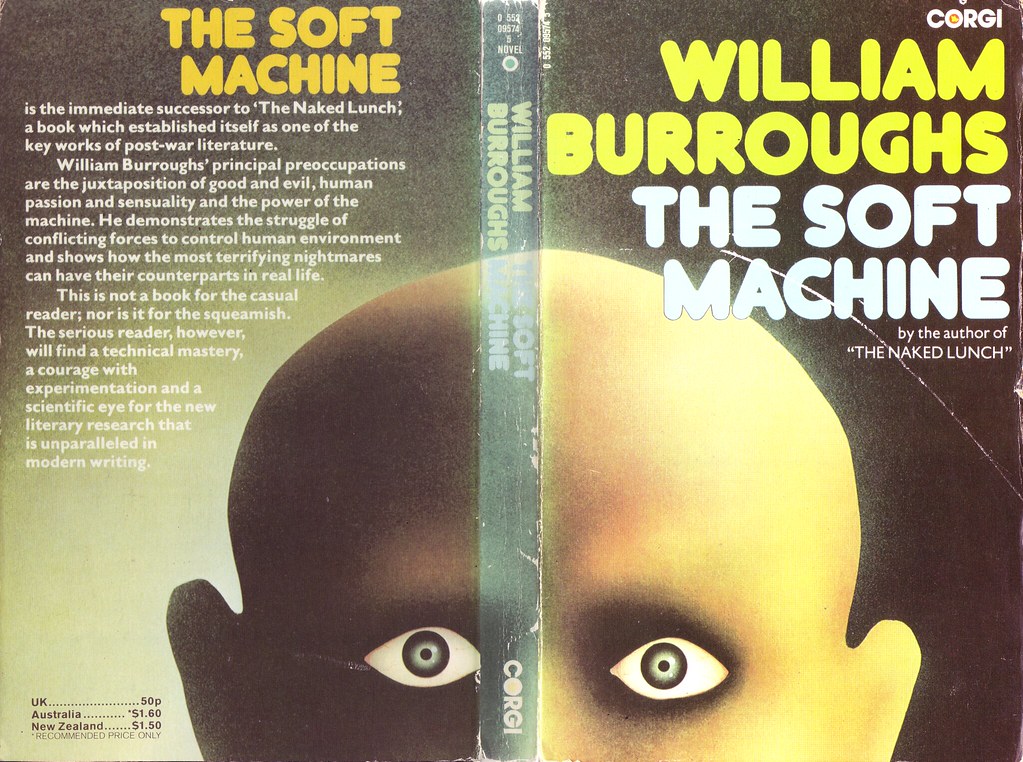
The Soft Machine is a 1961 dystopian sci-fi novel, the most famous of William Burroughs’ “cut-ups.” The “cut−up” is an aleatory literary technique in which a written text is physically cut up and rearranged to create a new text. Pioneered by the Dadaists, it was popularized in the ’50s and ’60s by Burroughs — who’d credit Eliot’s The Waste Land and John Dos Passos’ U.S.A. trilogy as inspiration. He’d spend years promoting the cut-up as a tool to sabotage the “controlling order” of representational meaning.
To the extent that The Soft Machine has a plot, we find it in the linear-ish narrative of the seventh chapter… in which an agent who operates outside of conventional linear time and space uses a time-travel machine and metamorphic “U.T.” (undifferentiated tissue) to disrupt the mind-control efforts of Mayan priests. Mayan society, it seems, is characterized by a “word and image” control system — encoded “calendars” and “control images” recorded onto magnetic tapes and in illustrated codices, which serve to keep the society’s slave laborers docile and productive by manipulating their perception of reality.
This is a Saussurean insight. Saussure separated language into langue (the structural system) and parole (individual speech). He argued that langue is the only thing that matters for analysis. This implies that your personal thoughts, creativity, and agency are irrelevant; to a greater or lesser extent, you are just repeating a pre-existing, impersonal system. Our thoughts are limited by the structure of the language we speak, meaning we cannot think outside the system we are born into. You are not the master of your own thoughts or words; you are a node operating within a pre-existing, arbitrary system of differences that defines your world.
Our hero — Inspector Lee, who may or may not be William Lee / Willy the Agent, from the 1959 novel Naked Lunch — overdubs the priests’ “heavy metal” tapes with messages like “Cut word lines — Cut music lines — Smash the control images — Smash the control machine.” Does this sound like too simplistic a form of sociocultural sabotage? Fortunately for Agent Lee, The Soft Machine is set in what sf exegetes call a “Low Culture, High Tech” story-world… that is to say, one in which technology is inherited from a lost “ancestor” civilization, allowing a less advanced society to make use of items that they can neither reproduce nor properly comprehend.
I found out also that the priests themselves do not understand exactly how the system works and that I undoubtedly knew more about it than they did as a result of my intensive training and studies — The technicians who had devised the control system had died out and the present line of priests were in the position of some one who knows what buttons to push in order to set a machine in motion, but would have no idea how to fix that machine if it broke down, or to construct another if the machine were destroyed — If I could gain access to the codices and mix the sound and image track the priests would go on pressing the old buttons with unexpected results —
Once the “track” that defines reality is hacked, once the society’s laborers can see and hear for themselves, and once their daily lives are no longer strictly routinized by the priests’ calendar, the totalitarian system collapses. The slaves revolt. The priests’ temples are obliterated by earthquakes and tidal waves; the priests reduced to a silvery dust. Lee, who belongs to an interdimensional and intergalactic force known as the Nova Police, can now move on (forward? back? up? down?) to his next effort at disrupting the machinations of the villainous Nova Mob.
Burroughs would go on to publish two more installments in what we now know as the Nova Trilogy. The Ticket That Exploded (1962) uses metaphors like tape recorders and cybernetic “pleasure farms” on Venus to illustrate how control systems manipulate reality. (In a 1973 Harper’s essay, “Playback from Eden to Watergate,” Burroughs would boil down the message of his fiction into a single phrase: “Language is a virus.”) Nova Express (1964) is a space opera depicting all-out war between the Nova Police and the Nova Mob, who use language viruses and media bombardment to destroy planets.
These cut-up and meta-fictional (meta-fictional because characters from other stories, by Burroughs but also by Kipling, Melville, and others make appearances) tales constitute what Burroughs called a “mythology for the space age,” one in which human freedom is threatened by addictive, oppressive systems… and in which the only way out is to sabotage and “scramble” the means — language, images — by which we are all controlled. This mythology would influence sf authors from J.G. Ballard and Michael Moorcock (another meta-fictional author for whom agents of chaos are the good guys) to Alan Moore, William Gibson, and Neal Stephenson. Only by altering the way we read, write, and think, Burroughs spent the ’60s and ’70s insisting, can we begin to perceive “what is on the end of every fork” (i.e., the “naked lunch”), much less begin to think and behave in a liberated way. The “word track” — i.e., Saussure’s langue — moves us away from plurality towards uniformity, shifting us ever further from the “multi-leveled structure of experience” navigated so fluidly by the Nova Police.
“He who fights with monsters might take care lest he thereby become a monster,” Nietzsche warns us. “And if you gaze for long into an abyss, the abyss gazes also into you.” Semioticians who gaze for long into the abyss of Ferdinand de Saussure’s structuralism will eventually realize at an instinctual, existential level — not just intellectually, that is — that language is an impersonal, arbitrary system that constructs our reality, rather than a tool we use to describe it. And if language, via which we comprehend reality, is entirely arbitrary, then our entire understanding of “reality” is nothing but a fragile, man-made illusion.
How do we carry on, then? Boldly, experimentally, ironically yet not cynically, passionately.
The millennia-long operation that Burroughs calls, in these books, the Nova Conspiracy, via which humans are transformed into “soft machines” whose perceptions and behavior are predetermined by sociocultural coding, would have us believe that thought and language can be aligned with how things actually are. But what we call truth, Inspector Lee and his comrades insist, is merely a reified fiction that suppresses possibility. Life, the universe, and everything is as free and ever-evolving as a work of fiction — cut-up, experimentalist meta-fiction, to be precise. And if we don’t experience it that way, it’s only because the Nova Mob has succeeded in implanting their virus in our minds.