

One in a series of posts dedicated to the author’s favorite semiopunk sci-fi. A version of each installment in this series first appeared at our sister site, HILOBROW.
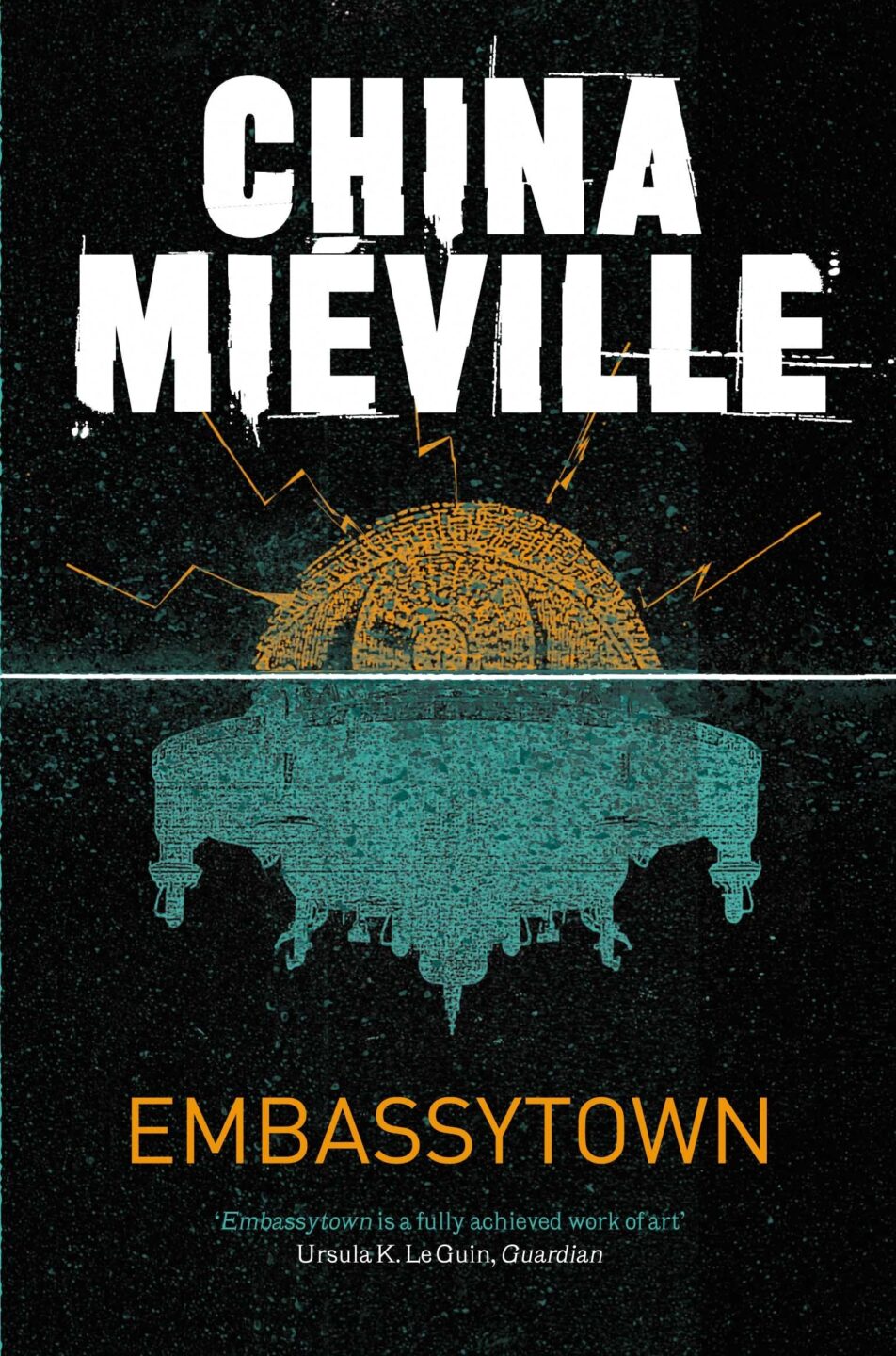
In China Miéville’s 2011 sf novel Embassytown, human colonists have established an enclave on the far-distant planet Arieka. The planet’s highly advanced, crab-like natives, the Ariekei, possess two mouths and are capable of speaking two words at once — a device expressed in the narrative via fractional notation. So humans have genetically bred and pharmaceutically altered pairs of “ambassadors,” who can communicate with the Ariekei. But this doesn’t mean they really get the Ariekei.
When Ez/Ra, a new (two-person) ambassador arrives, their subtly unusual way of speaking the Ariekei’s language (known as “Language”) causes a sensation. In fact, the native population becomes addicted to Ez/Ra’s speech, and cannot live without it. Which leads a faction of Ariekei to deafen themselves, and others. Catastrophe!
Enter Avice Brenner Cho, who possesses an intimate understanding of the salient fact about the Ariekei’s Language: It is exclusively literal, containing no figurative dimension. The Ariekei do not and cannot traffic in irony, metaphor, simile, oxymoron, and so forth; they also cannot lie. Avice, who is married to a linguist, decides the only way to save the Ariekei is by teaching them to… use metaphors.
Which makes the book sound like it’s about linguistics. But in an interview about Embassytown, Miéville would explain that “the book is not so much about actually existing linguistics necessarily so much as it is to do with a certain kind of more abstract kind of philosophy of language of symbols, and of semiotics, and indeed some of this crosses over into theological debates.”
Embassytown‘s acknowledgements page lists as influences the formalist literary critic I.A. Richards, coauthor of The Meaning of Meaning: A Study of the Influence of Language upon Thought and of the Science of Symbolism (1923); the philosopher Paul Ricœur, who revolutionized the methods of hermeneutic phenomenology; and the philosopher Tran Duc Thao, who argued that the defects of the phenomenological account of consciousness could only be remedied by Marxism’s account of labor and society. Aiming to explain how we connect abstract language to concrete reality, Richards suggested that symbols gain their power by being linked with experiences and contexts. Words and things are linked through their shared presence in a context, that is to say, not by an inherent or direct connection; meaning is always contextual. Ricœur valued the structuralist approach of semiotics for its analytical rigor but — arguing that it “decentered the human subject” by reducing human experience to an effect of linguistic structures — he subordinated semiotics, in his work, to the more all-encompassing philosophical project of understanding how language refers to the world and shapes human experience.
Tran Duc Thao, meanwhile, goes even further in bringing semiotics into contact with the real world. His “semiology of real life” posits that language and consciousness arise from collective, goal-oriented, cooperative work activities. Language is not merely a tool for communication, but a foundational element of thought and social reality — something that colonialists understand perfectly. In the 1940s, he argued that the colonized Vietnamese experience, perception, and horizons of existence were separate from and incommensurate with the colonialist (French) horizon; his life’s work was locating and liberating those political possibilities foreclosed by the epistemological hegemony of French colonialism.
With the above intellectual context in mind, let’s think about what it means that the Ariekei’s references to the world are bound so tightly to empirical facts. Avice helps us to understand that the Ariekei cannot separate signifiers from signifieds in any abstract fashion — i.e., via metaphor and other forms of figurative speech that allow us to be playful with signs and signifieds. Signification always implies elision or slippage between sign and signified. Not that we semios admit this to our clients.
As has often been mentioned here at SEMIOVOX, the elision or slippage between sign and signified is what makes semiotics so pleasurable to its practitioners. It’s a puzzle — and when, once in a while, we temporarily solve the puzzle, it can be quite an intoxicating feeling. The Ariekei’s discovery of this sort of thing — that is, the myriad possibilities of signifier/signified connections — proves catastrophic.
There’s a lot more to this book that I haven’t mentioned. Miéville’s version of hyperspace (warped dimensionality, fluid distances) and faster-than-light travel (dodging pseudo-animalistic creatures) is excellent. So are the Hosts’ biological machinery, dwellings, and urban infrastructure. I’m here for all of it. But the semiotics-informed puzzle at the center of the plot is killer.